Components of Radio System ~ Radio technology has been at the heart of communication systems for over a century, enabling everything from broadcast entertainment to emergency services and modern wireless networks. Despite rapid advancements in communication technology, radio remains one of the most reliable and widely used systems worldwide.
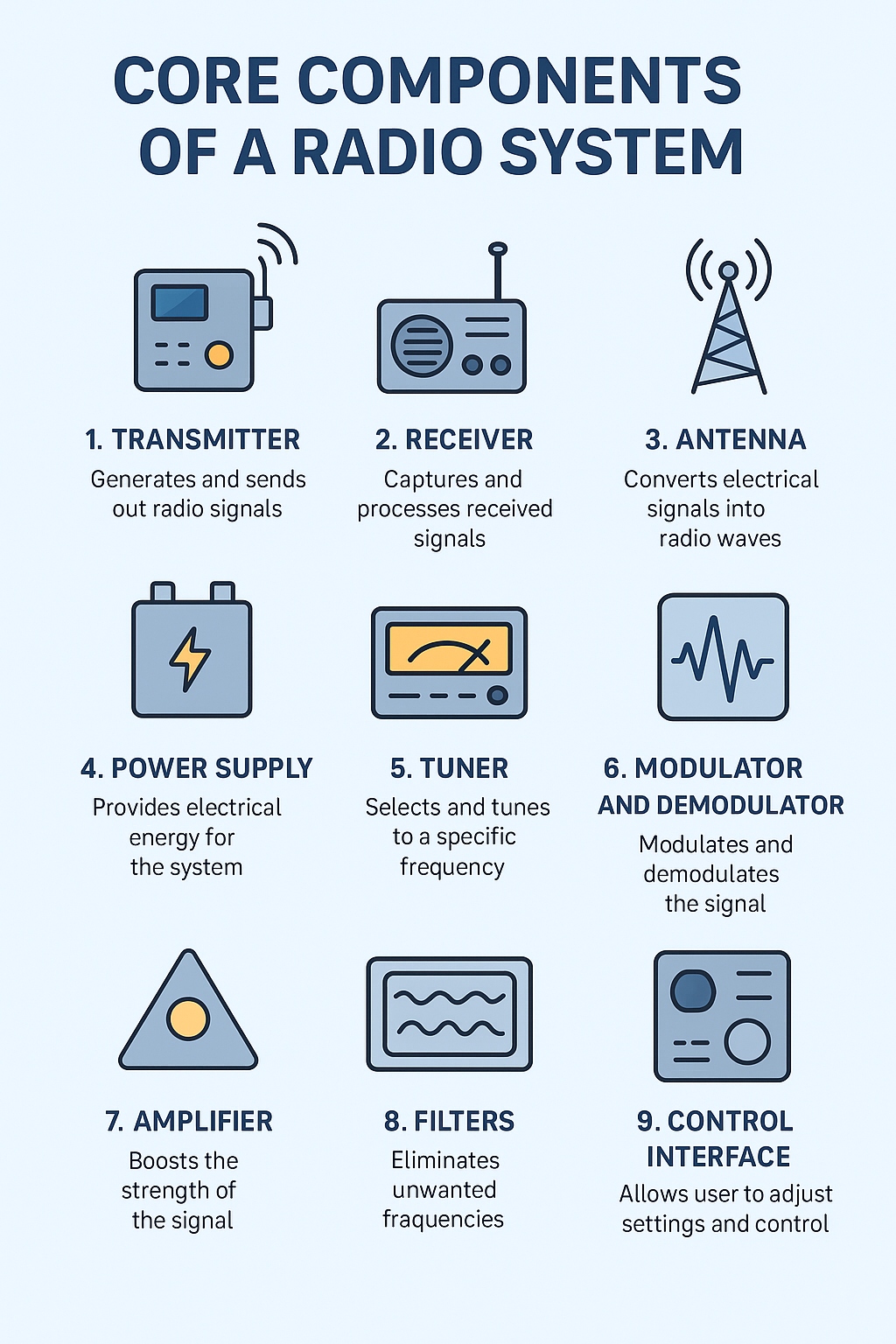
To understand how a radio works, it is essential to break it down into its core components. Each part plays a vital role in transmitting and receiving signals effectively.
In this article, we will explore the primary components of a radio system, their functions, and why they are crucial for smooth communication.
1. Components of Radio System: Transmitter
A transmitter is the starting point of any radio communication process. It generates and sends out radio signals over a specific frequency.
Key Functions:
- Signal Generation: Creates the carrier wave that will be modulated with information.
- Modulation: Adds voice, music, or data to the carrier wave using AM (Amplitude Modulation), FM (Frequency Modulation), or digital modulation.
- Power Amplification: Boosts the signal strength to ensure it can travel long distances.
Example Applications:
- FM radio stations broadcasting music.
- Two-way radios used by police and firefighters.
- Air traffic control communication systems.
Read More about Radio Transmitter: Principles, Types, and Applications in Modern Communication
2. Components of Radio System: Receiver
A receiver is designed to capture radio signals and extract the original information.
Key Functions:
- Signal Detection: Captures radio waves using an antenna.
- Demodulation: Separates the audio or data from the carrier wave.
- Signal Amplification: Strengthens weak incoming signals for clear output.
Example Applications:
- Portable AM/FM radios.
- Communication systems in ships and aircraft.
- Wireless microphones and headsets.
Read More about Understanding Radio Receivers: Components, Functions, and Applications in Modern Communication
3. Components of Radio System: Antenna
The antenna is the bridge between the transmitter/receiver and the surrounding environment. It converts electrical signals into radio waves (for transmission) and vice versa (for reception).
Key Functions:
- Transmission: Radiates modulated carrier waves into the air.
- Reception: Captures incoming radio signals from the environment.
- Signal Matching: Optimizes impedance for maximum power transfer.
Types of Antennas:
- Dipole Antenna: Common in home radios.
- Parabolic Dish: Used in satellite communication.
- Yagi-Uda: Popular for long-range radio and TV signals.
Read More about Radio Antenna: The Backbone of Wireless Communication
4. Components of Radio System: Power Supply
Every radio system requires a stable power source to operate effectively.
Power Supply Types:
- Batteries: For portable and emergency radios.
- AC Power: For home and commercial radio stations.
- Solar Power: For remote and off-grid operations.
Without reliable power, both transmitters and receivers cannot function properly.
Read More about Understanding Radio Power Supply: Types, Functions, and Importance in Communication Systems
5. Components of Radio System: Tuner
The tuner selects the desired frequency from all the signals in the air.
Key Functions:
- Filters unwanted frequencies.
- Locks onto the chosen station or channel.
- Works with oscillators and filters for precision.
A well-designed tuner ensures minimal interference and clear reception.
Read More about The Complete Guide to Radio Tuners: How They Work, Types, and Modern Applications
6. Components of Radio System: Modulator and Demodulator (Modem)
Although sometimes built into the transmitter and receiver, modulators and demodulators deserve special attention.
Modulator:
- Embeds information onto the carrier wave.
- Supports different modulation techniques like AM, FM, and digital formats.
Demodulator:
- Extracts the original information from the modulated carrier wave.
- Filters noise and distortion for clarity.
Read More about Understanding Radio Modulator and Demodulator (Modem): Functions, Types, and Applications
7. Components of Radio System: Amplifiers
Amplifiers are critical in both transmitters and receivers.
Types of Amplifiers in Radio Systems:
- RF Amplifier: Strengthens the radio frequency signal.
- Audio Amplifier: Boosts sound output for speakers or headphones.
- Power Amplifier: Increases transmission power.
Without amplification, signals would be too weak to transmit over long distances or be heard clearly.
Read More about Radio Amplifiers: Function, Types, and Applications in Modern Communication Systems
8. Components of Radio System: Filters
Filters are used to remove unwanted noise and interference.
Filter Types:
- Low-Pass Filter: Allows low frequencies and blocks high frequencies.
- High-Pass Filter: Allows high frequencies and blocks low frequencies.
- Band-Pass Filter: Allows a specific range of frequencies.
High-quality filters ensure that only the intended signals are processed.
Read More about Radio Filters: Types, Applications, and Their Role in Modern Communication
9. Components of Radio System: Control Interface
Modern radio systems often have a user interface for easy control and tuning.
Examples:
- Knobs and dials on traditional radios.
- Digital touchscreens on modern transceivers.
- Software interfaces in software-defined radios (SDRs).
Read More about Radio Control Interface: A Comprehensive Guide to Technology, Applications, and Benefits
10. Components of Radio System: Connecting Cables and Accessories
Cables, connectors, and other accessories may seem minor, but they are crucial for signal integrity and performance.
Examples:
- Coaxial Cables: For connecting antennas to transmitters/receivers.
- Adapters and Splitters: For multiple device connections.
- Grounding Wires: To prevent electrical interference.
Read More about Cables and Accessories for Radio: Essential Guide for Reliable Communication

Putting It All Together
A basic radio system works as follows:
- Signal Creation: The transmitter generates and modulates a carrier wave.
- Transmission: The antenna radiates the signal into the environment.
- Reception: A receiver’s antenna captures the signal.
- Demodulation & Amplification: The receiver extracts and boosts the original message.
- Output: The sound or data is presented to the listener or user.
Why Understanding Core Components Matters
Knowing the components of a radio system is essential for:
- Troubleshooting: Identifying and fixing issues.
- System Design: Creating efficient communication setups.
- Upgrading Equipment: Choosing the right parts for better performance.
Whether you’re a radio hobbyist, a communication engineer, or simply curious, this knowledge forms the foundation for exploring more advanced radio technologies.
Conclusion
Radio systems may seem simple on the surface, but they rely on a complex interplay of components. From the transmitter that sends out the message to the antenna that carries it through the air, each part plays a vital role in seamless communication. By understanding these core components, we can better appreciate the technology that connects us across distances — whether for entertainment, safety, or essential operations.