Passive electronic components are the backbone of every electrical and electronic circuit. Unlike active components, passive components do not generate power or amplify signals. Instead, they respond to electrical signals by resisting, storing, or releasing energy. Their simplicity, reliability, and essential roles make them fundamental in designing analog and digital systems.
This article provides an in-depth understanding of passive electronic components, their types, key functions, and where they are used across various industries.
🔎 What Are Passive Electronic Components?
Passive components are electrical devices that do not require external power to operate (beyond the signal being processed). They do not have gain or control capabilities and cannot introduce energy into the circuit. Instead, they absorb, store, or dissipate energy.
The three most common types of passive components are:
- Resistors
- Capacitors
- Inductors
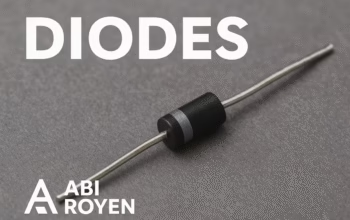
Other examples include transformers, diodes (in a limited sense), and ferrite beads.
📌 Key Characteristics of Passive Electronic Components
- No Power Amplification: They do not increase signal power.
- Energy Dissipation or Storage: They either dissipate energy (like resistors) or store energy (like capacitors and inductors).
- Linearity: Most passive components operate linearly, meaning their output is directly proportional to their input.
- Bidirectional: They can work with currents and voltages in both directions (with exceptions).
- No Control Function: Unlike transistors or integrated circuits, they do not control signal flow or switching.
🧩 Types of Passive Electronic Components
Let’s explore the main types of passive components and their roles in a circuit.
1. 🔥 Resistors
Function: Resistors oppose the flow of electric current, converting electrical energy into heat.
Unit: Ohms (Ω)
Common Uses:
- Current limiting
- Voltage division
- Biasing active components
- Pull-up/pull-down configurations in digital circuits
Types:
- Carbon composition
- Metal film
- Wire-wound
- Surface-mount (SMD resistors)
- Variable resistors (potentiometers, rheostats)
2. ⚡ Capacitors
Function: Capacitors store electrical energy temporarily in an electric field and release it when required.
Unit: Farads (F)
Common Uses:
- Filtering in power supplies
- Signal coupling and decoupling
- Timing applications (RC circuits)
- Energy storage in flash devices
Types:
- Ceramic capacitors
- Electrolytic capacitors
- Tantalum capacitors
- Film capacitors
- Supercapacitors
3. 🌀 Inductors
Function: Inductors store energy in a magnetic field when current flows through them. They resist changes in current.
Unit: Henry (H)
Common Uses:
- Filtering in power supplies
- RF tuning
- Energy storage in switch-mode power supplies
- Chokes in noise reduction
Types:
- Air-core inductors
- Iron-core inductors
- Toroidal inductors
- SMD inductors
4. 🔁 Transformers (Composite Passive Devices)
Function: Transfer electrical energy between two or more circuits using electromagnetic induction.
Common Uses:
- Voltage step-up or step-down
- Isolation between circuits
- Impedance matching
5. 🧲 Ferrite Beads
Function: Suppress high-frequency noise in electronic circuits.
Common Uses:
- EMI suppression
- Noise filtering in power lines
- Signal line filtering
🛠️ Applications of Passive Electronic Components
Passive components are found in almost every electronic product. Here are common industries and systems where they are indispensable:
🔧 Consumer Electronics
- TVs, radios, computers, smartphones
- Power regulation and signal filtering
🚀 Automotive Industry
- Engine control units (ECUs)
- Sensor interfaces
- Infotainment systems
🏥 Medical Equipment
- Patient monitoring devices
- Diagnostic equipment
- Signal conditioning in ECG machines
🏭 Industrial Automation
- PLCs and control systems
- Motor drives and power conditioning
- EMI/RFI filtering in factory equipment
📡 Telecommunications
- Signal tuning and filtering in radio communication
- Power supplies in networking gear
⚖️ Passive Electronic Components vs Active Components: The Key Differences
| Feature | Passive Components | Active Components |
|---|---|---|
| Power Requirement | No external power needed | Require external power |
| Signal Amplification | Cannot amplify signals | Can amplify signals |
| Energy Source | Absorbs or stores energy | Source of energy |
| Control Capability | No signal control | Can control and switch signals |
| Examples | Resistors, capacitors, inductors | Transistors, ICs, op-amps |
🧰 Design Tips When Using Passive Electronic Components
- Choose the right tolerance: For precise applications, low-tolerance resistors and capacitors are essential.
- Watch out for parasitics: Capacitors and inductors can introduce unintended resistance and reactance.
- Ensure proper ratings: Always select components rated for voltage, temperature, and power beyond the operational limits.
- Use filters smartly: Combine inductors and capacitors to build low-pass, high-pass, band-pass, and notch filters.
- PCB layout matters: The physical layout can impact inductance, capacitance, and heat dissipation.
🧠 Conclusion of Passive Electronic Components
Passive electronic components may seem simple compared to microcontrollers and integrated circuits, but they are foundational to every electronic device. Their roles in controlling current, filtering signals, storing energy, and maintaining system stability are critical in ensuring circuits perform reliably and safely.
Understanding passive components is a crucial step for anyone diving into electronics — from hobbyists and technicians to engineers working in complex industrial systems.
🔗 About Abi Royen
This article is brought to you by Abi Royen, a source of knowledge and innovation in the field of electronics, automation, and engineering systems. For more technical insights, tutorials, and product guides, visit https://abiroyen.com/