



Introduction
Instrumentation and Industry 4.0 ~ The industrial world is undergoing a transformation unlike any in history. Known as the Fourth Industrial Revolution or Industry 4.0, this movement is driven by advanced automation, interconnected systems, and intelligent data analytics. At the heart of this revolution lies instrumentation—the technology and science of measuring, monitoring, and controlling industrial processes.
Instrumentation provides the eyes, ears, and nervous system of Industry 4.0, enabling real-time decision-making and efficient, automated operations. Without precise instrumentation, the vision of a fully connected and self-optimizing factory would remain a distant dream.
What is Industry 4.0?
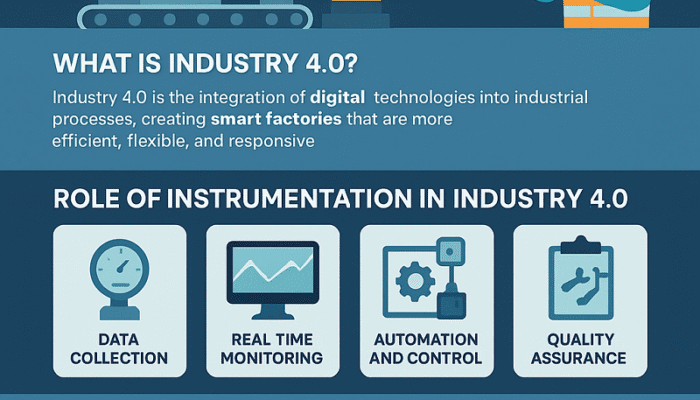
Industry 4.0 refers to the integration of digital technologies into industrial processes, creating smart factories that are more efficient, flexible, and responsive. It builds upon previous industrial revolutions:
- Industry 1.0 – Mechanization powered by steam engines.
- Industry 2.0 – Mass production using electricity.
- Industry 3.0 – Automation through electronics and IT systems.
- Industry 4.0 – Digital transformation using IoT, AI, robotics, cloud computing, and advanced analytics.
The hallmark of Industry 4.0 is connectivity—machines, sensors, and systems communicating in real time to optimize production without human intervention.
Role of Instrumentation and Industry 4.0
Instrumentation in Industry 4.0 goes beyond simple measurement. Modern instruments are smart devices equipped with sensors, communication capabilities, and embedded intelligence. Their main roles include:
1. Instrumentation and Industry 4.0: Data Collection
Accurate and continuous measurement of temperature, pressure, flow, vibration, and other process parameters is essential for automation.
2. Real-Time Monitoring
Connected instruments provide live operational data, allowing for instant adjustments and predictive alerts.
3. Instrumentation and Industry 4.0: Automation and Control
Through integration with Programmable Logic Controllers (PLCs), Distributed Control Systems (DCS), and AI algorithms, instrumentation helps execute precise automated actions.
4. Predictive Maintenance
By analyzing patterns and anomalies in sensor data, industries can prevent breakdowns before they occur, reducing downtime and costs.
5. Quality Assurance
Instrumentation ensures that production processes meet exact specifications, reducing defects and ensuring product consistency.
Key Instrumentation and Industry 4.0 Technologies
The fusion of instrumentation and digital technology has produced a wide range of advanced tools:
1. Smart Sensors
Sensors equipped with microprocessors can not only measure variables but also process and transmit data over networks.
2. Wireless Instrumentation
Wireless communication eliminates cabling costs and allows flexible placement of devices, even in remote or hazardous locations.
3. Industrial IoT (IIoT) Devices
Instruments are now part of the Industrial Internet of Things, enabling machine-to-machine (M2M) communication and cloud integration.
4. Machine Vision Systems
Cameras and image-processing algorithms inspect products in real-time, ensuring quality and detecting defects instantly.
5. Advanced Process Analyzers
Online chemical and gas analyzers provide continuous feedback for process optimization.
Benefits of Integrating Instrumentation and Industry 4.0
Implementing modern instrumentation within an Industry 4.0 framework offers a range of advantages:
1. Enhanced Productivity
Automation reduces manual intervention and speeds up production cycles.
2. Improved Operational Efficiency
Real-time data ensures that processes operate at optimal levels, minimizing waste.
3. Reduced Downtime
Predictive maintenance and condition monitoring keep equipment running reliably.
4. Higher Product Quality
Continuous monitoring ensures consistent production quality.
5. Better Decision-Making
Data-driven insights allow managers to respond quickly to changes in demand or supply chain conditions.

Challenges in Instrumentation and Industry 4.0
Despite its advantages, integrating instrumentation into Industry 4.0 comes with challenges:
- Cybersecurity Risks – Connected devices are vulnerable to cyberattacks.
- High Implementation Costs – Upgrading legacy systems requires significant investment.
- Skill Gaps – Workforce training is necessary to handle advanced technologies.
- Data Overload – Managing and analyzing massive amounts of data can be complex.
Future Trends in Instrumentation and Industry 4.0
The future of industrial instrumentation will be shaped by continuous innovation:
- Artificial Intelligence in Process Control – AI algorithms will make automated decisions more accurate.
- Digital Twins – Virtual models of equipment will simulate and predict performance.
- Edge Computing – Data processing closer to the source will reduce latency.
- Sustainable Instrumentation – Devices will consume less power and use eco-friendly materials.
Conclusion of Instrumentation and Industry 4.0
Instrumentation is the cornerstone of Industry 4.0, enabling factories to become smarter, faster, and more efficient. As industrial processes continue to evolve, the synergy between advanced instrumentation and digital transformation will define the future of manufacturing.
For industries looking to stay competitive, investing in smart instrumentation is not just a choice—it is a necessity.