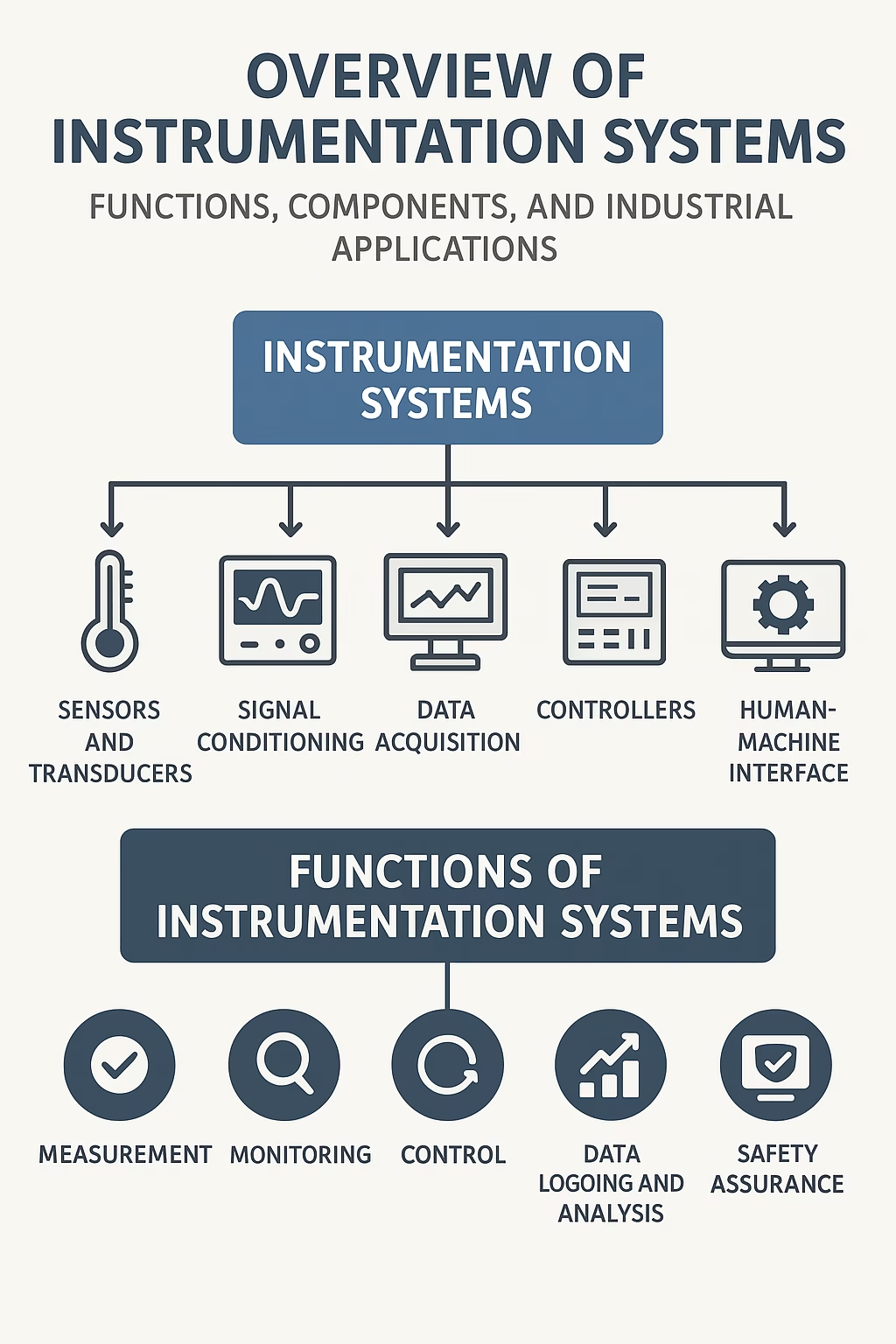
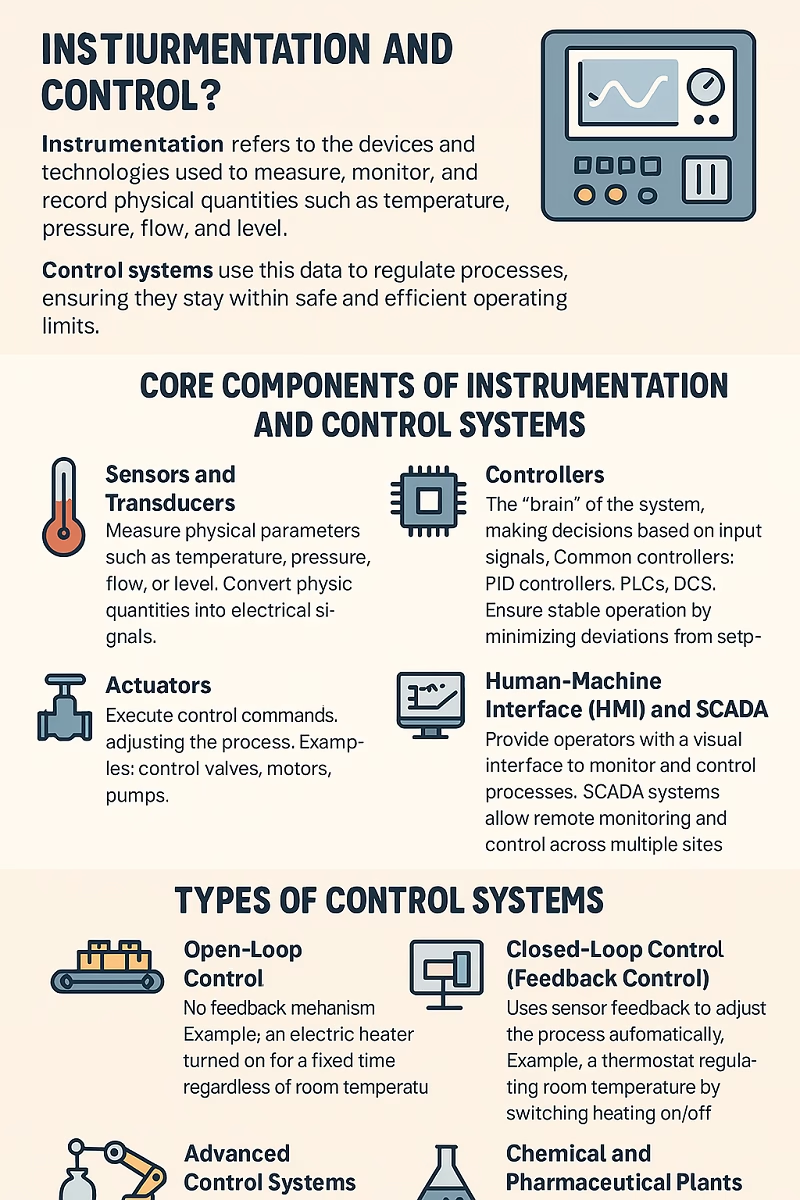
What is Instrumentation? ~ Instrumentation is a fundamental aspect of modern industry, science, and engineering. From measuring temperature in a chemical process to monitoring pressure in an oil refinery, instrumentation ensures that operations are safe, efficient, and reliable. It involves the design, selection, installation, and maintenance of devices that measure, control, and monitor physical quantities.
In this article, we will explore the definition, principles, types, and applications of instrumentation, as well as its importance in today’s world.
1. What is Instrumentation? Definition of Instrumentation
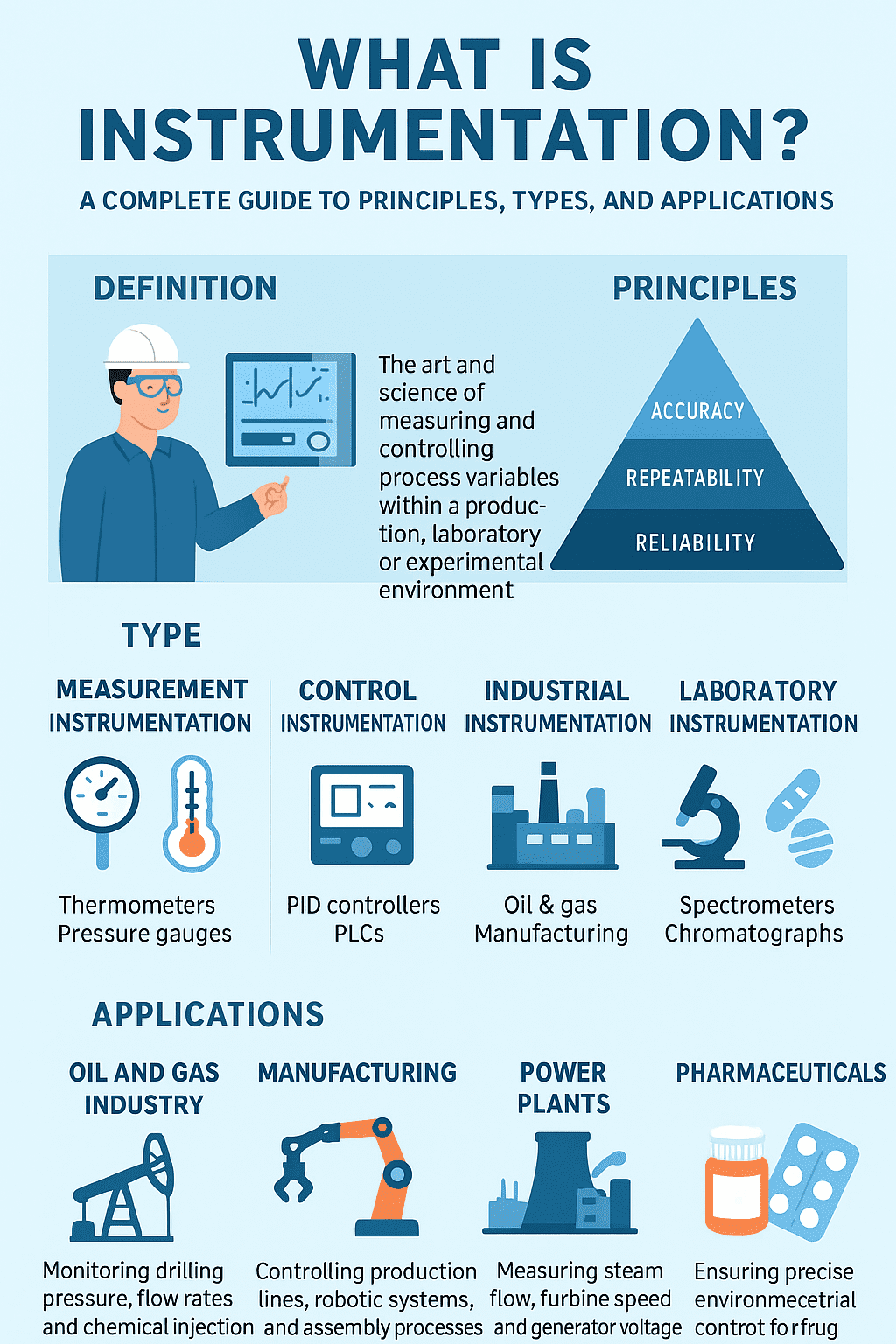
Instrumentation can be defined as the art and science of measuring and controlling process variables within a production, laboratory, or experimental environment. These process variables include:
- Temperature
- Pressure
- Flow
- Level
- Humidity
- pH
- Speed and vibration
Instrumentation not only involves the measurement of these variables but also ensures they remain within the desired range for optimal operation.
Want to know more? Read here: Definition of Instrumentation: Principles, Components, and Applications
2. What is Instrumentation? The Principles of Instrumentation
The principles of instrumentation revolve around accuracy, repeatability, and reliability.
- Accuracy ensures the measurement is close to the true value.
- Repeatability ensures consistent results when measurements are taken under the same conditions.
- Reliability ensures the instrument functions correctly over time without frequent breakdowns.
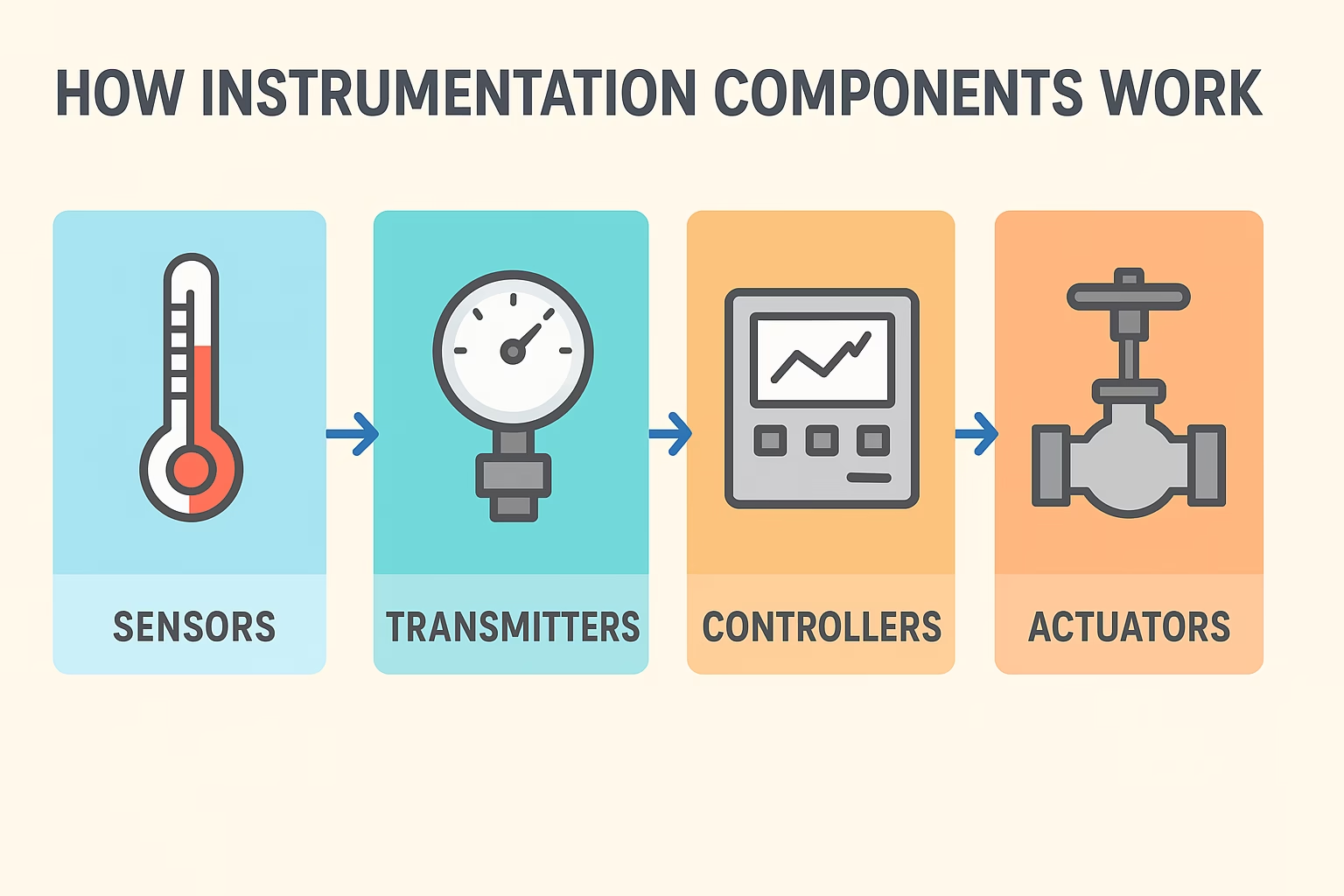
Most instrumentation systems follow a common measurement principle:
- Sensing Element – Detects the physical parameter (e.g., thermocouple for temperature).
- Signal Conversion – Converts the sensed value into an electrical signal.
- Signal Conditioning – Amplifies, filters, or processes the signal.
- Display/Control – Shows the measured value or uses it for automated control.
Want to know more? Read here: Principles of Instrumentation: Understanding the Fundamentals for Accurate Measurements
3. What is Instrumentation? Types of Instrumentation
Instrumentation can be categorized based on its purpose, functionality, and measurement type.
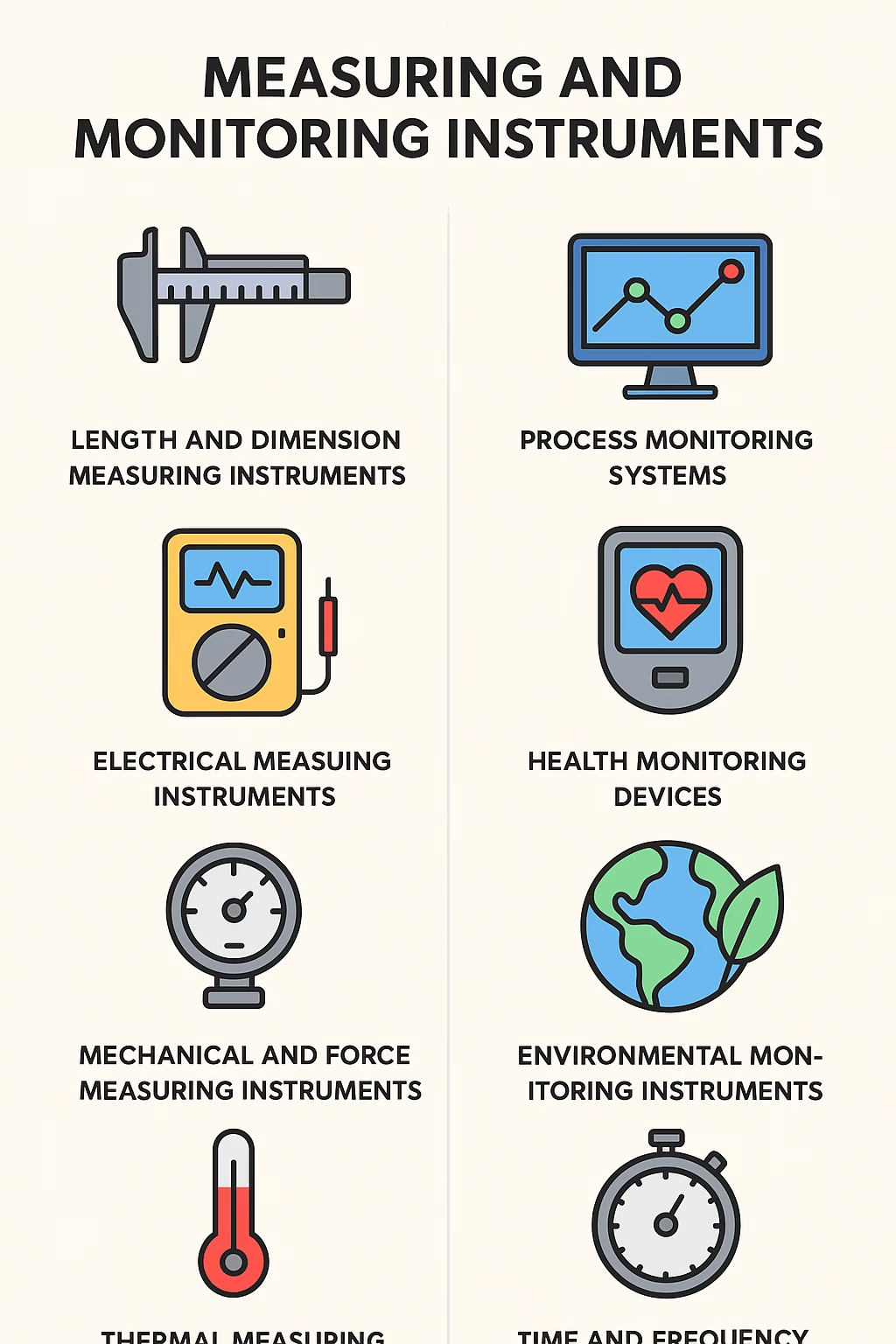
a. Measurement Instrumentation
These devices measure specific variables. Examples include:
- Thermometers & thermocouples (temperature)
- Pressure gauges & transducers (pressure)
- Flow meters (flow rate)
- Level sensors (liquid levels in tanks)
b. Control Instrumentation
These systems not only measure but also control the variable. Examples:
- PID controllers
- Programmable Logic Controllers (PLCs)
- Distributed Control Systems (DCS)
c. Industrial Instrumentation
Used in large-scale processes like oil & gas, food processing, pharmaceuticals, and manufacturing.
d. Laboratory Instrumentation
Used for research and analysis, such as spectrometers, chromatographs, and analytical balances.
Want to know more? Read here: Understanding the Different Types of Instrumentation in Modern Industry
4. What is Instrumentation? Importance of Instrumentation
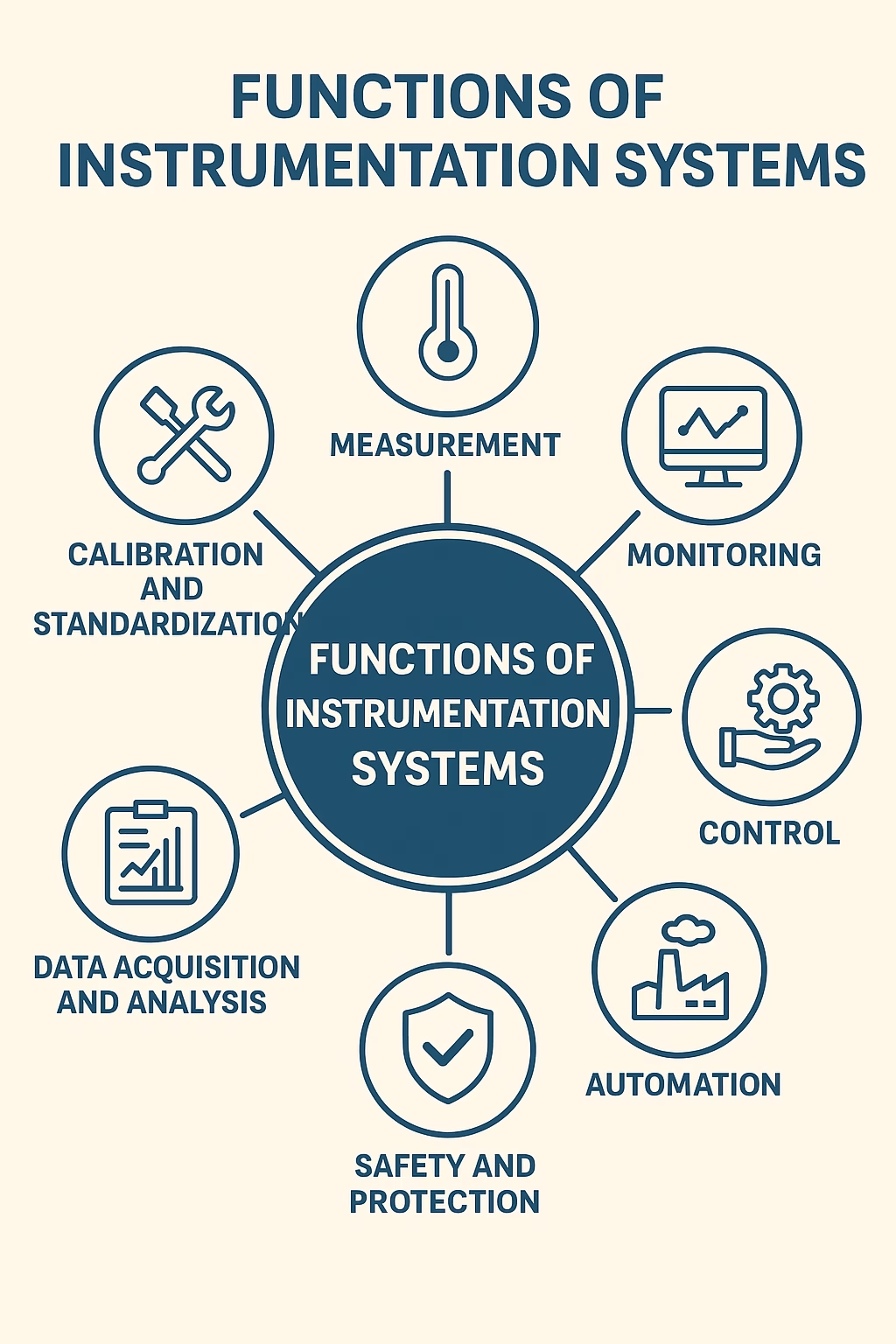
Instrumentation plays a crucial role in various industries for multiple reasons:
- Safety – Prevents dangerous conditions by monitoring and controlling variables.
- Efficiency – Optimizes processes for better productivity.
- Quality Control – Ensures products meet the required standards.
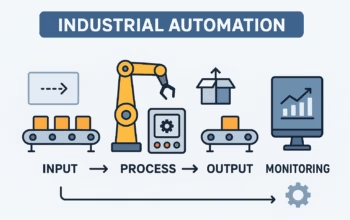
- Automation – Enables advanced control systems to run with minimal human intervention.
- Cost Savings – Reduces waste and operational costs.
Want to know more? Read here: Instrumentation in Industrial Applications: Enhancing Efficiency, Accuracy, and Safety
5. What is Instrumentation? Applications of Instrumentation
Instrumentation is applied in numerous sectors, including:
- Oil and Gas Industry – Monitoring drilling pressure, flow rates, and chemical injection.
- Manufacturing – Controlling production lines, robotic systems, and assembly processes.
- Power Plants – Measuring steam flow, turbine speed, and generator voltage.
- Pharmaceuticals – Ensuring precise environmental control for drug manufacturing.
- Environmental Monitoring – Measuring air quality, water purity, and pollution levels.
Want to know more? Read here: Applications of Instrumentation: Enhancing Accuracy, Safety, and Efficiency Across Industries
6. Instrumentation in Automation and Industry 4.0
With the rise of Industry 4.0, instrumentation has evolved to integrate with smart technologies. Modern instruments are now equipped with:
- IoT connectivity for remote monitoring.
- Wireless communication for flexibility and reduced wiring costs.
- Cloud data storage for predictive analysis.
- AI-based predictive maintenance to prevent breakdowns before they occur.
Want to know more? Read here: Instrumentation and Industry 4.0: Driving the Future of Smart Manufacturing

7. Calibration and Maintenance in Instrumentation
For any instrument to perform accurately, calibration is essential. Calibration involves comparing the measurement from an instrument to a known standard and adjusting it as necessary.
Maintenance practices include:
- Regular cleaning of sensors.
- Periodic recalibration.
- Replacing worn-out parts.
- Firmware and software updates for smart devices.
Want to know more? Read here:
Calibration in Instrumentation: Calibration in Instrumentation: Ensuring Accuracy and Reliability in Measurements
Maintenance in Instrumentation: Maintenance in Instrumentation: Best Practices, Types, and Importance
8. Career Opportunities in Instrumentation
Instrumentation engineering is a sought-after field, with career paths such as:
- Instrumentation Engineer
- Process Control Engineer
- Calibration Technician
- Automation Specialist
- Industrial Maintenance Engineer
These professionals work in sectors like oil & gas, energy, manufacturing, pharmaceuticals, and environmental services.
Want to know more? Read here: Instrumentation Careers and Skills: Building a Future in Industrial Automation
9. Future Trends in Instrumentation
The future of instrumentation is shaped by advancements in smart sensors, wireless communication, and AI-driven analytics. Expect to see:
- Increased automation in complex processes.
- More compact, energy-efficient devices.
- Advanced cybersecurity for instrument networks.
- Greater use of virtual sensors (software-based estimation of parameters).
Want to know more? Read here: Future Trends in Instrumentation: Shaping the Next Industrial Revolution
Conclusion of What is Instrumentation?
Instrumentation is the backbone of modern industry, ensuring that processes are measured, monitored, and controlled effectively. From basic thermometers to complex PLC systems, instrumentation supports safety, efficiency, and quality.
As industries move towards smarter and more connected operations, the role of instrumentation will continue to expand, offering exciting opportunities for innovation and career growth.