Electrical Resistance (R) is one of the most fundamental concepts in physics and electrical engineering. It plays a crucial role in how electric current flows through a conductor, determining the efficiency, safety, and functionality of electrical circuits. Whether you are a student, an engineer, or simply someone interested in electronics, understanding resistance is essential for mastering electrical principles.
In this article, we will explore the definition of resistance, its unit, the formula used to calculate it, the factors that affect resistance, and its practical applications in real-world scenarios.
What is Electrical Resistance (R)?
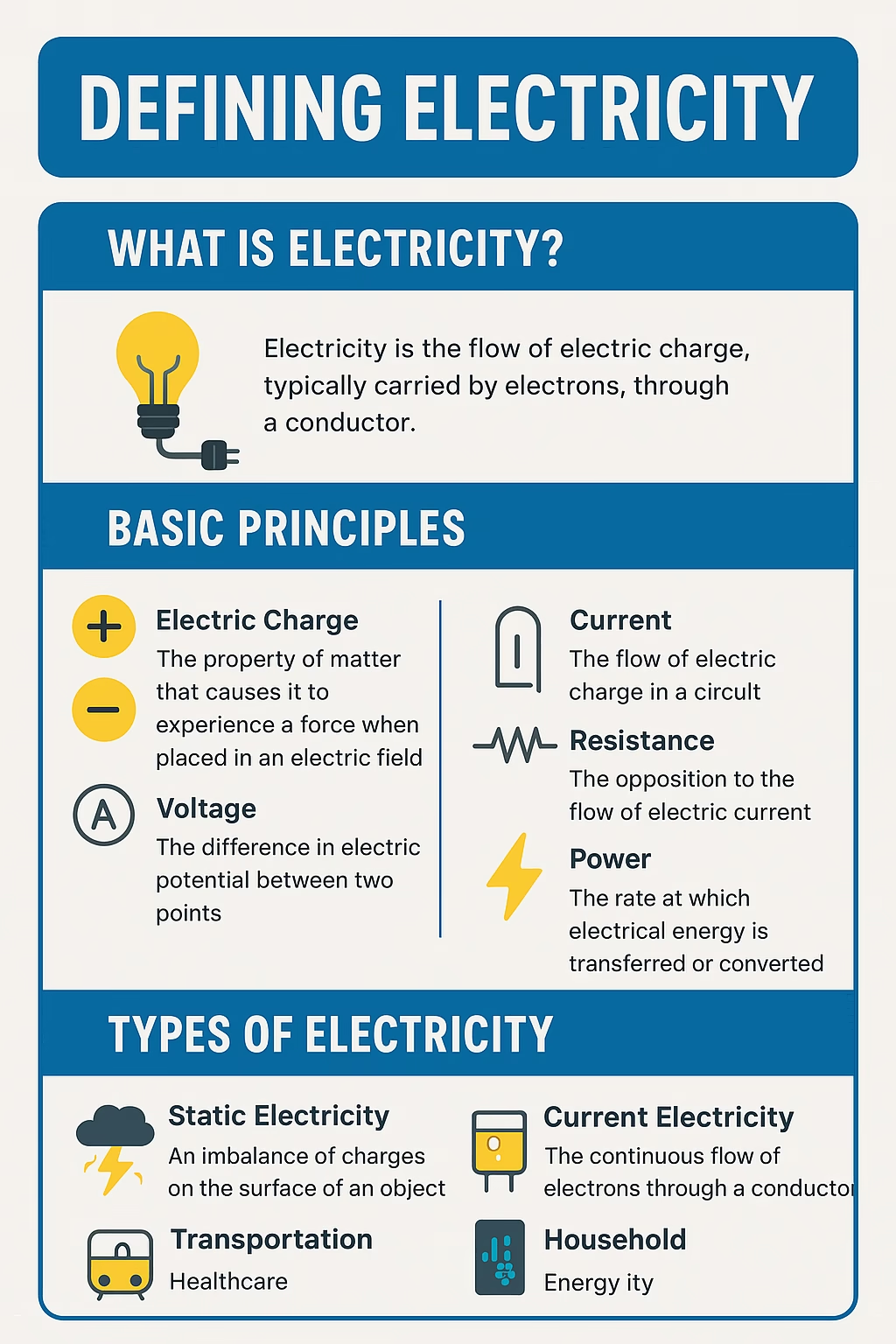
Electrical resistance is the property of a material that opposes the flow of electric current. When a voltage is applied across a conductor, electrons move through it, creating current. However, due to collisions between electrons and the atoms of the conductor, energy is lost in the form of heat. This opposition to current is what we call resistance.
In simple terms, resistance determines how easily current can flow through a material. A conductor with low resistance allows current to flow more freely, while a material with high resistance restricts the flow of current.
The Unit of Resistance (R)
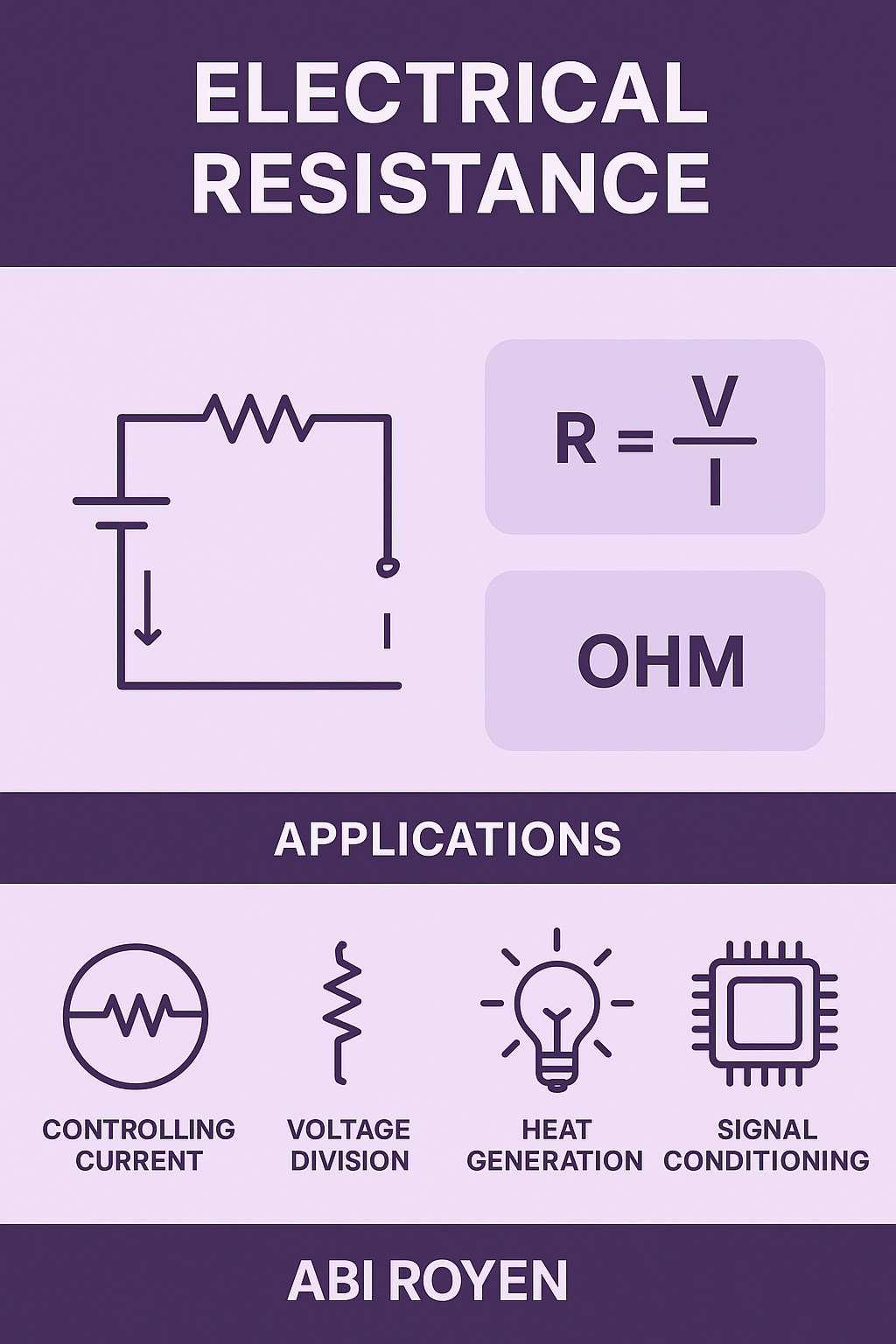
The SI unit of resistance is the Ohm (Ω), named after the German physicist Georg Simon Ohm, who formulated Ohm’s Law.
1 Ohm is defined as the resistance between two points of a conductor when a potential difference of 1 volt produces a current of 1 ampere.
Mathematically: R=VIR = \frac{V}{I}R=IV
Where:
- RRR = Resistance (Ohms, Ω)
- VVV = Voltage (Volts, V)
- III = Current (Amperes, A)
Ohm’s Law and Resistance (R)
Ohm’s Law is the foundation for understanding resistance in an electric circuit. It states that the current passing through a conductor is directly proportional to the voltage applied and inversely proportional to the resistance. V=I×RV = I \times RV=I×R
From this relationship:
- Increasing resistance decreases current.
- Decreasing resistance increases current.
- For a constant resistance, doubling the voltage doubles the current.
This principle is widely used in electrical engineering, electronics design, and circuit analysis.
Formula for Resistance (R) of a Conductor
Apart from Ohm’s Law, resistance can also be calculated based on the physical properties of a conductor: R=ρLAR = \rho \frac{L}{A}R=ρAL
Where:
- RRR = Resistance (Ω)
- ρ\rhoρ = Resistivity of the material (Ω·m)
- LLL = Length of the conductor (m)
- AAA = Cross-sectional area of the conductor (m²)
This equation shows that resistance depends on both the material and the geometry of the conductor.
Factors Affecting Resistance
Several factors influence the resistance of a conductor:
- Material Type – Conductors like copper and aluminum have low resistivity, while materials like rubber or glass have very high resistivity, making them insulators.
- Length of the Conductor – The longer the conductor, the higher the resistance, since electrons face more collisions.
- Cross-sectional Area – A thicker conductor has lower resistance because it provides more pathways for electrons to move.
- Temperature – For most conductors, resistance increases with temperature. However, in some materials called semiconductors, resistance decreases as temperature rises.
- Impurities in Material – Pure materials have lower resistance, while impurities increase resistivity by disturbing electron flow.
Types of Resistors
In electronics, resistance is implemented using components called resistors. They come in different types depending on application:
- Fixed Resistors: Provide a constant resistance value (e.g., carbon film, metal film resistors).
- Variable Resistors (Potentiometers/Rheostats): Allow adjustment of resistance.
- Thermistors: Change resistance with temperature (NTC/PTC).
- Photoresistors (LDRs): Change resistance with light intensity.
- Wirewound Resistors: High precision resistors used in power applications.
Practical Applications of Resistance (R)
Resistance is not just a theoretical concept—it is applied in countless real-world scenarios:
- Controlling Current in Circuits
Resistors limit the flow of current to protect components such as LEDs, transistors, and integrated circuits from damage. - Voltage Division
By using resistors in series, voltage can be divided across different components, creating voltage dividers. - Heat Generation
Resistance is used in devices like electric heaters, toasters, and light bulbs to generate heat or light. - Signal Conditioning
Resistors are used in amplifiers, filters, and other circuits to adjust and control signals. - Sensor Technology
Components like thermistors and photoresistors rely on resistance variation to measure temperature or light. - Measuring Instruments
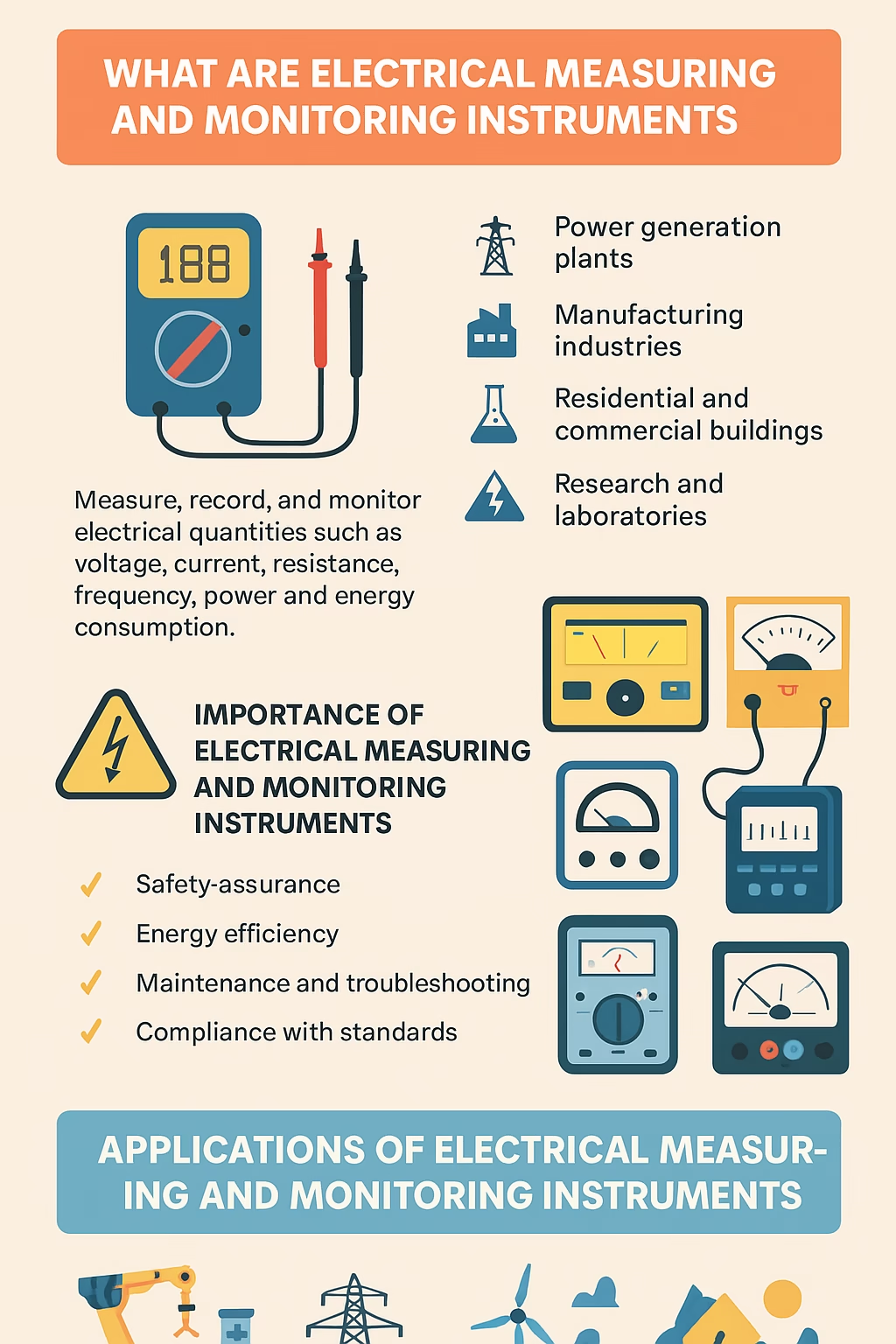
Devices such as ohmmeters and multimeters measure resistance directly for testing circuits.

Resistance in Series and Parallel Circuits
When resistors are connected in circuits, their total resistance varies based on configuration:
- Series Connection: Rtotal=R1+R2+R3+…R_{total} = R_1 + R_2 + R_3 + \dotsRtotal=R1+R2+R3+… Current is the same through all resistors, but voltage is divided.
- Parallel Connection: 1Rtotal=1R1+1R2+1R3+…\frac{1}{R_{total}} = \frac{1}{R_1} + \frac{1}{R_2} + \frac{1}{R_3} + \dotsRtotal1=R11+R21+R31+… Voltage is the same across all resistors, but current is divided.
This principle is vital in designing efficient circuits for electronics and electrical systems.
Resistance in Real Life Examples
- Household Wiring: Copper wires are used because of their low resistance.
- Electric Heaters: Use high-resistance materials like nichrome to convert electricity into heat.
- Electronic Devices: Smartphones, computers, and televisions all rely on resistors to regulate current.
- Automotive Industry: Resistance sensors are used in fuel measurement, temperature monitoring, and safety systems.
Conclusion
Electrical resistance is a cornerstone of modern electrical engineering and electronics. It determines how current flows, how devices operate, and how energy is used in circuits. By understanding resistance, engineers and technicians can design safer, more efficient, and more reliable electrical systems.
Whether it is in small electronic gadgets or large industrial machinery, resistance plays a vital role in shaping how electricity powers our world.