

Introduction
Electrical systems are the backbone of modern civilization, powering homes, industries, transportation, and communication networks. At the heart of every electrical system are conductors and wiring, which form the physical pathways for the flow of electric current. Understanding conductors, their properties, and wiring techniques is essential for designing efficient, safe, and reliable electrical systems.
This article provides a comprehensive guide to conductors and wiring in electrical systems, covering their types, characteristics, installation methods, safety considerations, and applications.
What Are Conductors in Electrical Systems?
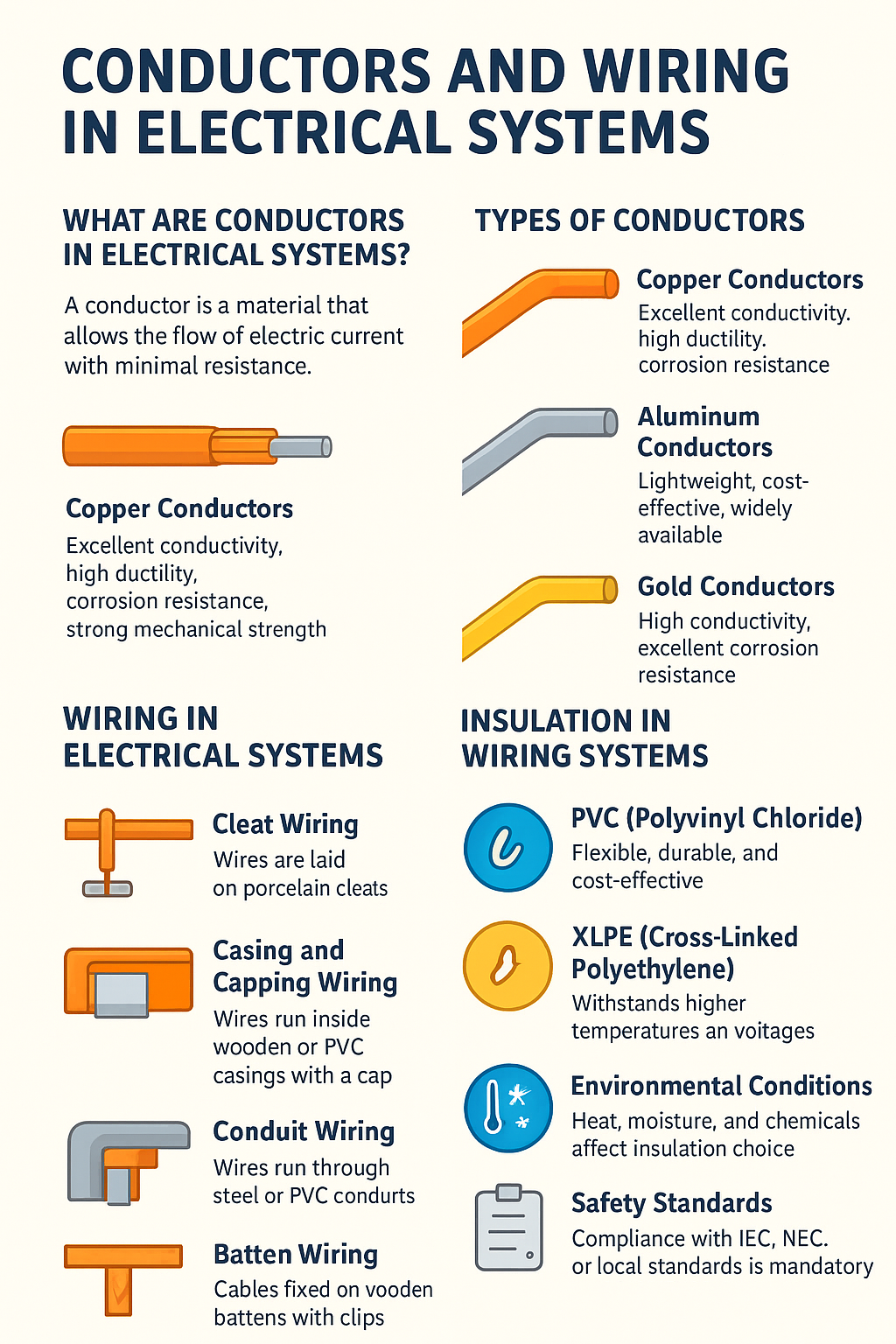
A conductor is a material that allows the flow of electric current with minimal resistance. The most widely used conductors in electrical engineering are copper and aluminum, but other materials like silver and gold also exhibit high conductivity, though they are less practical due to cost.
Properties of Good Conductors
- High electrical conductivity – Allows electrons to flow easily.
- Ductility – Can be drawn into wires without breaking.
- Mechanical strength – Must withstand tension and external forces.
- Thermal stability – Should handle heat generated by current flow.
- Corrosion resistance – Ensures durability over time.
Types of Conductors
1. Copper Conductors
- Advantages: Excellent conductivity, high ductility, corrosion resistance, strong mechanical strength.
- Applications: Residential wiring, transformers, power distribution, motor windings.
- Disadvantages: Higher cost compared to aluminum.
2. Aluminum Conductors
- Advantages: Lightweight, cost-effective, widely available.
- Applications: Overhead power lines, large-scale transmission networks.
- Disadvantages: Lower conductivity, requires larger diameter wires, prone to oxidation.
3. Silver Conductors
- Advantages: Highest electrical conductivity of all metals.
- Applications: High-frequency applications, aerospace, and precision instruments.
- Disadvantages: Very expensive, limited use.
4. Gold Conductors
- Advantages: High conductivity, excellent corrosion resistance.
- Applications: Microelectronics, computer chips, connectors.
- Disadvantages: Extremely costly.
5. Special Alloy Conductors
- Examples: Copper-clad aluminum, bronze, brass.
- Applications: Where specific mechanical and electrical properties are needed.
Wiring in Electrical Systems
Wiring refers to the network of insulated conductors that distribute electrical power within a building, machine, or system. Proper wiring is critical to ensure safety, efficiency, and reliability of electrical installations.
Types of Electrical Wiring Systems
- Cleat Wiring
- Wires are laid on porcelain cleats.
- Used in temporary installations.
- Casing and Capping Wiring
- Wires run inside wooden or PVC casings with a cap.
- Provides mechanical protection.
- Conduit Wiring
- Wires run through steel or PVC conduits.
- Most common in residential and commercial installations.
- Offers maximum safety and durability.
- Batten Wiring
- Cables fixed on wooden battens with clips.
- Simple and economical, but less safe.
- Lead Sheathed Wiring
- Conductors covered with a lead sheath.
- Offers protection against moisture and chemicals.
Insulation in Wiring Systems
Conductors must be insulated to prevent leakage of current and ensure safety. Common insulation materials include:
- PVC (Polyvinyl Chloride) – Flexible, durable, and cost-effective.
- Rubber – Used in older systems, less common today.
- XLPE (Cross-Linked Polyethylene) – Withstands higher temperatures and voltages.
- Teflon – Used in high-performance applications.
Key Factors in Electrical Wiring Design
- Current Carrying Capacity – Wire gauge must match load requirements.
- Voltage Drop – Longer cables require thicker wires to minimize losses.
- Environmental Conditions – Heat, moisture, and chemicals affect insulation choice.
- Safety Standards – Compliance with IEC, NEC, or local standards is mandatory.
- Cost Consideration – Balancing performance with affordability.

Applications of Conductors and Wiring
- Residential Buildings – Lighting, outlets, appliances.
- Commercial Facilities – Offices, data centers, HVAC systems.
- Industrial Plants – Heavy machinery, motors, automation.
- Power Transmission – High-voltage lines across long distances.
- Transportation – Automobiles, railways, aircraft, ships.
- Electronics – Microprocessors, circuit boards, communication devices.
Safety in Conductors and Wiring
Electrical accidents often result from poor wiring or improper conductor use. Key safety practices include:
- Using proper circuit protection devices (fuses, circuit breakers).
- Ensuring earthing/grounding of electrical installations.
- Selecting conductors with adequate ampacity.
- Following color coding standards for wires.
- Regular inspection and maintenance of wiring systems.
Future Trends in Conductors and Wiring
- Smart Wiring Systems – Integration with IoT for automation and monitoring.
- High-Temperature Superconductors (HTS) – Zero resistance conductors for efficient power transmission.
- Eco-Friendly Materials – Lead-free insulation and recyclable conductors.
- Nanotechnology Conductors – Carbon nanotubes and graphene for ultra-efficient conductivity.
Conclusion of Conductors and Wiring
Conductors and wiring are fundamental components of electrical systems, determining performance, safety, and efficiency. Choosing the right conductor material and wiring method depends on factors like application, cost, safety requirements, and environmental conditions. With the rapid growth of smart technology and renewable energy, the role of conductors and wiring in electrical engineering will continue to evolve, ensuring reliable power distribution for the future.