1. Introduction
Shunt resistors are an essential component in electrical and electronic systems, especially in applications that require accurate current measurement. They are often found in power supplies, battery management systems, and industrial automation equipment. By providing a known, low-resistance path for current to flow, shunt resistors enable precise current sensing through voltage measurement according to Ohm’s law.
In this article, we will discuss the definition of shunt resistors, how they work, their types, common applications, and factors to consider when selecting the right one.
2. What is a Shunt Resistor?
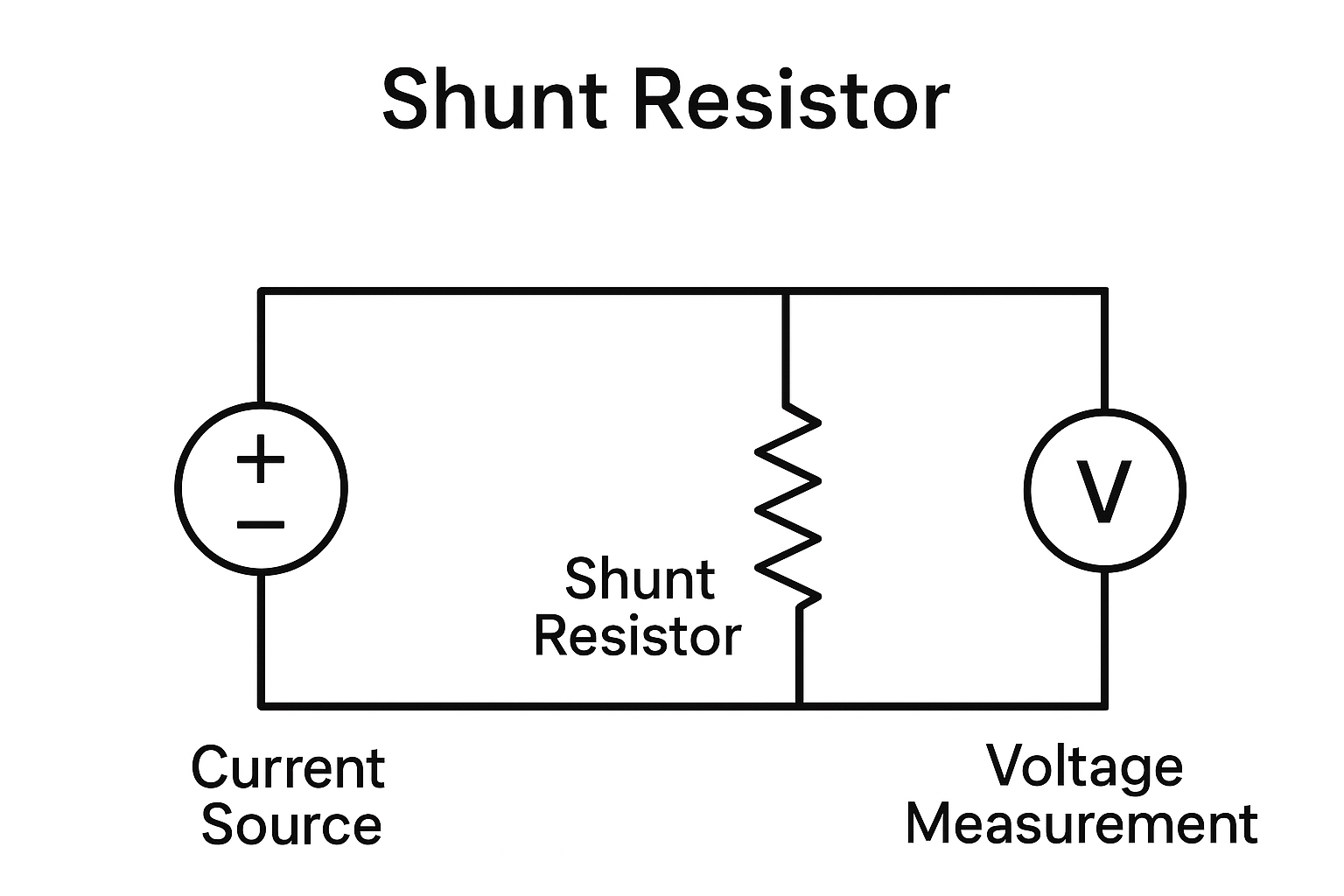
A shunt resistor is a precision resistor with a very low resistance value, designed to create a small voltage drop proportional to the current passing through it. This voltage drop is then measured and used to calculate the current in the circuit.
The term “shunt” refers to the fact that these resistors are placed in parallel or series with the load to “divert” or “sense” the current without significantly affecting the circuit’s overall operation.
Key Characteristics of Shunt Resistors:
- Low resistance (often in the micro-ohm to milliohm range)
- High current handling capacity
- Stable resistance over a wide temperature range
- High accuracy and precision
3. How Shunt Resistors Work
The operation of a shunt resistor is based on Ohm’s Law: V=I×RV = I \times RV=I×R
Where:
- V = Voltage drop across the resistor
- I = Current through the resistor
- R = Resistance value of the shunt
By knowing the exact resistance value (R) and measuring the voltage drop (V), the current (I) can be accurately calculated.
Example:
If a shunt resistor has a resistance of 0.01 Ω and the measured voltage drop is 0.5 V, then: I=VR=0.50.01=50 AI = \frac{V}{R} = \frac{0.5}{0.01} = 50 \, \text{A}I=RV=0.010.5=50A
This principle is widely used in ammeters, power monitoring systems, and battery management systems.
4. Types of Shunt Resistors
Shunt resistors come in different types depending on their application and construction:
4.1. Precision Wirewound Shunt Resistors
- Made from resistance wire wound on a non-conductive core
- High accuracy and stability
- Suitable for high-current applications
4.2. Metal Strip Shunt Resistors
- Made from a solid piece of resistive metal
- Very low resistance values
- Low inductance, suitable for high-frequency applications
4.3. Foil Shunt Resistors
- Ultra-high precision
- Minimal temperature coefficient
- Used in precision instrumentation
4.4. Surface-Mount Shunt Resistors
- Compact size for PCB mounting
- Used in portable electronics and compact devices
5. Applications of Shunt Resistors
Shunt resistors are used in a wide range of applications across industries:
5.1. Current Measurement in Power Supplies
Shunt resistors provide accurate current sensing in AC and DC power supplies, enabling overload protection and energy monitoring.
5.2. Battery Management Systems (BMS)
They monitor charging and discharging currents in electric vehicles (EVs), solar power systems, and UPS systems.
5.3. Motor Control Systems
Used to measure current in industrial motors, enabling precise torque and speed control.
5.4. Renewable Energy Systems
Essential for current monitoring in wind turbines, solar inverters, and energy storage systems.
5.5. Electronic Test Equipment
Integrated into multimeters and ammeters for accurate current measurement.
6. Advantages of Using Shunt Resistors
- High Accuracy: Ensures precise current measurement
- Cost-Effective: Cheaper than hall-effect sensors or other current sensing methods
- Wide Range of Applications: Suitable for both low and high current measurements
- Simple Integration: Easily connected in series with the load
7. Limitations of Shunt Resistors
- Heat Generation: Large current flow can cause heating, affecting measurement accuracy
- Power Loss: Some energy is dissipated as heat
- Voltage Drop Impact: In sensitive circuits, the small voltage drop might still affect performance

8. How to Select the Right Shunt Resistor
When choosing a shunt resistor, consider the following factors:
8.1. Resistance Value
Select a low resistance value to minimize power loss but high enough to produce a measurable voltage drop.
8.2. Power Rating
Ensure the resistor can handle the power dissipated: P=I2×RP = I^2 \times RP=I2×R
8.3. Tolerance and Accuracy
High-precision resistors (±0.1% or better) are essential for accurate measurements.
8.4. Temperature Coefficient
Choose a resistor with a low temperature coefficient to minimize drift due to heat.
8.5. Mounting Type
Decide between through-hole or surface-mount based on your circuit design.
9. Installation Tips
- Place the shunt resistor as close as possible to the measuring circuit to reduce errors from wiring resistance.
- Use thick, short conductors for high-current applications.
- Ensure proper ventilation or heat sinking for high-power dissipation.
10. Conclusion
Shunt resistors are indispensable for accurate current measurement in various electrical and industrial applications. Their low resistance, high precision, and wide usability make them an ideal choice for engineers and technicians. By understanding their working principle, applications, and selection criteria, you can ensure optimal performance and reliability in your projects.
Abi Royen provides insights and information about industrial and electrical components to help you make informed choices for your engineering needs. For more articles on resistors and other components, visit https://abiroyen.com/.