In the world of high-frequency electronics, Gunn diodes have earned a special place due to their unique ability to generate microwave signals without requiring traditional PN junctions. These diodes, widely used in radar systems, communication devices, and microwave oscillators, are a fascinating application of semiconductor physics. This article explores what a Gunn diode is, how it works, its construction, applications, and why it remains crucial in modern technology.
What is a Gunn Diode?
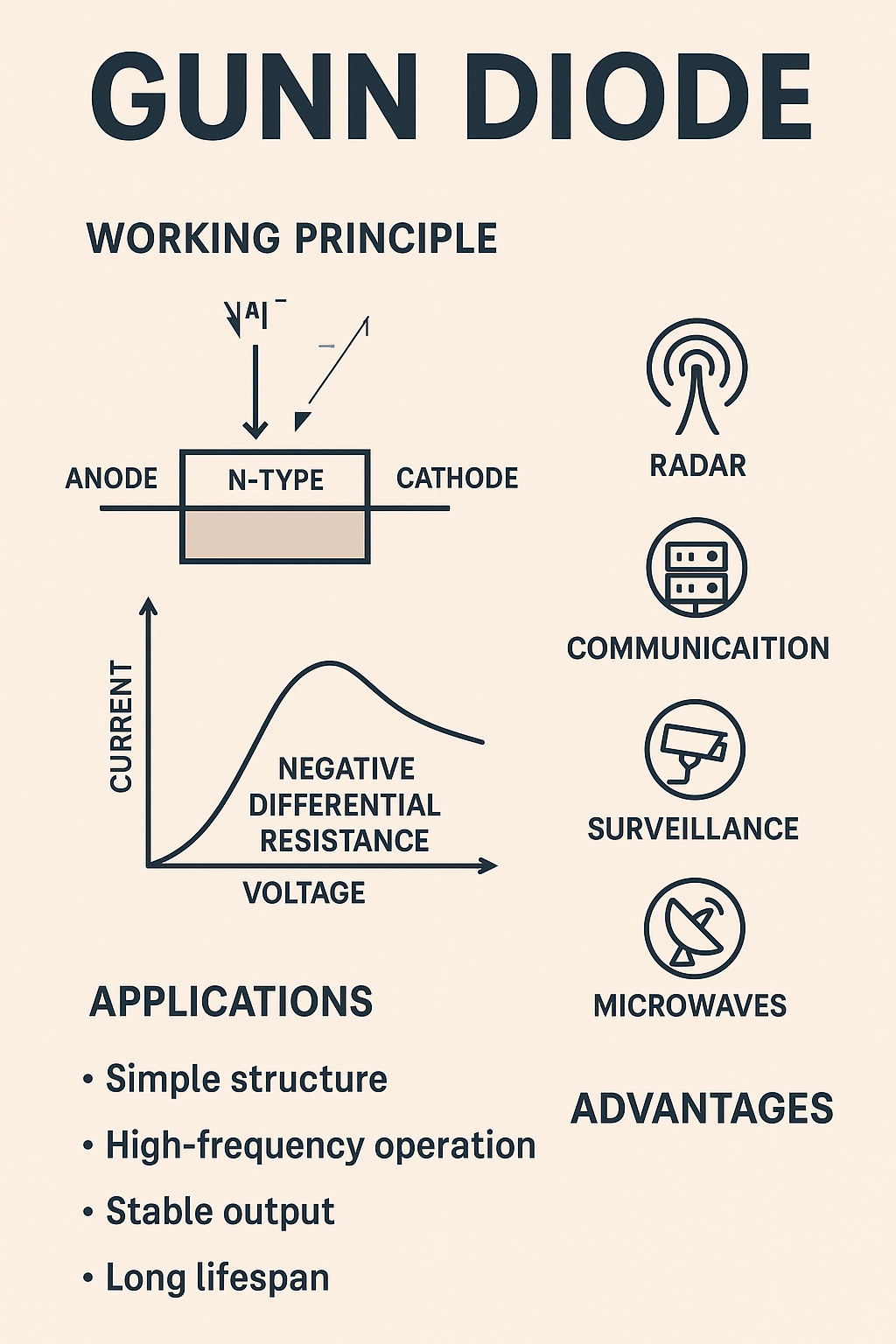
A Gunn diode, also known as a transferred electron device (TED), is a type of diode that operates based on the Gunn effect, discovered by physicist J.B. Gunn in 1963. Unlike conventional diodes, Gunn diodes do not rely on a PN junction for operation. Instead, they utilize a bulk semiconductor material, such as Gallium Arsenide (GaAs) or Indium Phosphide (InP), which exhibits negative differential resistance (NDR).
This negative resistance property allows Gunn diodes to function as oscillators at microwave frequencies, typically in the range of 1 GHz to 100 GHz, making them highly valuable in high-speed electronics.
The Gunn Effect – The Science Behind the Diode
The core operating principle of a Gunn diode is the Gunn effect. When a voltage is applied across certain types of semiconductors, electrons gain energy and transition into a higher energy conduction band with lower mobility. This leads to negative differential resistance, where an increase in voltage results in a decrease in current.
Key aspects of the Gunn effect include:
- Threshold Voltage: The minimum voltage at which negative resistance occurs.
- Electron Drift: Electrons move in clusters called domains, leading to periodic current oscillations.
- Microwave Generation: The formation and movement of these domains create high-frequency oscillations without external resonant circuits.
Construction of a Gunn Diode
A typical Gunn diode consists of:
- Active Layer: Made of a suitable semiconductor material like GaAs, typically a few micrometers thick.
- N-type Doping: The diode is uniformly doped to facilitate electron movement.
- Contacts: Metal contacts are placed at both ends to apply bias voltage.
The simplicity of its structure makes it reliable and cost-effective for mass production, particularly for microwave oscillators.
How Does a Gunn Diode Work?
The working of a Gunn diode can be summarized as follows:
- Bias Voltage Application: A DC voltage is applied across the diode.
- Domain Formation: At the threshold voltage, high-field domains form within the active region.
- Domain Drift: These domains travel across the semiconductor material.
- Oscillation Output: When the domain reaches the anode, a pulse of current is generated, resulting in continuous oscillations at microwave frequencies.
The frequency of oscillation depends on the material properties and the dimensions of the diode.
Applications of Gunn Diodes
Gunn diodes are integral to a variety of high-frequency applications:
- Microwave Oscillators: Used in radar speed guns, microwave transmitters, and local oscillators for receivers.
- Police Radar and Speed Detection: Employed in Doppler radar systems to measure vehicle speed.
- Telecommunication Systems: Facilitate point-to-point communication links in the GHz range.
- Industrial and Scientific Equipment: Used in material testing, level measurement, and spectroscopy.
- Intruder Alarms and Motion Detectors: Operate in motion-sensing devices due to their stable frequency generation.
Advantages of Gunn Diodes
- Simple Structure: Easy to manufacture and integrate into circuits.
- High-Frequency Operation: Capable of generating signals up to 100 GHz.
- Stable Output: Provides reliable and consistent microwave signals.
- Long Lifespan: Durable with minimal maintenance requirements.

Limitations of Gunn Diodes
While advantageous, Gunn diodes have some limitations:
- Limited Output Power: Typically in the milliwatt range, insufficient for high-power applications.
- Temperature Sensitivity: Performance can degrade under high temperatures.
- Requires Amplification: Often needs additional circuitry for power boosting.
Future of Gunn Diodes in Modern Technology
Despite competition from newer technologies like solid-state microwave generators and MMICs (Monolithic Microwave Integrated Circuits), Gunn diodes continue to find applications where cost, simplicity, and reliability are key factors. Emerging fields like automotive radar, IoT-based sensors, and 5G backhaul systems are expected to further leverage their capabilities.
Conclusion
The Gunn diode stands as a testament to how a simple semiconductor device can revolutionize high-frequency electronics. By harnessing the Gunn effect, it delivers efficient microwave generation essential for radar, communication, and sensing applications. As technology advances, Gunn diodes are likely to remain a vital component in bridging the gap between traditional electronics and next-generation wireless systems.