Integrated Circuits (ICs), also known as microchips or chips, are the building blocks of modern electronics. Found in virtually every electronic device—from smartphones and laptops to industrial automation systems and satellites—ICs are revolutionizing the way we interact with technology.
In this comprehensive article, we will explore what Integrated Circuits are, how they work, the different types available, their key functions, benefits, and common applications. This guide will help professionals, students, and electronics enthusiasts understand the importance of ICs in today’s interconnected world.
🔧 What is an Integrated Circuits (ICs)?
An Integrated Circuit (IC) is a miniature electronic circuit composed of thousands or even millions of components such as transistors, diodes, resistors, and capacitors, all fabricated on a single piece of semiconductor material, usually silicon.
Instead of assembling these components individually, as done in traditional circuits, ICs integrate them into a compact and cost-effective chip. This miniaturization allows for greater reliability, lower power consumption, and improved performance.
📜 A Brief History of Integrated Circuits
The first working IC was invented in 1958 by Jack Kilby at Texas Instruments and independently by Robert Noyce at Fairchild Semiconductor. This groundbreaking development marked the beginning of the microelectronics revolution, leading to the development of the modern computer, mobile communication, and advanced control systems.
Since then, IC technology has evolved rapidly, shrinking in size while increasing in power, thanks to Moore’s Law, which predicts the doubling of transistors on a chip approximately every two years.
🧩 Types of Integrated Circuits
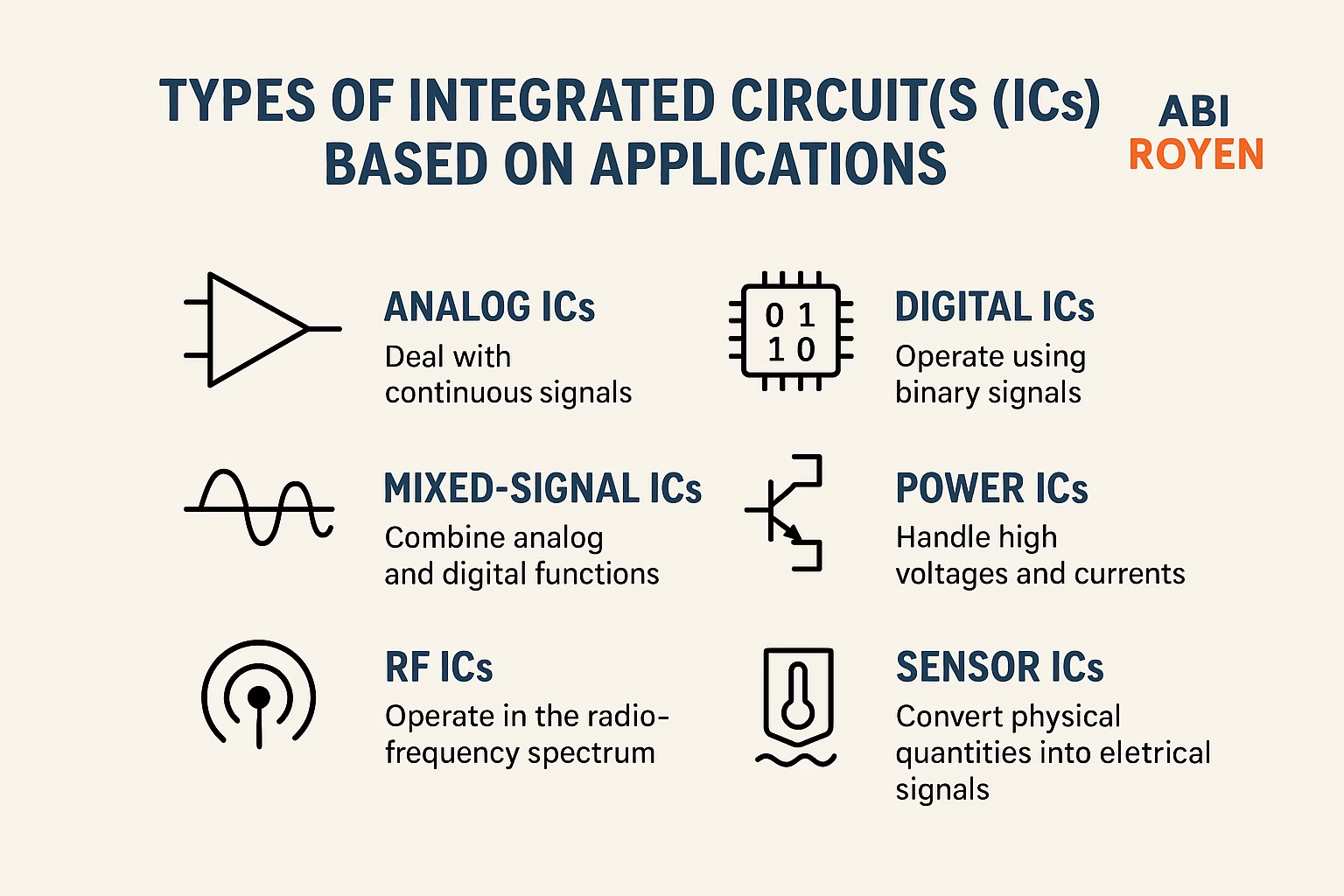
ICs can be classified based on functionality, scale of integration, and packaging. The most common types include:
1. Analog ICs
Analog or linear ICs process continuous signals. These include:
- Operational Amplifiers (Op-Amps)
- Voltage Regulators
- Analog Multipliers
- Comparators
2. Digital ICs
Digital ICs work with binary data (0s and 1s). These are commonly used in:
- Logic Gates (AND, OR, NOT)
- Microprocessors
- Memory Chips (RAM, ROM)
- Flip-Flops and Counters
3. Mixed-Signal ICs
These ICs combine analog and digital functions. Used in:
- ADC (Analog-to-Digital Converters)
- DAC (Digital-to-Analog Converters)
- Modulators/Demodulators (Modem ICs)
4. Power ICs
Specialized for handling high voltage/current in:
- Power Management Systems
- Motor Drivers
- Battery Chargers
⚙️ Functions of Integrated Circuits
ICs serve a wide range of functions in electronic systems:
- Signal Amplification: Amplifying weak input signals (e.g., audio ICs)
- Computation and Control: Enabling data processing (e.g., microcontrollers)
- Timing and Oscillation: Providing clock signals (e.g., timer ICs like 555 timer)
- Data Storage: Saving data in volatile or non-volatile memory
- Switching: Acting as a digital switch in logic operations
🧪 Advantages of Using Integrated Circuits (ICs)
The use of ICs in electronics provides several advantages:
| Advantage | Description |
|---|---|
| Miniaturization | ICs are extremely compact, reducing circuit board space. |
| Reliability | Fewer connections mean fewer points of failure. |
| Cost-Effective | Mass production lowers unit cost significantly. |
| Energy Efficiency | Lower power consumption than discrete components. |
| Speed | Fast operation due to reduced interconnect delays. |
💡 Common Applications of Integrated Circuits (ICs)
Integrated Circuits are used in a wide variety of industries and products:
📱 Consumer Electronics
- Mobile Phones
- Televisions
- Gaming Consoles
- Digital Cameras
💼 Industrial Automation
- PLCs and Control Systems
- Robotics
- Sensor Modules
🚗 Automotive Electronics
- Engine Control Units (ECUs)
- Infotainment Systems
- ADAS (Advanced Driver Assistance Systems)
🏥 Medical Devices
- ECG Machines
- Portable Diagnostic Devices
- Implantable Medical Electronics
🛰 Aerospace and Defense
- Radar and Navigation
- Satellite Systems
- Avionics and Military-grade Systems
🏗 How Integrated Circuits (ICs) Are Manufactured
The production of ICs is a highly complex process that involves:
- Wafer Fabrication: Pure silicon is sliced into wafers.
- Photolithography: Circuit patterns are printed using light exposure.
- Etching and Doping: Material is added or removed to form components.
- Metallization: Electrical pathways are formed.
- Packaging: The die is encapsulated and prepared for PCB mounting.
This process happens in ultra-clean environments known as cleanrooms to avoid contamination.
🔄 Integrated Circuits (ICs) Packaging Types
The packaging of ICs ensures protection and connection to circuit boards. Common types include:
- DIP (Dual Inline Package)
- SMD (Surface Mount Device)
- QFP (Quad Flat Package)
- BGA (Ball Grid Array)
Each has specific use cases depending on the size, performance, and mounting technology.
📈 Future Trends in Integrated Circuits
With ongoing advancements in nanotechnology and materials science, future ICs are expected to be:
- Smaller and Denser: Continued adherence to Moore’s Law with 3D ICs.
- More Energy Efficient: Using FinFET and beyond-CMOS technologies.
- AI-Powered: Integrating machine learning accelerators on-chip.
- Quantum-Ready: Early steps toward quantum computing circuits.
These trends will redefine how devices compute, connect, and operate in the future.
✅ Conclusion of Integrated Circuits (ICs)
Integrated Circuits (ICs) have transformed the world of electronics by making devices smaller, faster, and more affordable. From simple logic operations to complex AI processing, ICs are at the heart of virtually every electronic system we rely on today.
For engineers, designers, and electronics enthusiasts, understanding ICs is crucial to building and innovating the technologies of tomorrow.
Stay connected with Abi Royen for more insightful articles, tutorials, and technical guides in the field of electronics and instrumentation.
🔗 Visit: https://abiroyen.com