Electricity is the backbone of modern technology, powering everything from household appliances to industrial machinery. But what exactly is electricity, and how does it work? This guide will walk you through the basic concepts of electricity, offering a strong foundation for beginners and enthusiasts alike.
🔌 What is Electricity?
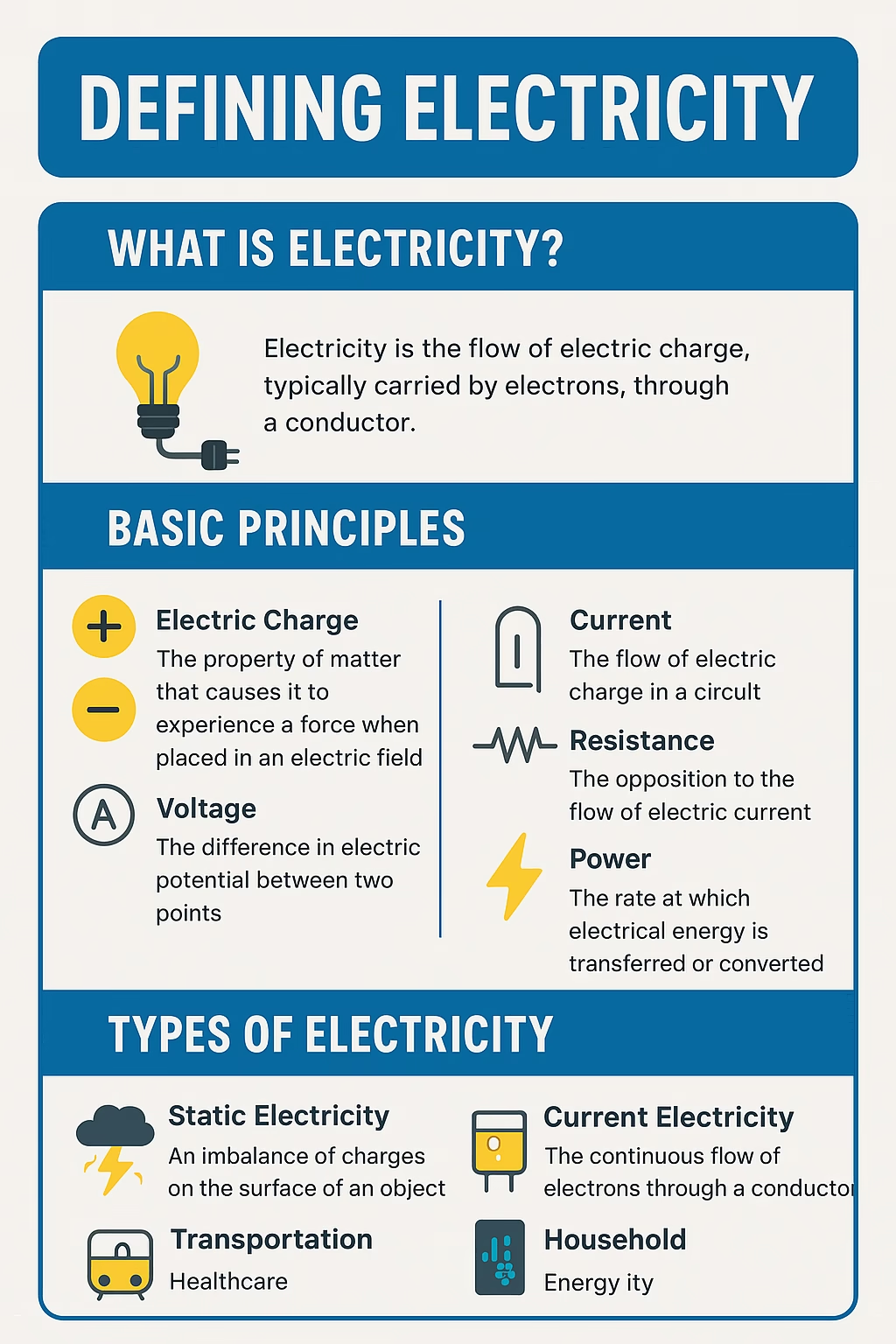
At its core, electricity is the movement of electric charge, typically carried by electrons in a conductor such as copper wire. This flow of charges is what powers electronic devices, lights up homes, and runs motors.
There are two main types of electricity:
- Static Electricity: Caused by the buildup of electric charge on the surface of objects.
- Current Electricity: The flow of electric charge through a conductor, used in all electrical circuits and systems.
Read More about What is Electricity? A Comprehensive Introduction to the Invisible Force Powering Our World
⚙️ Basic Concepts of Electricity Quantities
To understand electricity, it’s crucial to become familiar with a few key electrical quantities:
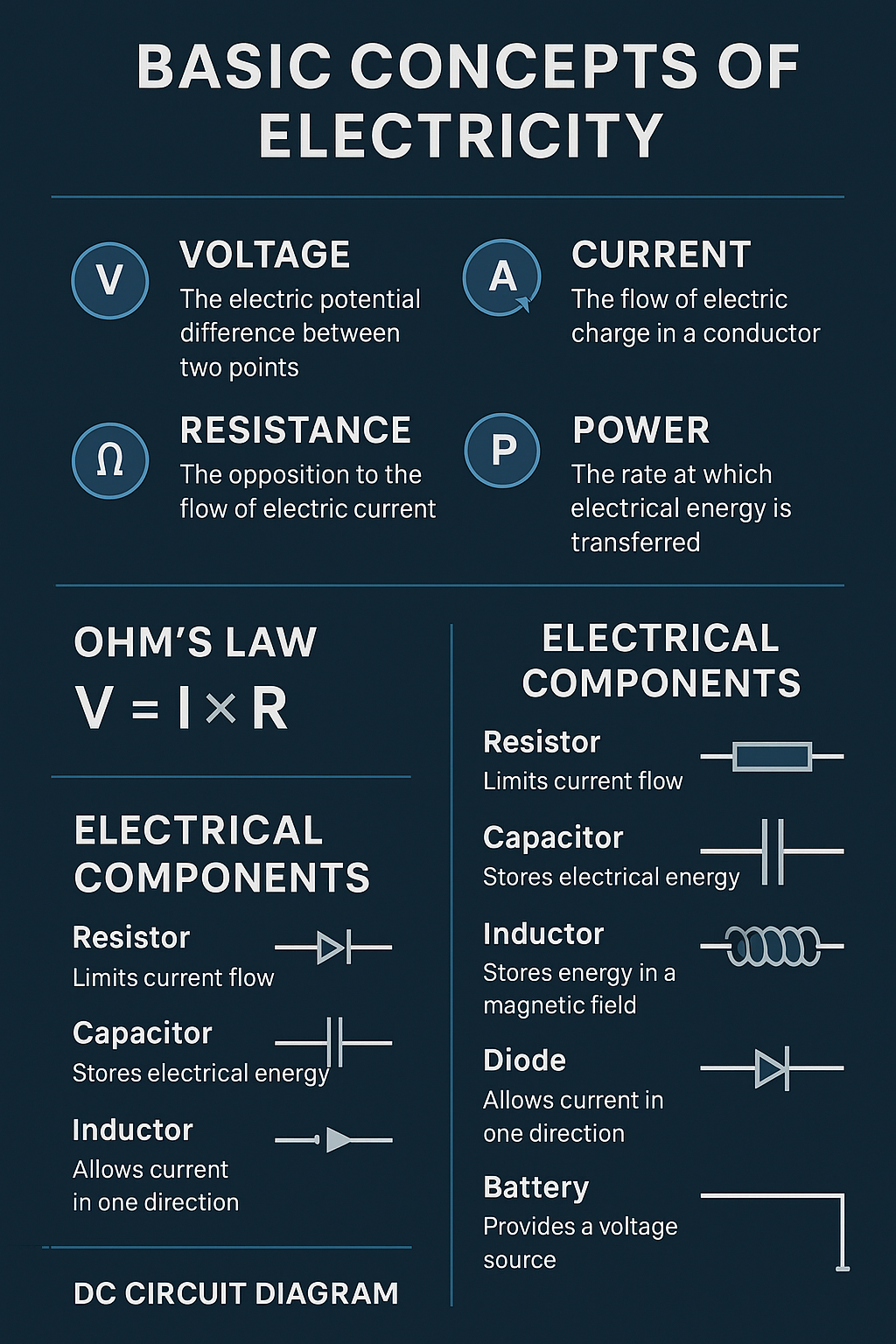
1. Voltage (V)
Also known as electric potential difference, voltage is the force that pushes electric charges through a conductor.
- Unit: Volt (V)
- Analogy: Think of it like water pressure in a pipe.
2. Current (I)
Electric current is the flow of electric charge (electrons) through a conductor.
- Unit: Ampere (A)
- Analogy: Similar to the flow of water in a pipe.
3. Resistance (R)
Resistance is the opposition to the flow of electric current in a circuit.
- Unit: Ohm (Ω)
- Analogy: Like friction in a water pipe that slows down the flow.
4. Power (P)
Power is the rate at which electrical energy is consumed or generated.
- Unit: Watt (W)
- Formula: Power = Voltage × Current (P = V × I)
📐 Ohm’s Law: The Cornerstone of Electricity
Ohm’s Law is a fundamental equation that links voltage, current, and resistance: V=I×RV = I \times RV=I×R
Where:
- VVV = Voltage (volts)
- III = Current (amperes)
- RRR = Resistance (ohms)
This law is essential for analyzing and designing electrical circuits.
Read More about Ohm’s Law: The Fundamental Principle of Electricity
🔋 Types of Electrical Circuits
There are two main types of electrical circuits:
✅ Series Circuit
- Components connected end-to-end.
- Same current flows through all components.
- Total resistance is the sum of all resistors.
✅ Parallel Circuit
- Components connected across the same voltage source.
- Voltage across each branch is the same.
- Current splits across branches.
Read More about Types of Electrical Circuits: A Complete Guide
🔧 Basic Concepts of Electricity Components
Understanding basic components helps in interpreting how electrical systems operate:
| Component | Symbol | Function |
|---|---|---|
| Resistor | Ω | Limits current flow |
| Capacitor | ||
| Inductor | L | Stores energy in a magnetic field |
| Diode | → | |
| Transistor | Q | Acts as a switch or amplifier |
| Battery | ─ |
⚡ How Basic Concepts of Electricity is Generated
Electricity is typically produced by converting mechanical, chemical, or solar energy:
- Mechanical: Using generators in power plants (coal, hydro, wind turbines)
- Chemical: Batteries
- Solar: Photovoltaic (PV) cells convert sunlight into electrical energy
Read More about Basic Components of Electricity: A Beginner’s Guide
🏭 Applications of Basic Concepts of Electricity
Electricity is used in virtually every industry and household. Common applications include:
- Lighting and heating
- Computers and communication devices
- Industrial automation and machinery
- Transportation (EVs, trains, etc.)
- Healthcare equipment
Read More about Understanding the Basic Concepts of Electricity Generation
🧠 Safety Tips When Working with Basic Concepts of Electricity
Electricity can be dangerous if not handled properly. Here are key safety precautions:
- Always turn off power before working on a circuit.
- Use insulated tools and wear rubber gloves.
- Never touch live wires with bare hands.
- Be cautious around water when dealing with electrical devices.
- Understand the device’s voltage and current ratings.
Read More about Safety Tips of Electricity: Protecting Yourself and Your Home

🧮 Common Electrical Formulas
| Quantity | Formula |
|---|---|
| Ohm’s Law | V = I × R |
| Power | P = V × I |
| Energy (Joule) | E = P × t |
| Current | I = P / V |
| Resistance | R = V / I |
Read More about Common Electrical Formulas: A Complete Guide for Students and Professionals
🧭 Visual Infographic – Basic Concepts of Electricity
(Visual suggestion for inclusion on website or infographic)
Diagram: Basic DC Electrical Circuit
- Battery (Voltage Source)
- Resistor (Load)
- Wires (Conductor)
- Current Flow Direction (Arrow)
- Voltage Drop across Resistor
Flow:
Battery (+) → Wire → Resistor → Wire → Battery (−)
🔍 Why Learning Electricity Matters
Understanding electricity is critical for students, technicians, engineers, and DIY enthusiasts. It helps:
- Develop problem-solving and diagnostic skills.
- Improve safety and efficiency when handling equipment.
- Enable innovation in electronics, automation, and energy systems.
Read More about Why Learning Electricity Matters: A Complete Guide for Students and Professionals
📚 Conclusion of Basic Concepts of Electricity
Electricity is one of the most powerful and essential forces in the modern world. By mastering the basic concepts of electricity—voltage, current, resistance, and power—you build a strong foundation for further exploration in electrical and electronic systems. Whether you’re a beginner or an aspiring engineer, understanding these principles is the first step toward innovation and safety in the world of technology.