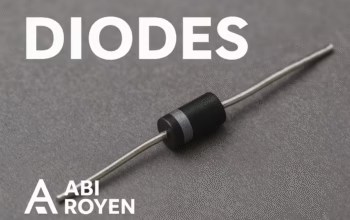
A photodiode is a semiconductor device that converts light into electrical current. It operates based on the principle of the photoelectric effect, where incident photons generate electron-hole pairs in the semiconductor material, producing a measurable current. Photo-diodes are widely used in electronics, optical communication, medical instruments, and various sensing applications due to their high sensitivity and fast response.
This article will explore the working principle, construction, types, characteristics, advantages, disadvantages, and applications of photo-diodes.
1. What is a Photodiode?
A photodiode is essentially a light-sensitive semiconductor device designed to detect and measure light. Unlike solar cells, photo-diodes are optimized for sensing light rather than generating power. They work in reverse bias mode, meaning the positive terminal is connected to the n-type material and the negative terminal to the p-type material.
When light strikes the photo-diode’s surface, photons with sufficient energy excite electrons from the valence band to the conduction band, creating free charge carriers. This process generates a current proportional to the intensity of the incident light.
2. Construction of a Photodiode
A typical photo-diode consists of:
- Semiconductor material (usually silicon, germanium, or InGaAs)
- P-N junction or PIN structure to increase sensitivity
- Transparent window to allow light to enter
- Metallic contacts for external connection
The PIN photo-diode structure (p-type, intrinsic, and n-type layers) is the most common because the intrinsic layer increases the volume where light absorption occurs, improving efficiency.
3. Working Principle of a Photodiode
The working principle of a photodiode can be explained in three steps:
- Light Absorption – Photons with energy greater than the semiconductor’s bandgap are absorbed, creating electron-hole pairs.
- Charge Separation – The electric field in the depletion region separates these charge carriers, with electrons moving toward the n-side and holes toward the p-side.
- Current Generation – The movement of carriers results in a photocurrent proportional to the light intensity.
Photo-diodes usually operate in photovoltaic mode (zero bias) or photoconductive mode (reverse bias).
- Photovoltaic Mode – Produces a voltage without external bias, used in solar cells.
- Photoconductive Mode – Reverse bias increases the depletion region, reducing capacitance and improving speed.
4. Types of Photodiodes
a. PN Photodiode
The simplest type with a basic p-n junction. Suitable for low-speed and general-purpose light detection.
b. PIN Photodiode
Includes an intrinsic layer between the p and n regions, increasing sensitivity and bandwidth.
c. Avalanche Photodiode (APD)
Operates with high reverse bias, where electrons are multiplied through avalanche breakdown, resulting in high gain and extreme sensitivity.
d. Schottky Photodiode
Uses a metal-semiconductor junction, offering fast response but lower sensitivity compared to PIN photo-diodes.
e. Phototransistor
A transistor that is activated by light instead of electrical current. Provides high sensitivity but slower response than a photo-diode.
5. Characteristics of a Photodiode
Key performance parameters include:
- Responsivity (A/W) – Output current per unit of incident light power.
- Dark Current – Small leakage current present even without light.
- Spectral Response – Range of wavelengths the photo-diode can detect.
- Response Time – Speed at which the photo-diode reacts to light changes.
- Noise Equivalent Power (NEP) – Minimum optical power required for detection.
- Quantum Efficiency – Percentage of photons converted into electrons.
6. Advantages of Photodiodes
- High speed and fast response time
- Excellent linearity between light intensity and output current
- Compact size and lightweight
- Long operational life and stability
- Capable of detecting a wide range of wavelengths
7. Disadvantages of Photodiodes
- Requires reverse bias power supply for most applications
- Generates small output current, requiring amplification in some cases
- Sensitive to temperature changes
- Limited gain compared to phototransistors
8. Applications of Photodiodes
Photo-diodes are essential in modern electronics and optical systems. Some key applications include:
a. Optical Communication
Used in fiber optic receivers to convert light signals into electrical signals with high precision.
b. Light Measurement
Employed in lux meters, camera light meters, and laboratory instruments for precise light intensity measurements.
c. Safety and Security Systems
Used in smoke detectors, intrusion alarms, and light curtains.
d. Medical Instruments
Applied in pulse oximeters, medical imaging devices, and spectroscopy equipment.
e. Consumer Electronics
Used in TV remote controls, CD/DVD players, and touchless sensors.
f. Industrial Automation
Involved in counting systems, position sensing, and laser range finding.


9. Photodiode vs. Phototransistor
| Feature | Photodiode | Phototransistor |
|---|---|---|
| Response Speed | Very Fast | Slower |
| Sensitivity | Moderate | High |
| Gain | Low | High |
| Linearity | Excellent | Moderate |
| Complexity | Simple | More Complex |
10. Conclusion
The photodiode is a versatile and essential light-detecting component used in countless modern technologies. Its ability to convert light into electrical signals with high speed and precision makes it invaluable in fields ranging from communication to medical science.
As advancements in semiconductor materials continue, photo-diodes are becoming more efficient, sensitive, and reliable, enabling new applications in areas such as autonomous vehicles, environmental monitoring, and advanced robotics.