

Introduction to Ohm’s Law
When it comes to the study of electricity and electronics, one of the most important principles is Ohm’s Law. Discovered by the German physicist Georg Simon Ohm in 1827, this law forms the foundation of electrical and electronic circuit analysis. Ohm’s Law establishes a simple relationship between three fundamental electrical quantities: voltage (V), current (I), and resistance (R).
The beauty of Ohm’s Law lies in its simplicity—it allows engineers, technicians, and students to understand, analyze, and design electrical circuits effectively. Without this principle, solving even basic electronic problems would be nearly impossible.
What is Ohm’s Law?
Ohm’s Law states that the current passing through a conductor between two points is directly proportional to the voltage across the two points and inversely proportional to the resistance of the conductor.
In formula form: V=I×RV = I \times RV=I×R
Where:
- V = Voltage (Volts)
- I = Current (Amperes)
- R = Resistance (Ohms)
This means:
- If the voltage increases, the current also increases, provided resistance remains constant.
- If resistance increases, the current decreases, assuming voltage stays constant.
Key Components in Ohm’s Law
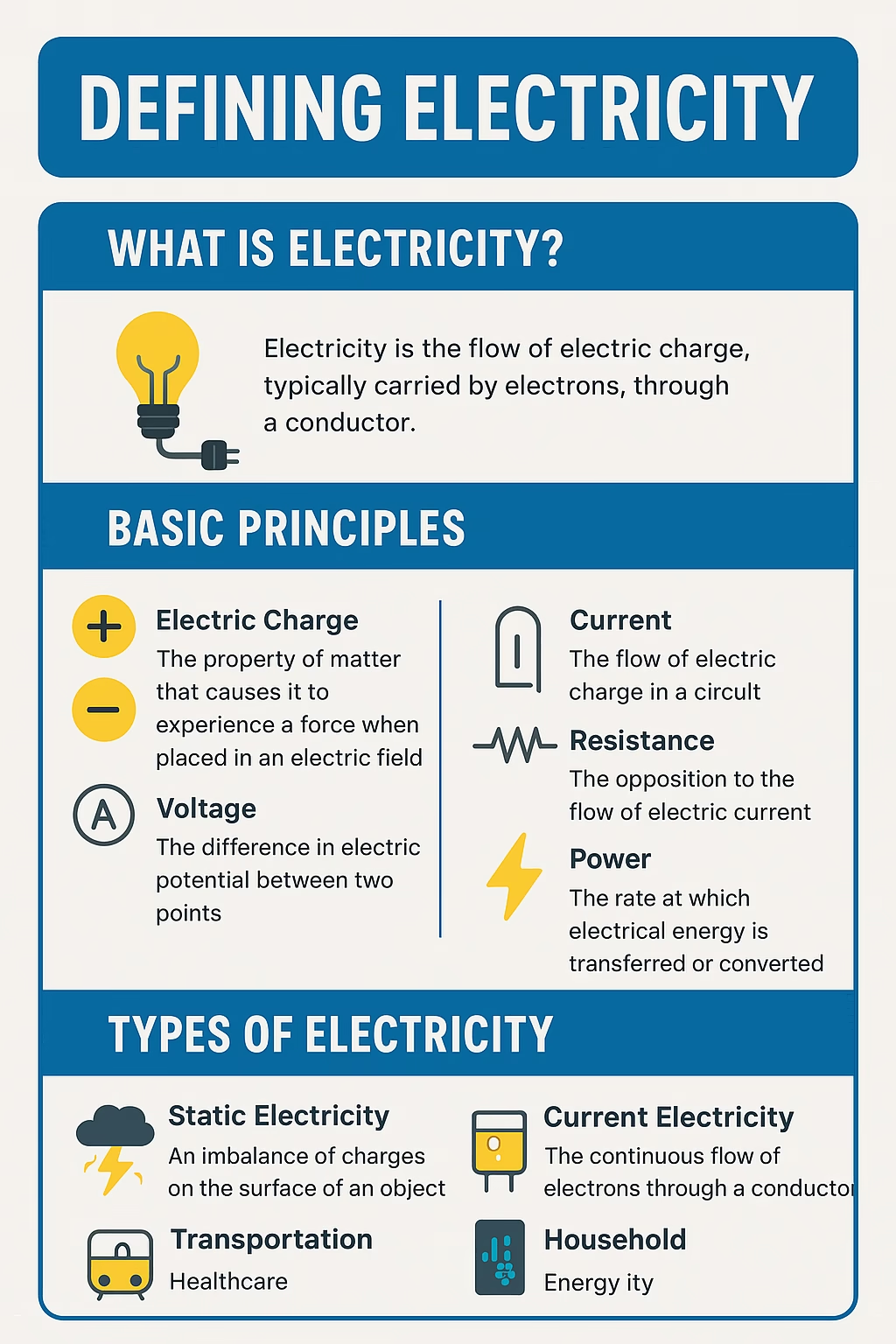
- Voltage (V):
Voltage is the electrical potential difference between two points. It acts like the “pressure” that pushes electrons through a circuit. - Current (I):
Current is the flow of electric charge, measured in amperes (A). It represents how many electrons move through a conductor per second. - Resistance (R):
Resistance is the opposition to the flow of current in a circuit, measured in ohms (Ω). Materials like copper have low resistance, while rubber has high resistance.
Practical Example of Ohm’s Law
Suppose you have a simple circuit with a 9V battery and a resistor of 3Ω.
Using Ohm’s Law: I=VR=93=3 AI = \frac{V}{R} = \frac{9}{3} = 3 \, AI=RV=39=3A
This means the current flowing through the circuit will be 3 amperes.
If you increase the resistor to 9Ω, the current will drop to: I=99=1 AI = \frac{9}{9} = 1 \, AI=99=1A
This clearly demonstrates the inverse relationship between resistance and current.
The Ohm’s Law Triangle
To make calculations easier, students and professionals often use the Ohm’s Law Triangle.
      V
   -------
   I   ×   R
- Cover the quantity you want to calculate.
- For current (I): I = V / R
- For resistance (R): R = V / I
- For voltage (V): V = I × R
This simple diagram helps avoid mistakes in quick calculations.
Applications of Ohm’s Law
Ohm’s Law is not just theoretical—it has countless practical applications in the world of electronics and electrical engineering.
- Circuit Design:
Engineers use Ohm’s Law to determine the correct resistor values to achieve desired current flow in electronic circuits. - Troubleshooting:
Technicians apply Ohm’s Law to check whether a circuit is functioning properly. By measuring voltage and resistance, they can predict the expected current. - Power Calculation:
Since electrical power is given by the formula: P=V×IP = V \times IP=V×I Ohm’s Law helps in understanding how voltage and current affect power consumption in devices. - Safety Applications:
Ohm’s Law helps design safe electrical systems by ensuring current flow is within safe limits to prevent overheating or fire hazards. - Household Appliances:
From light bulbs to mobile chargers, manufacturers apply Ohm’s Law to determine the correct electrical ratings.
Real-Life Example: Light Bulb
Imagine you have a 60W light bulb designed to work at 120V. To calculate the resistance: P=V×I⇒I=PV=60120=0.5AP = V \times I \quad \Rightarrow \quad I = \frac{P}{V} = \frac{60}{120} = 0.5 AP=V×I⇒I=VP=12060=0.5A
Now, applying Ohm’s Law: R=VI=1200.5=240 ΩR = \frac{V}{I} = \frac{120}{0.5} = 240 \, \OmegaR=IV=0.5120=240Ω
This means the bulb has a resistance of 240 ohms when operating at 120V.


Limitations of Ohm’s Law
While Ohm’s Law is widely applicable, it has some limitations:
- Non-Ohmic Materials:
Certain materials, such as diodes and transistors, do not follow Ohm’s Law. Their resistance changes with voltage or current. - Temperature Dependency:
The resistance of conductors changes with temperature. For example, metals usually have higher resistance at higher temperatures. - High-Frequency Circuits:
In alternating current (AC) systems with high frequency, factors like inductance and capacitance influence the current flow beyond Ohm’s Law.
Importance of Ohm’s Law in Modern Technology
Despite its limitations, Ohm’s Law remains the backbone of electrical studies. From designing consumer electronics to large power distribution systems, understanding Ohm’s Law is crucial.
- In education: Students learn it as one of the first principles of electronics.
- In engineering: It is applied in designing circuits, analyzing performance, and ensuring safety.
- In daily life: It helps us understand how devices consume electricity and why certain appliances require specific voltage ratings.
Conclusion
Ohm’s Law is more than just a formula—it is the key to understanding electricity. By linking voltage, current, and resistance, it provides the foundation for analyzing and designing electrical systems. Whether you are a student, hobbyist, or professional engineer, mastering Ohm’s Law is essential for working with electronics.
From simple battery-powered circuits to advanced electrical engineering systems, Ohm’s Law remains timeless and universally applicable.