Introduction
In electronic and electrical systems, safety and reliability are crucial factors. One component that combines the functionality of a resistor and a fuse is the fusible resistors. As the name suggests, a fusible resistor is designed to act both as a resistor, controlling the flow of current, and as a fuse, breaking the circuit when excessive current flows. This dual-purpose component is particularly useful in applications where space-saving and cost-efficiency are important.
In this article, we will explore what fusible resistors are, how they work, their benefits, and their common applications in various industries.
What is a Fusible Resistors?
A fusible resistor is a resistor that has been specially designed to burn out and open the circuit when subjected to a specific amount of overload current for a certain period. Unlike regular resistors that may fail unpredictably or cause secondary damage when overloaded, fusible resistors are manufactured to fail in a safe and controlled manner, similar to a fuse.
This makes them a vital component in circuit protection systems, especially in sensitive electronics where preventing fire hazards and protecting other components is essential.
How Fusible Resistors Work
Fusible resistors operate under normal conditions like any other resistor — they limit current flow according to their resistance value, following Ohm’s Law (V = IR).
However, in case of a fault condition:
- Excess Current Flow: If the current exceeds the resistor’s rated limit due to a short circuit, component failure, or overload, the fusible resistor’s internal conductive element heats up.
- Thermal Reaction: The resistor’s fusible element is designed to melt at a specific temperature.
- Circuit Disconnection: Once the element melts, the resistor’s circuit path opens, stopping current flow and preventing further damage.
Key Features of Fusible Resistors
Fusible resistors are designed with several important characteristics:
- Dual Functionality: Acts as both a resistor and a fuse.
- Safety-Oriented Design: Burns out without creating flames or toxic fumes.
- Precise Melting Point: Ensures predictable failure mode under overload.
- Stable Resistance: Provides reliable performance under normal load conditions.
- Compliance with Safety Standards: Often designed to meet UL, IEC, or other regulatory certifications.
Construction of a Fusible Resistors
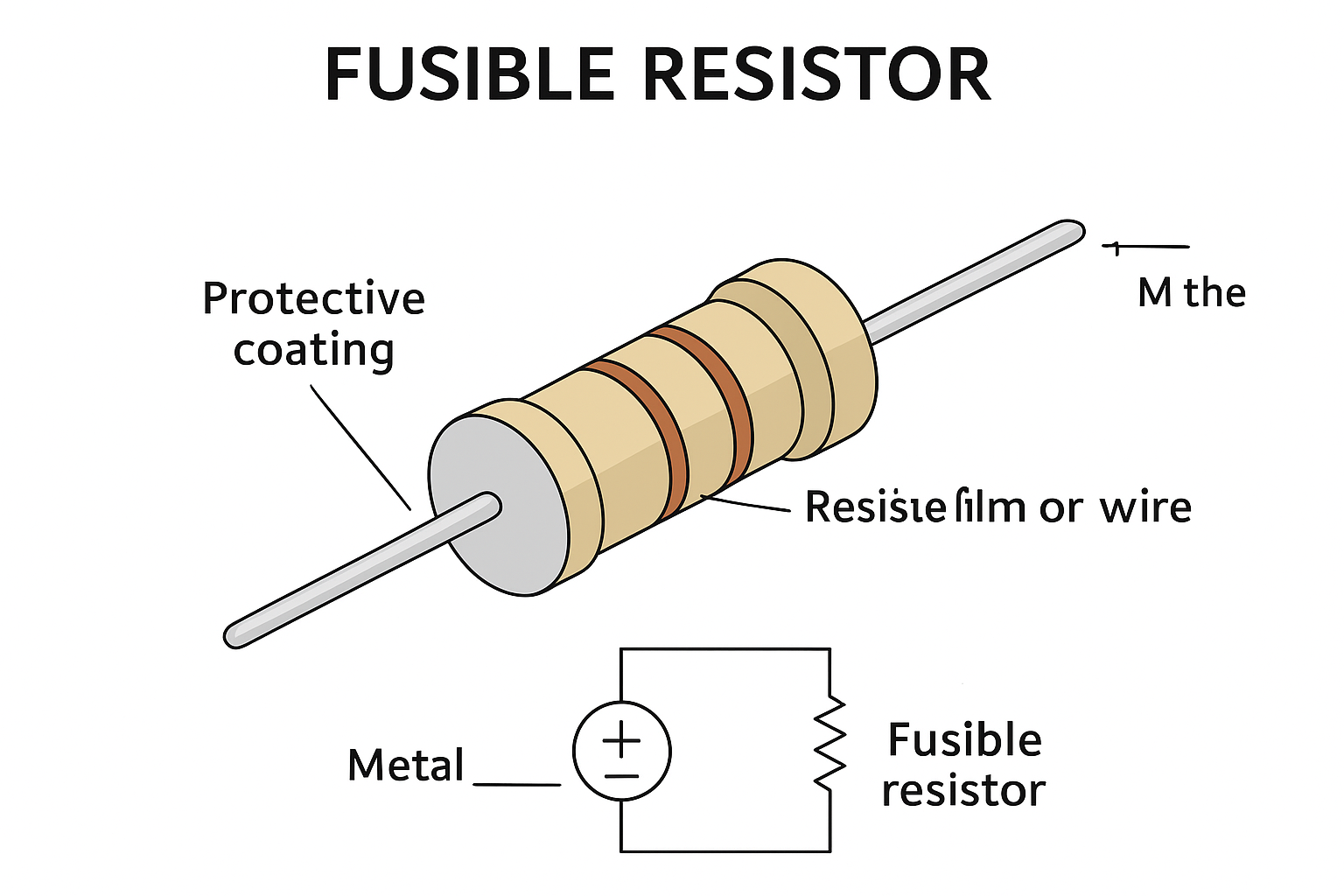
Fusible resistors typically consist of:
- Ceramic Core: Provides mechanical strength and high heat tolerance.
- Resistive Film or Wire: Made of materials like nichrome, chosen for predictable resistance and melting behavior.
- Protective Coating: Flame-retardant material to contain any particles when the resistor burns out.
- Metal Leads: For connection to the circuit.
This construction allows the fusible resistor to withstand normal operating conditions but fail in a controlled manner under fault conditions.
Advantages of Fusible Resistors
Fusible resistors offer several benefits over using separate resistors and fuses:
- Space Saving
Combines two components into one, reducing PCB size. - Cost Efficiency
Eliminates the need for a separate fuse and resistor, lowering material and assembly costs. - Enhanced Safety
Fails without causing sparks, flames, or dangerous heat buildup. - Predictable Failure Mode
Breaks the circuit cleanly when overloaded, avoiding damage to surrounding components. - Simplified Circuit Design
Reduces the number of components and potential failure points.
Common Applications of Fusible Resistors
Fusible resistors are widely used in electronics where both resistance and circuit protection are required. Some typical applications include:
- Power Supplies
Protects the circuit from overcurrent conditions caused by short circuits or component failure. - Television and Audio Equipment
Safeguards sensitive circuits from damage due to electrical surges. - Industrial Control Systems
Prevents damage to expensive automation equipment by cutting off current during faults. - Battery Chargers
Ensures safe operation by disconnecting faulty charging circuits. - Household Appliances
Used in microwave ovens, refrigerators, and washing machines to improve safety.
Choosing the Right Fusible Resistors
When selecting a fusible resistor, you should consider:
- Resistance Value (Ω): Determines normal current control.
- Power Rating (W): Indicates the maximum power the resistor can dissipate under normal operation.
- Fusing Current and Time: The current at which the resistor will melt and the time it will take.
- Temperature Coefficient: Ensures stable performance under temperature changes.
- Certification Requirements: Verify compliance with safety standards for your region.

Fusible Resistor vs. Regular Resistors
| Feature | Fusible Resistor | Regular Resistor |
|---|---|---|
| Circuit Protection | Yes (acts as a fuse) | No |
| Failure Mode | Safe and controlled | Unpredictable |
| Cost | Slightly higher | Lower |
| Applications | Safety-critical circuits | General current limiting |
Installation and Safety Precautions
When using fusible resistors:
- Ensure proper ventilation for heat dissipation.
- Avoid placing near heat-sensitive components.
- Follow manufacturer’s specifications for mounting.
- Never replace a fusible resistor with a regular resistor — it will remove the safety function.
Conclusion
Fusible resistors are a crucial innovation in circuit protection, combining the functions of a resistor and a fuse into a single component. They provide safety, cost savings, and design simplicity, making them ideal for modern electronics and industrial applications.
Whether you are designing a household appliance, an industrial machine, or sensitive electronic equipment, incorporating a fusible resistor can improve both performance and safety.