

In today’s world, electricity powers almost every aspect of our lives—from household appliances and office equipment to massive industrial plants and high-voltage power stations. With this widespread dependency on electrical systems, the need for accurate Electrical Measuring Monitoring Instruments has become increasingly important.
These instruments are not just optional accessories; they are critical tools that help engineers, technicians, and industries ensure efficiency, reliability, and safety in their electrical operations. This article explores the functions, types, benefits, and applications of electrical measuring and monitoring instruments while highlighting their growing role in modern industries.
1. What Are Electrical Measuring Monitoring Instruments?
Electrical measuring and monitoring instruments are devices used to measure, record, and monitor electrical quantities such as voltage, current, resistance, frequency, power, and energy consumption.
Their main purpose is to provide accurate readings that allow for proper system analysis, troubleshooting, and decision-making. These instruments are widely used in:
- Power generation plants – for monitoring electricity output and system stability.
- Manufacturing industries – to ensure machines operate within safe electrical limits.
- Residential and commercial buildings – for energy monitoring and electrical safety.
- Research and laboratories – for precision testing and development of new technologies.
2. Importance of Electrical Measuring Monitoring Instruments
The importance of these tools cannot be overstated. They serve several vital roles, including:
a. Safety Assurance
Monitoring instruments detect irregularities such as over-voltage, over-current, or short circuits. This prevents potential accidents, electrical fires, and equipment damage.
b. Energy Efficiency
By measuring power consumption and energy losses, industries can optimize processes and reduce unnecessary energy costs.
c. Maintenance and Troubleshooting
Accurate measurements make it easier to identify faults, predict failures, and perform preventive maintenance.
d. Compliance with Standards
Many industries must comply with international standards (such as IEC, IEEE, or ISO). Measuring instruments help meet these requirements by ensuring reliable system performance.
3. Common Types of Electrical Measuring Monitoring Instruments
Electrical measuring and monitoring instruments come in various forms, each designed for specific measurements. Below are some of the most commonly used types:
a. Voltmeter
Measures the voltage across two points in a circuit. Essential for ensuring proper voltage supply.
b. Ammeter
Measures current flow in amperes. It helps monitor whether circuits are overloaded or operating normally.
c. Ohmmeter
Used to measure electrical resistance. Commonly applied in testing insulation and conductor resistance.
d. Multimeter
A versatile instrument that combines voltmeter, ammeter, and ohmmeter functions. Used by electricians, engineers, and technicians for everyday electrical testing.
e. Wattmeter
Measures power consumption in watts. Frequently used in industrial and energy auditing applications.
f. Energy Meter
Also known as a kilowatt-hour (kWh) meter, it tracks energy consumption over time. Widely used in homes, offices, and factories.
g. Frequency Meter
Used to measure the frequency of electrical signals. Essential in power systems to maintain stable supply quality.
h. Power Quality Analyzer
Monitors harmonics, voltage fluctuations, and other quality issues in electrical systems. Important for ensuring smooth industrial operations.
i. Oscilloscope
Displays electrical signals graphically, allowing engineers to study waveforms, distortions, and transient events.
j. Smart Monitoring Devices
With the rise of IoT, smart meters and cloud-based monitoring devices are becoming popular for real-time data collection and analysis.
4. Modern Trends in Electrical Measuring Monitoring Instruments
The electrical industry is evolving rapidly, and so are its monitoring tools. Here are some key trends:
a. Digital Transformation
Traditional analog devices are being replaced by digital instruments with advanced features such as data logging, wireless connectivity, and touchscreen interfaces.
b. IoT Integration
Internet of Things (IoT) technology allows remote monitoring of electrical systems via smartphones, tablets, or cloud platforms.
c. AI and Predictive Analytics
Artificial intelligence is increasingly being used to predict system failures and optimize energy usage.
d. Miniaturization
Portable, compact measuring instruments make fieldwork and on-site maintenance easier.
e. Sustainability Focus
Energy-efficient monitoring devices are helping industries reduce carbon footprints and move toward sustainable practices.

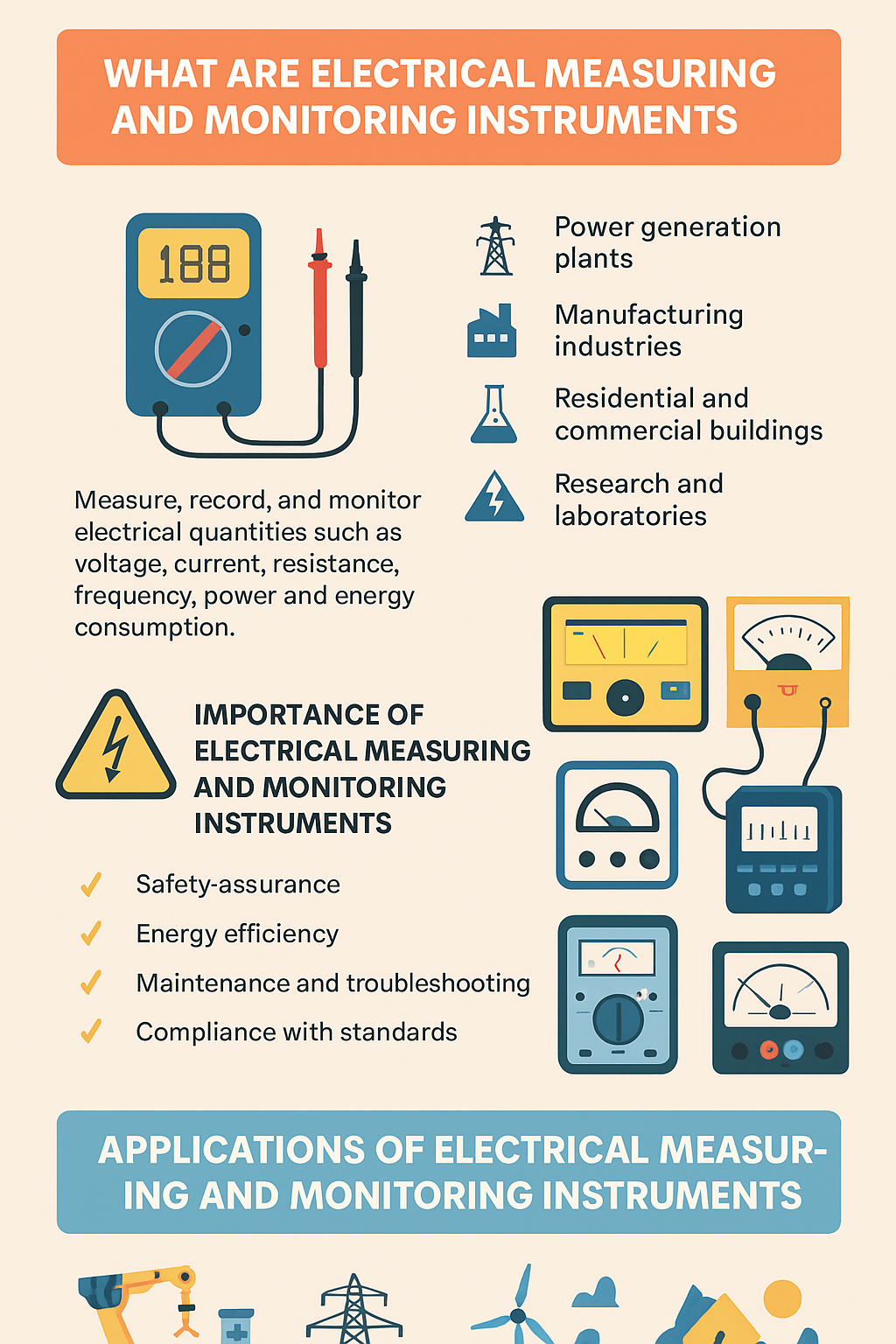
5. Applications of Electrical Measuring Monitoring Instruments
These instruments are used across multiple sectors. Some common applications include:
- Industrial Manufacturing – Ensuring machines run within optimal electrical parameters.
- Power Distribution – Monitoring grid stability and preventing blackouts.
- Renewable Energy – Tracking energy output from solar panels, wind turbines, and other renewable sources.
- Construction and Building Management – Ensuring electrical installations comply with safety standards.
- Automotive Industry – Testing electrical systems in electric vehicles (EVs) and hybrid vehicles.
- Telecommunications – Monitoring power supply to ensure uninterrupted network services.
- Healthcare – Maintaining reliability of sensitive electrical equipment in hospitals.
6. Benefits of Using Electrical Measuring Monitoring Instruments
Investing in reliable measuring and monitoring tools brings several benefits:
- Enhanced Safety – Early detection of potential hazards.
- Cost Savings – Reduced energy waste and maintenance expenses.
- Improved Productivity – Reliable systems ensure uninterrupted operations.
- Accurate Data – Essential for decision-making and compliance reporting.
- Long-Term Reliability – Regular monitoring extends the lifespan of electrical equipment.
7. Choosing the Right Electrical Measuring Monitoring Instruments
When selecting instruments, consider the following factors:
- Accuracy and Precision – Choose instruments that provide reliable readings.
- Measurement Range – Ensure the device can handle the expected voltage, current, or frequency levels.
- Durability – Industrial-grade instruments are recommended for harsh environments.
- Ease of Use – Look for user-friendly devices with digital interfaces.
- Integration Capabilities – For modern applications, opt for IoT-enabled smart devices.
- Compliance – Ensure the instrument meets international standards.
Conclusion of Electrical Measuring Monitoring Instruments
Electrical measuring and monitoring instruments play a vital role in ensuring the safety, efficiency, and reliability of electrical systems across industries. As technology advances, these instruments are becoming smarter, more accurate, and easier to use, enabling engineers and organizations to make data-driven decisions.
From simple voltmeters to advanced power quality analyzers, these tools are indispensable for industries that rely heavily on electricity. By investing in the right instruments, businesses can reduce risks, improve energy efficiency, and enhance overall performance.