Introduction
Emerging Trends Ship’s Equipment ~ The maritime industry has always been at the forefront of technological transformation. From the age of sail to steam engines and diesel propulsion, ships have continuously evolved with advancements in engineering and technology. Today, the shipping industry is facing unprecedented challenges and opportunities due to global trade expansion, environmental regulations, and digital transformation. As a result, ship’s equipment is undergoing revolutionary changes to meet the demands of efficiency, safety, sustainability, and automation.
In this article, we will explore the emerging trends in ship’s equipment that are shaping the future of the maritime industry, focusing on innovation, digitalization, eco-friendly technologies, and smart systems.
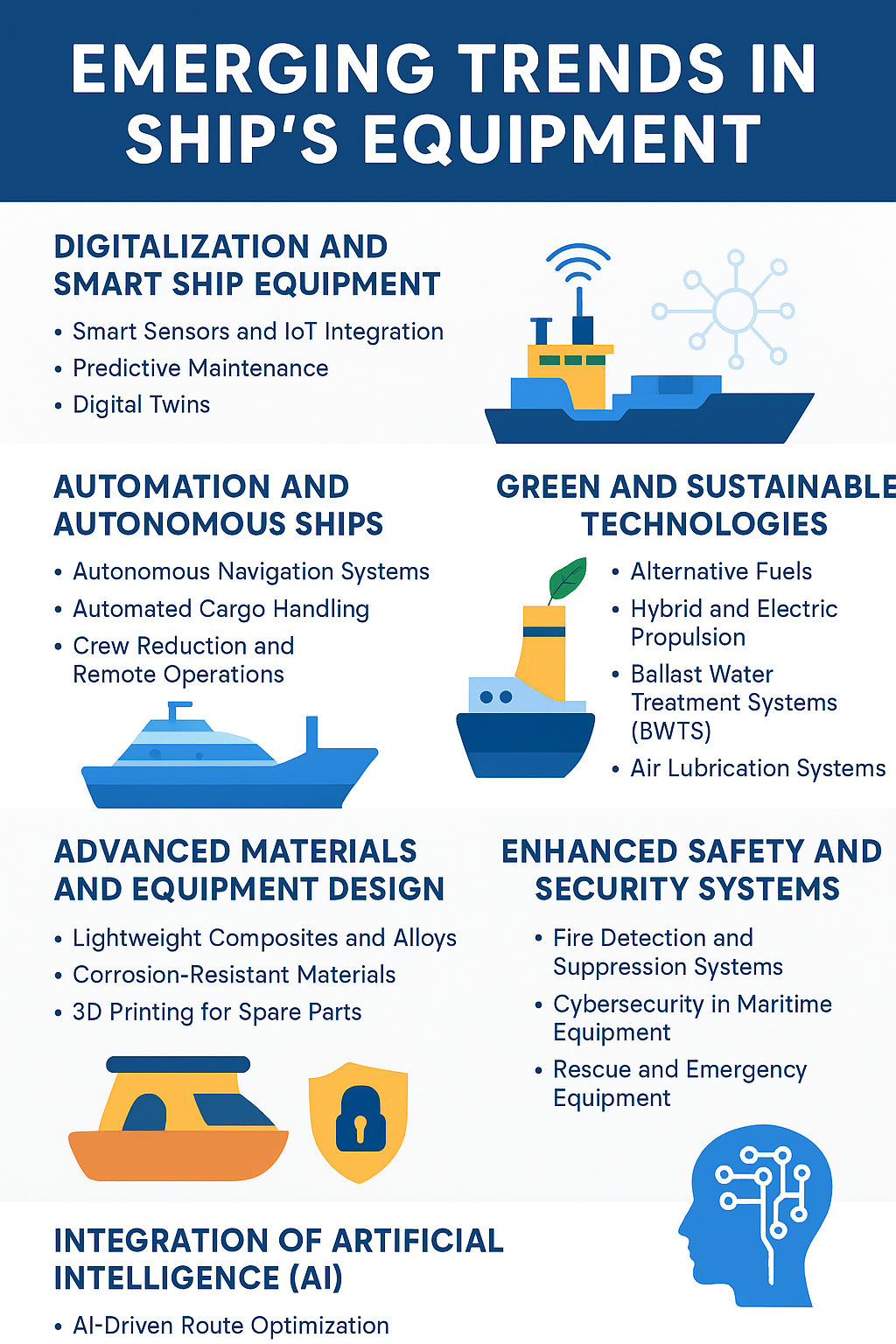
1. Emerging Trends Ship’s Equipment: Digitalization and Smart Ship Equipment
One of the most significant trends in modern shipbuilding is the integration of digital technologies into ship’s equipment. The concept of “smart ships” is no longer a futuristic idea but a growing reality.
- Smart Sensors and IoT Integration
Ships are now equipped with Internet of Things (IoT) devices and sensors that provide real-time data on fuel consumption, engine performance, cargo conditions, and weather forecasts. This data allows ship operators to optimize efficiency, reduce costs, and improve safety. - Predictive Maintenance
Instead of relying on scheduled maintenance, ships now use predictive maintenance systems. Sensors detect anomalies in critical equipment, such as engines, turbines, and navigation systems, before failures occur. This reduces downtime and operational costs. - Digital Twins
A digital twin is a virtual replica of a ship and its equipment. By simulating real-time performance, operators can predict outcomes, plan maintenance, and optimize efficiency. This trend is rapidly transforming ship design and operations.
2. Automation and Autonomous Ships
Automation is redefining the future of maritime transport. Several major shipping companies and shipbuilders are already experimenting with autonomous vessels.
- Autonomous Navigation Systems
Advanced navigation systems powered by AI and machine learning enable ships to navigate with minimal human intervention. These systems can detect obstacles, avoid collisions, and choose optimal routes. - Automated Cargo Handling
Modern cargo ships are adopting automated cranes and loading systems that speed up port operations, reduce labor dependency, and minimize human error. - Crew Reduction and Remote Operations
Autonomous ship technology aims to reduce crew size and enable remote monitoring from shore-based control centers, increasing efficiency while lowering operational risks.
3. Emerging Trends Ship’s Equipment: Green and Sustainable Technologies
Environmental sustainability is a driving force behind new trends in ship’s equipment. With stricter regulations from the International Maritime Organization (IMO), shipbuilders are integrating eco-friendly technologies into vessel design.
- Alternative Fuels
Ships are transitioning from heavy fuel oil to cleaner alternatives such as liquefied natural gas (LNG), hydrogen, methanol, and even ammonia. This shift significantly reduces greenhouse gas emissions. - Hybrid and Electric Propulsion
Hybrid ships using a combination of diesel engines and battery systems are gaining popularity. Fully electric ships are also emerging for short-distance routes, reducing carbon emissions and noise pollution. - Ballast Water Treatment Systems (BWTS)
To comply with IMO regulations, ships are installing ballast water treatment equipment that prevents the spread of invasive aquatic species, protecting marine ecosystems. - Air Lubrication Systems
This innovative technology reduces friction between the ship’s hull and seawater by injecting air bubbles. The result is improved fuel efficiency and lower emissions.
4. Advanced Materials and Equipment Design
The choice of materials used in ship’s equipment is evolving to improve durability, reduce weight, and enhance efficiency.
- Lightweight Composites and Alloys
Advanced composites and high-strength alloys are being used in hulls, propellers, and other critical equipment to reduce weight without compromising strength. This leads to fuel savings and better performance. - Corrosion-Resistant Materials
Since ships operate in harsh marine environments, new corrosion-resistant coatings and materials extend equipment lifespan and reduce maintenance costs. - 3D Printing for Spare Parts
Additive manufacturing (3D printing) is revolutionizing how ship spare parts are produced. Instead of waiting for deliveries, ships can produce components onboard, reducing downtime and logistics costs.
5. Emerging Trends Ship’s Equipment: Enhanced Safety and Security Systems
Safety remains the top priority in maritime operations. Emerging technologies are making ship’s equipment safer and more reliable.
- Fire Detection and Suppression Systems
New intelligent fire detection systems use AI to identify risks early. Automated suppression systems ensure rapid response in case of fire emergencies. - Cybersecurity in Maritime Equipment
With the rise of digitalization, cybersecurity has become crucial. Advanced security protocols are being integrated into navigation and communication systems to prevent cyberattacks on ships. - Rescue and Emergency Equipment
Modern lifeboats, evacuation systems, and personal safety equipment are being enhanced with GPS, automatic distress signals, and better durability for extreme conditions.
6. Integration of Artificial Intelligence (AI)
Artificial intelligence is playing an increasingly important role in ship’s equipment.
- AI-Driven Route Optimization
AI analyzes weather patterns, sea conditions, and fuel efficiency to suggest the most cost-effective and safe routes. - Cargo Monitoring Systems
AI-powered equipment monitors cargo conditions in real-time, ensuring the safe transportation of sensitive goods such as pharmaceuticals and perishable items. - Decision-Support Systems
AI provides real-time decision support to ship captains, helping them make informed choices under challenging conditions.
7. Emerging Trends Ship’s Equipment: Future Outlook of Ship’s Equipment
The future of ship’s equipment will be defined by sustainability, automation, and digital intelligence. The global shipping industry is investing heavily in research and development to achieve zero-emission ships by 2050 in line with IMO goals. Equipment manufacturers are also working on modular and scalable systems that can adapt to different ship types and operational needs.
Some future concepts include:
- Fully autonomous cargo ships powered by renewable energy.
- Smart shipyards that use robotics and AI for shipbuilding.
- Next-generation propulsion systems based on hydrogen fuel cells.

Conclusion of Emerging Trends Ship’s Equipment
The maritime industry is entering a new era driven by innovation in ship’s equipment. From digitalization and AI to green technologies and advanced materials, these emerging trends are transforming the way ships are built, operated, and maintained. As global trade continues to grow and environmental concerns rise, the adoption of these technologies will be crucial for ensuring the shipping industry remains efficient, safe, and sustainable.
The future of maritime transportation will depend heavily on how quickly ship operators and manufacturers embrace these innovations. By staying ahead of the curve, the shipping industry can not only meet international regulations but also pave the way for a more sustainable and technologically advanced future.