Introduction
In the world of electronics and communication, radio amplifiers play a crucial role in strengthening weak signals to a level where they can be effectively processed, transmitted, or heard. From vintage radios to modern wireless systems, amplifiers are the backbone of signal transmission and reception. Without them, our radios, mobile phones, and broadcasting systems would not function effectively. This article will explore the definition, working principle, types, and applications of radio amplifiers in detail.
What is a Radio Amplifiers?
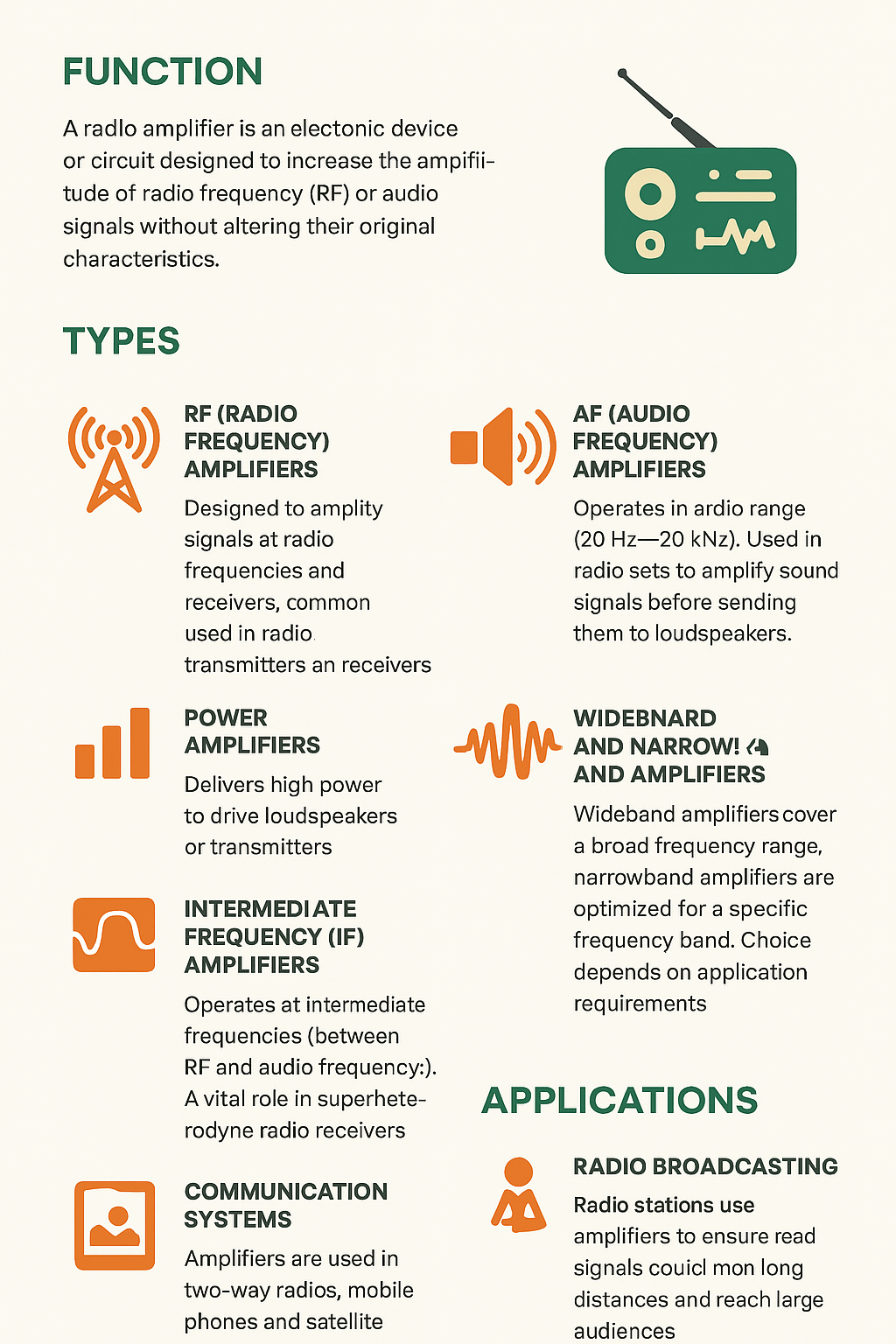
A radio amplifier is an electronic device or circuit designed to increase the amplitude of radio frequency (RF) or audio signals without altering their original characteristics. Essentially, it takes a weak signal and boosts it to a stronger, usable level.
Amplifiers are essential in communication systems, as they ensure that signals transmitted over long distances remain clear, audible, and free from significant distortion. They can be used at both the transmitter and receiver ends of a communication system.
Working Principle of Radio Amplifiers
The working principle of a radio amplifier is based on the concept of signal amplification. Using active electronic components like transistors or vacuum tubes, the amplifier increases the power of an input signal by drawing energy from an external power source.
Key points in the working mechanism include:
- Input Stage – Receives a weak signal from an antenna or other source.
- Amplification Stage – The signal passes through transistors or tubes where it is strengthened.
- Output Stage – The amplified signal is sent to speakers, transmitters, or other devices for further processing.
The goal of this process is to increase signal strength without changing its frequency or wave shape.
Types of Radio Amplifiers
Radio amplifiers come in different types depending on their application and frequency range. Below are the most common categories:
1. RF (Radio Frequency) Amplifiers
- Designed to amplify signals at radio frequencies, typically in the MHz or GHz range.
- Commonly used in radio transmitters and receivers.
- Helps boost weak signals received by antennas.
2. AF (Audio Frequency) Amplifiers
- Operate in the audio range (20 Hz – 20 kHz).
- Used in radio sets to amplify sound signals before sending them to loudspeakers.
- Essential for clear and powerful sound reproduction.
3. Power Amplifiers
- Deliver high power to drive loudspeakers or transmitters.
- Widely used in broadcasting stations and concert audio systems.
4. Intermediate Frequency (IF) Amplifiers
- Work at intermediate frequencies (between RF and audio frequencies).
- Play a vital role in superheterodyne radio receivers.
5. Wideband and Narrowband Amplifiers
- Wideband amplifiers cover a broad frequency range, while narrowband amplifiers are optimized for a specific frequency band.
- Choice depends on application requirements.
Applications of Radio Amplifiers
Radio amplifiers have widespread applications in modern technology. Some of the most notable include:
1. Radio Broadcasting
Radio stations use amplifiers to ensure their signals can travel over long distances and reach large audiences. Without amplifiers, listeners would experience weak or distorted reception.
2. Communication Systems
Amplifiers are used in two-way radios, mobile phones, and satellite communication to strengthen both transmitted and received signals.
3. Consumer Electronics
Home radios, televisions, and hi-fi audio systems rely on amplifiers for clear audio output.
4. Military and Aviation
In defense and aviation, amplifiers are crucial for radar systems, secure communications, and navigation aids.
5. Scientific and Industrial Applications
Used in test equipment, medical imaging systems (like MRI), and wireless sensors for accurate data transmission.
Advantages of Radio Amplifiers
- Signal Clarity – Ensures minimal distortion during amplification.
- Wide Frequency Handling – Suitable for both RF and AF applications.
- Improved Communication Range – Enables long-distance communication.
- Versatility – Found in a variety of fields from consumer electronics to aerospace.

Challenges and Limitations
Despite their benefits, radio amplifiers have some challenges:
- Noise Addition: Amplifiers may introduce unwanted electronic noise.
- Power Consumption: High-power amplifiers require significant energy.
- Heat Dissipation: Excessive heat may damage components if not managed properly.
- Distortion Risk: Poorly designed amplifiers can distort signals instead of enhancing them.
Future Trends in Radio Amplifiers
With the rise of 5G networks, IoT devices, and advanced communication technologies, radio amplifiers are evolving. Modern designs focus on:
- Energy Efficiency – Low-power amplifiers for portable devices.
- Miniaturization – Smaller amplifier circuits for integration into compact electronics.
- High-Frequency Capability – Amplifiers that handle GHz signals for next-generation communication.
- Smart Amplifiers – Adaptive designs that adjust gain based on input conditions.
Conclusion
Radio amplifiers are fundamental components in communication and electronics. Whether in simple AM radios, modern smartphones, or complex satellite systems, they ensure that signals are strong, clear, and reliable. As communication technologies continue to evolve, amplifiers will remain at the heart of innovation, enabling seamless global connectivity.
By understanding their types, working principles, and applications, we can appreciate the vital role amplifiers play in shaping modern communication systems.