Introduction
Radio transmitter are one of the most fundamental components in modern communication systems. They are responsible for generating and transmitting electromagnetic waves carrying information such as voice, music, data, or video. From traditional AM/FM radio broadcasting to aviation communication, mobile networks, and satellite links, radio transmitters play a critical role in connecting the world wirelessly.
This article explores the definition, working principles, major components, different types, and real-world applications of radio transmitters, making it easier to understand why this technology remains vital even in the digital era.
What is a Radio Transmitter?
A radio transmitter is an electronic device that converts electrical signals into electromagnetic waves and radiates them through an antenna. These waves travel across space and can be received by a radio receiver, which decodes the signals back into their original form (sound, data, or images).
In simpler terms, a transmitter is the “sender” of information in a wireless communication system. Without it, broadcasting stations, aviation towers, satellites, and even mobile phones would not be able to transmit data over long distances.
Working Principles of a Radio Transmitter
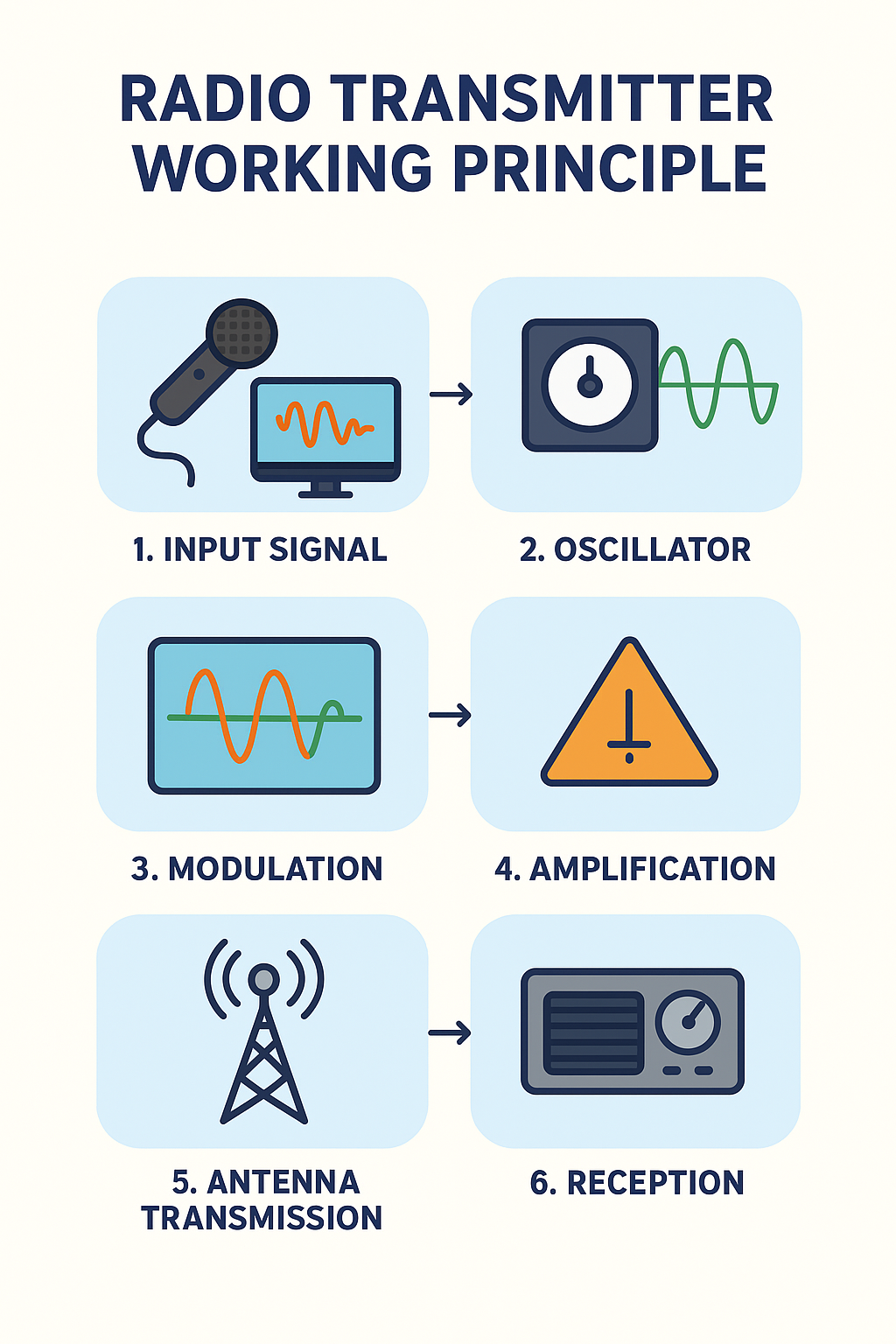
The working of a radio transmitter can be broken down into several key steps:
- Input Signal (Modulation Source)
The input can be a voice, music, or data signal, typically coming from a microphone, computer, or other devices. - Oscillator
The oscillator generates a high-frequency carrier wave that will carry the input signal. - Modulation
The input signal is superimposed on the carrier wave through modulation. There are different methods of modulation such as:- AM (Amplitude Modulation)
- FM (Frequency Modulation)
- PM (Phase Modulation)
- Amplification
The modulated signal is weak at this stage, so it passes through an amplifier to increase its power for long-distance transmission. - Antenna Transmission
Finally, the amplified modulated signal is sent to an antenna, which radiates electromagnetic waves into the atmosphere. - Reception
A receiver at the other end captures the electromagnetic waves, demodulates them, and converts them back into usable information.
Key Components of a Radio Transmitter
A transmitter consists of several important components:
- Oscillator – generates the carrier wave.
- Modulator – combines the carrier with the information signal.
- Amplifier – boosts the signal strength.
- Antenna – radiates the signal into space.
- Power Supply – provides the necessary energy for transmission.
Each component must be carefully designed and tuned to ensure efficient transmission and minimal interference.
Types of Radio Transmitter
Radio transmitters can be classified in various ways depending on their frequency range, application, and modulation technique:
1. Based on Frequency Range
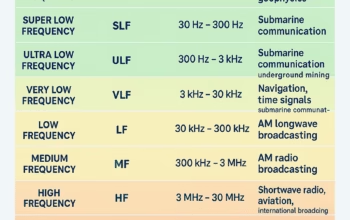
- Low Frequency (LF) Transmitters: Used for navigation and maritime communication.
- Medium Frequency (MF) Transmitters: Commonly used for AM broadcasting.
- High Frequency (HF) Transmitters: Support long-distance communication, including international broadcasting.
- Very High Frequency (VHF) Transmitters: Widely used in FM radio, television, and aviation.
- Ultra High Frequency (UHF) Transmitters: Used in modern television, mobile communication, and radar.
2. Based on Modulation Type
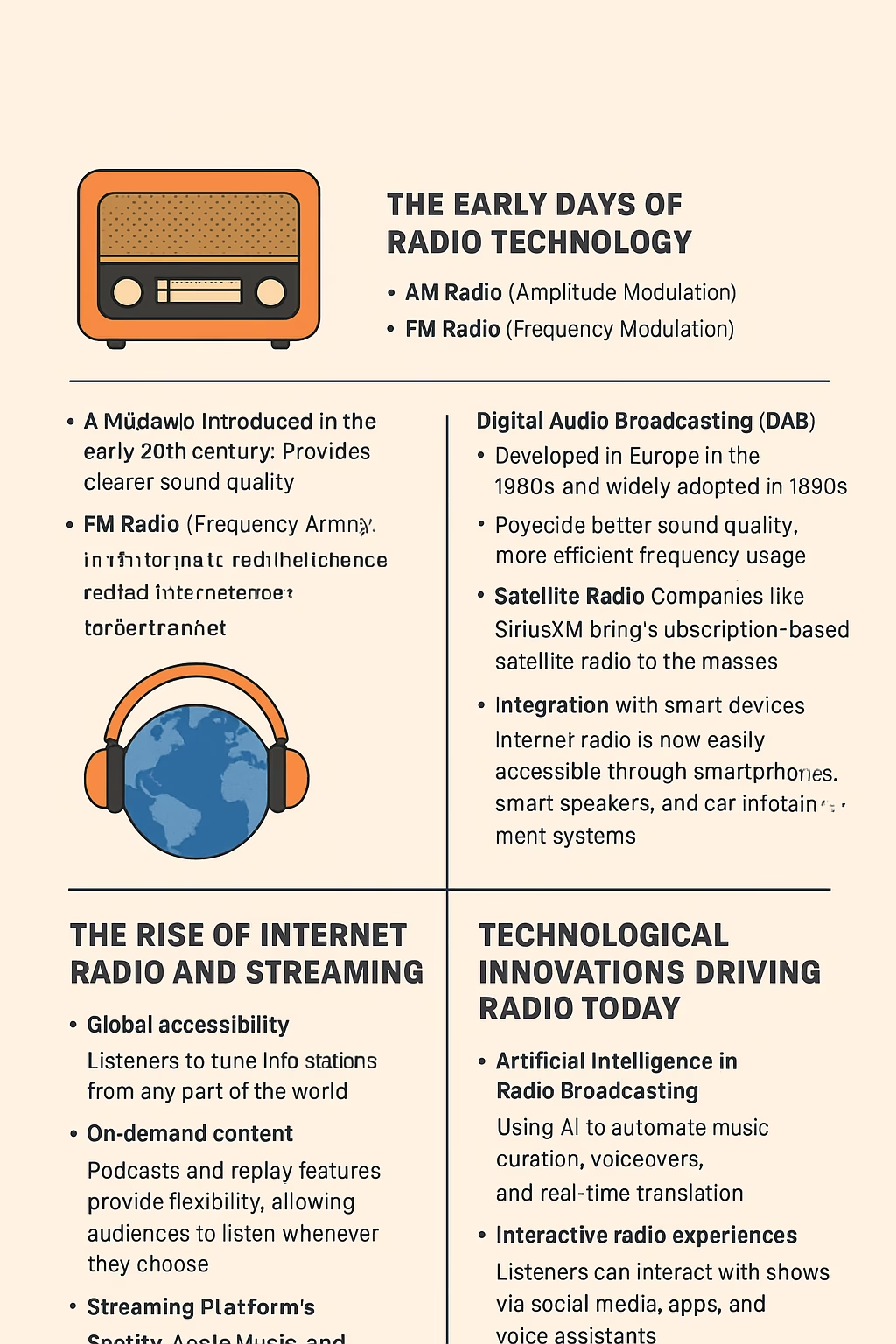
- AM Transmitters (Amplitude Modulation) – Used in traditional radio broadcasting.
- FM Transmitters (Frequency Modulation) – Popular in music and entertainment radio.
- Digital Transmitters – Support digital communication such as Wi-Fi, mobile networks, and satellite links.
3. Based on Application
- Broadcast Transmitters – For radio and TV broadcasting.
- Communication Transmitters – For mobile, satellite, and internet communication.
- Military and Aviation Transmitters – For navigation, radar, and secure communication.
- Scientific and Industrial Transmitters – For research, remote sensing, and industrial automation.
Applications of Radio Transmitter
Radio transmitters are used in countless fields. Some major applications include:
1. Broadcasting
- AM and FM radio stations.
- Television transmitters for terrestrial broadcasting.
2. Telecommunication
- Mobile phones rely on transmitters to send signals to base stations.
- Wi-Fi routers and Bluetooth devices also use small-scale transmitters.
3. Aviation and Maritime Communication
- Air traffic control towers use transmitters to communicate with pilots.
- Ships use transmitters for navigation and safety communication.
4. Military and Defense
- Secure communication systems.
- Radar systems for tracking and surveillance.
5. Satellite Communication
- Earth stations transmit signals to satellites, enabling global communication.
6. Everyday Devices
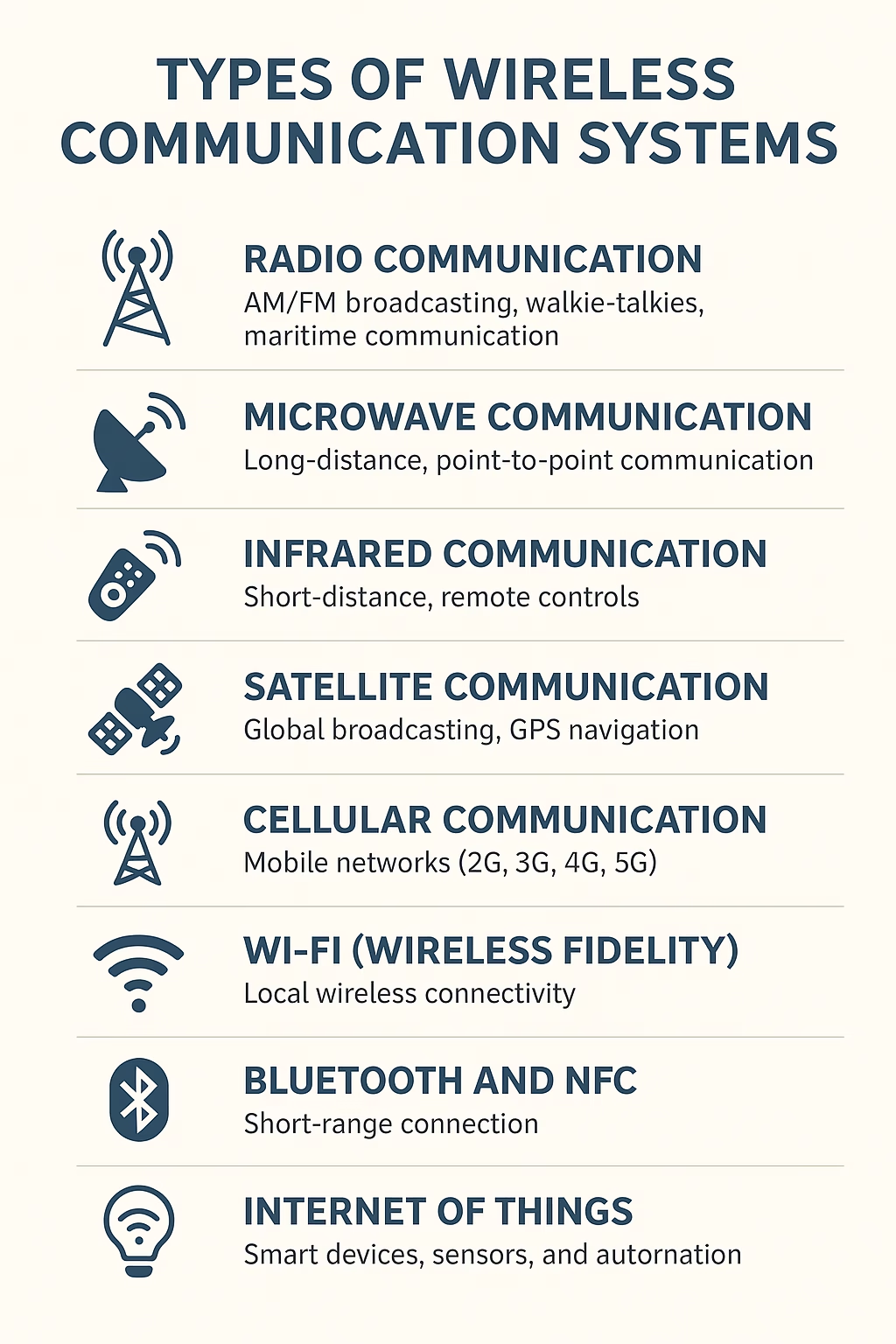
- Walkie-talkies, remote controls, wireless microphones, and IoT devices all use miniaturized radio transmitters.

Advantages of Radio Transmitters
- Enable wireless communication over long distances.
- Support multiple applications (entertainment, defense, industry).
- Reliable and cost-effective for mass communication.
- Can transmit signals through air, space, and even underwater in certain frequencies.
Challenges and Limitations Radio Transmitter
- Interference: Signals may interfere with other transmitters.
- Power Consumption: High-power transmitters require significant energy.
- Spectrum Regulation: Governments regulate frequencies to avoid conflicts.
- Security Risks: Signals can be intercepted or jammed.
Future of Radio Transmitters
With the rise of 5G, IoT, and satellite internet, transmitters are becoming more efficient, compact, and digitally advanced. Future transmitters will likely feature:
- Higher frequency ranges (millimeter waves) for faster data transfer.
- Smarter modulation techniques for improved efficiency.
- Integration with AI and IoT for intelligent wireless networks.
- Green technology designs to minimize energy consumption.
Conclusion of Radio Transmitter
Radio transmitters are the backbone of modern wireless communication. From broadcasting music on FM radio to enabling global internet through satellites, they ensure seamless connectivity across the globe. Despite challenges like interference and regulation, the continuous development of transmitter technology promises an even more connected future.
Understanding their working principles, types, and applications not only helps in appreciating their importance but also prepares us for the innovations they will bring in the coming decades.