Types of rectifier diodes ~ In the field of electronics, rectifier diodes play a critical role in converting alternating current (AC) to direct current (DC). This fundamental process is essential for powering most electronic devices. Without rectifier diodes, the conversion from AC to DC would not be possible in a cost-effective and efficient way.
This article explores the types of rectifier diodes, their characteristics, and how they are applied in various electronic circuits. Whether you’re a beginner in electronics or an experienced engineer, understanding these components can improve your circuit designs and ensure the longevity of your devices.
What is a Rectifier Diode?
A rectifier diode is a two-terminal semiconductor device that allows current to flow only in one direction. The primary purpose of a rectifier diode is to convert AC into DC. These diodes have high efficiency in blocking current in the reverse direction and allow smooth flow in the forward direction.
They are extensively used in power supplies, chargers, and virtually every electronic system that requires a steady DC voltage.
Main Types of Rectifier Diodes
Below are the major types of rectifier diodes commonly used in electronic circuits:
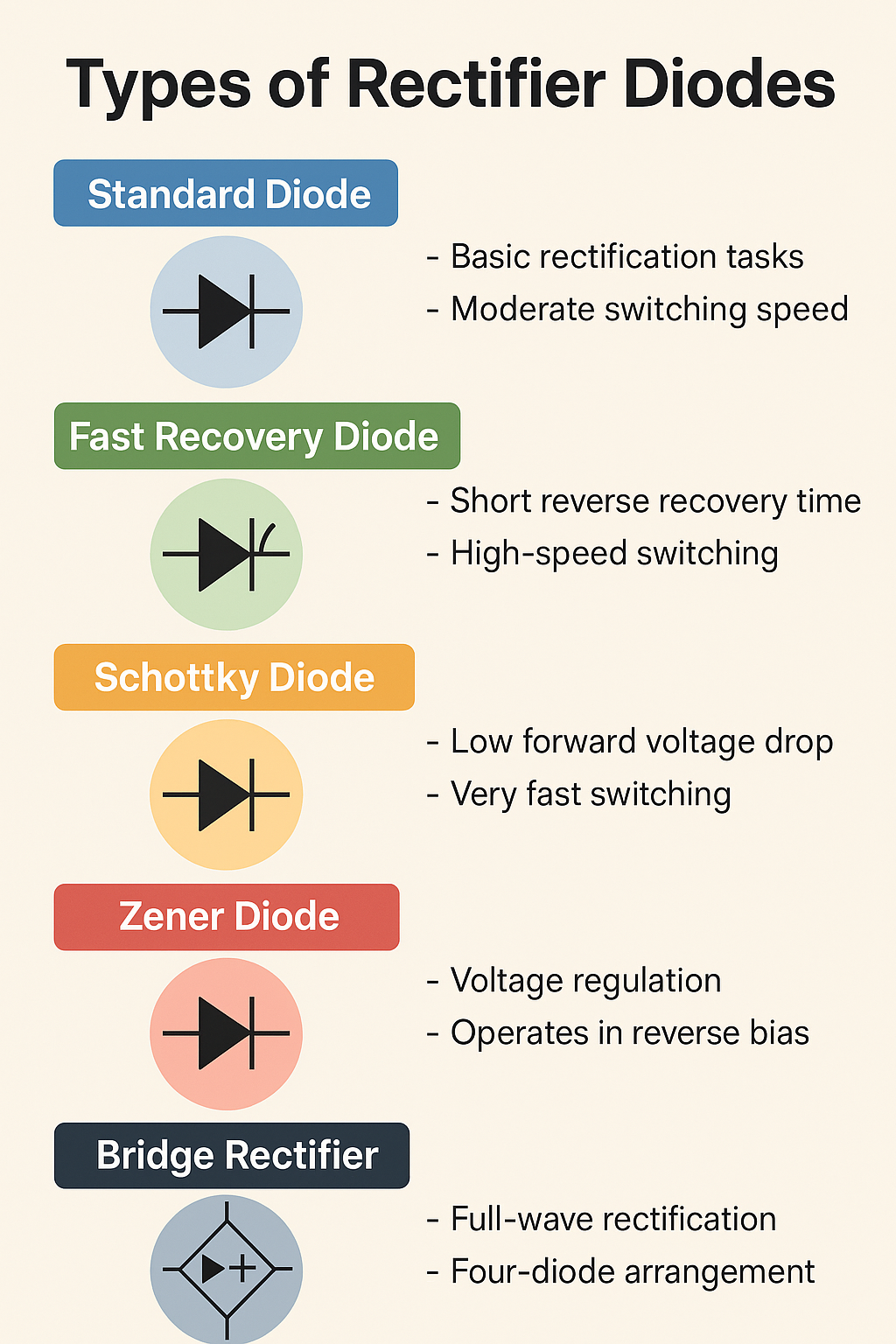
1. Types of Rectifier Diodes: Standard (General-Purpose) Diode
Standard diodes are the most basic type of rectifier diodes. They can handle moderate currents and voltages, making them ideal for basic rectification tasks.
Key Characteristics:
- Moderate switching speed
- Handles up to a few amps of current
- Inexpensive and widely available
Common Use Cases:
- Power supply units
- Battery chargers
- Small AC to DC converters
Example: 1N5408, 1N4007
2. Types of Rectifier Diodes: Fast Recovery Diode
As the name suggests, fast recovery diodes have a faster reverse recovery time compared to standard diodes. This makes them suitable for high-speed switching applications.
Key Characteristics:
- Short reverse recovery time
- Handles high-frequency signals
- Slightly more expensive than standard diodes
Common Use Cases:
- Switched-mode power supplies (SMPS)
- Inductive load protection
- Inverter circuits
Example: UF4007, MUR460
3. Schottky Diode
The Schottky diode is known for its low forward voltage drop and very fast switching action. It uses a metal-semiconductor junction rather than a p-n junction.
Key Characteristics:
- Low forward voltage drop (typically 0.2–0.45V)
- Very fast switching
- Lower reverse breakdown voltage
Common Use Cases:
- High-frequency circuits
- RF applications
- Power supply rectification in low-voltage systems
Example: 1N5819, SS14
4. Zener Diode (in Rectifier Role)
While Zener diodes are primarily known for voltage regulation, they can be part of rectifier systems, especially in overvoltage protection.
Key Characteristics:
- Operates in reverse bias beyond breakdown voltage
- Provides voltage clamping
- Maintains a stable voltage
Common Use Cases:
- Surge protection
- Voltage regulators in DC power supplies
Example: BZX55C12, 1N4733A
5. Types of Rectifier Diodes: Bridge Rectifier
A bridge rectifier is not a single diode but a configuration of four diodes arranged in a bridge format. It provides full-wave rectification from an AC source.
Key Characteristics:
- Converts both halves of the AC waveform into DC
- Better efficiency compared to half-wave rectifiers
- Compact designs available as single components
Common Use Cases:
- AC to DC power supplies
- Adapter circuits
- Home appliances
Example: KBPC5010, MB6S
6. Full-Wave and Half-Wave Rectifier Diodes
These terms refer to the configuration in which diodes are used rather than the diode types themselves.
- Half-Wave Rectification uses a single diode to pass one half of the AC cycle.
- Full-Wave Rectification uses multiple diodes (often in a bridge) to pass both halves of the AC cycle.
While not distinct diode types, these configurations influence which diode is chosen based on voltage and current needs.

Comparison Table: Types of Rectifier Diodes
| Diode Type | Forward Voltage Drop | Speed | Common Use | Example |
|---|---|---|---|---|
| Standard Diode | ~0.7V | Moderate | Power supplies, Chargers | 1N4007 |
| Fast Recovery | ~0.7V | Fast | SMPS, Inverters | UF4007 |
| Schottky Diode | 0.2V – 0.45V | Very Fast | RF, DC power conversion | 1N5819 |
| Zener Diode | Variable (Reverse) | Moderate | Voltage regulation | 1N4733A |
| Bridge Rectifier | Varies (4 diodes) | N/A | AC to DC power conversion | KBPC5010 |
How to Choose the Right Rectifier Diode
Choosing the appropriate rectifier diode depends on several factors:
- Voltage and Current Rating: Make sure the diode can handle the peak voltage and current in your circuit.
- Speed: For high-frequency circuits, choose fast recovery or Schottky diodes.
- Power Dissipation: Ensure the diode has enough thermal margin and heatsinking if required.
- Form Factor: Surface-mount vs. through-hole based on your PCB design.
- Cost vs. Performance: Standard diodes are cheaper but might not meet high-speed requirements.
Practical Applications of Rectifier Diodes
Rectifier diodes are the foundation of almost every electronic circuit. Some common practical uses include:
- Phone chargers
- Power supply circuits in computers and TVs
- Solar inverters
- Battery-powered devices
- Electric motor controllers
These diodes ensure that the power supply remains stable, safe, and efficient.
Conclusion of Types of Rectifier Diodes
Rectifier diodes are essential components in electronics, and choosing the right type can make or break your circuit’s performance. Whether you’re building a simple power supply or a high-frequency switching circuit, understanding the types of rectifier diodes—standard, fast recovery, Schottky, Zener, and bridge—is crucial.
With the right knowledge and selection, rectifier diodes help ensure smooth current flow, voltage stability, and long-lasting performance of electronic systems.
For more technical insights, tutorials, and component guides, visit Abi Royen.