Navigation has always been one of the greatest challenges for explorers, sailors, and adventurers throughout history. Before the rise of GPS and advanced electronic tools, mariners relied on celestial bodies and precise instruments to determine their position at sea. Among these instruments, the sextant stands out as one of the most revolutionary devices in maritime history.
This article will explore the history, function, and modern applications of the sextant, explaining why it remains a symbol of human ingenuity and precision in navigation.
What is a Sextant?
A sextant is a navigational instrument used to measure the angle between two visible objects. Most commonly, it measures the angle between a celestial body (such as the sun, moon, or stars) and the horizon. This measurement, known as the altitude, allows navigators to determine their latitude and longitude at sea.
The name “sextant” comes from the Latin word sextans, meaning one-sixth, because the instrument’s arc covers 60 degrees (one-sixth of a circle). Despite its seemingly simple design, the sextant is capable of providing remarkably accurate readings that made long-distance sea voyages possible.
A Brief History of the Sextant
Early Navigation Challenges
Before the sextant, sailors used tools like the astrolabe and cross-staff to measure celestial angles. However, these instruments lacked accuracy, especially on unstable ships rocking in the waves.
The Birth of the Sextant
The sextant was developed in the 18th century, with credit often given to John Hadley (an English mathematician) and Thomas Godfrey (an American inventor) around 1731. Their innovation replaced older tools by allowing sailors to sight both the horizon and celestial object simultaneously through a system of mirrors.
This breakthrough made the sextant far more reliable and easier to use, quickly becoming the standard navigational instrument for sailors across the globe.
Role in the Age of Exploration
During the 18th and 19th centuries, sextants played a critical role in global trade, exploration, and naval dominance. Without sextants, the great voyages of Captain James Cook, Admiral Nelson, or merchant fleets crossing the oceans would have faced extreme difficulties in determining their positions.
How Does a Sextant Work?
The operation of a sextant is based on a principle of double reflection using mirrors. Here’s a simplified breakdown:
- Sight the Horizon – The navigator looks through the telescope attached to the sextant to align with the horizon.
- Adjust the Index Arm – By moving the index arm, the image of a celestial body (such as the sun) is reflected into the view.
- Bring Objects Together – The navigator aligns the reflected celestial body with the horizon line.
- Read the Angle – Once aligned, the navigator reads the precise angle from the sextant’s scale.
With the measured angle and the time of observation, navigators can use nautical almanacs and sight reduction tables to calculate their exact position at sea.
Importance of the Sextant in Navigation
The sextant is not just an old relic; it represented a quantum leap in navigation technology. Its importance can be highlighted in several ways:
- Accuracy: Sextants allowed sailors to determine their position within a few nautical miles—remarkably precise for its time.
- Independence: Unlike electronic tools, sextants do not require power or signals, making them reliable in remote parts of the ocean.
- Survival Tool: Even today, many ships and navies train their crews in sextant navigation as a backup to GPS failures.
Sextants in Modern Times
With the advent of satellite navigation and GPS, the sextant may seem outdated. However, it still holds significance in several contexts:
1. Backup Navigation
Modern naval academies, such as the U.S. Naval Academy, continue to teach sextant use. In the event of cyber-attacks or GPS signal loss, sextants provide a secure backup method.
2. Aviation History
In the early days of aviation, sextants were also adapted for air navigation. Special bubble sextants helped pilots navigate across oceans before reliable radio and satellite systems.
3. Astronomical Education
Sextants remain an excellent educational tool for teaching astronomy, geometry, and the science of celestial navigation.
4. Collectors and Enthusiasts
Antique sextants are highly valued by collectors, historians, and maritime enthusiasts. Modern replicas are also popular among sailors who appreciate traditional navigation techniques.

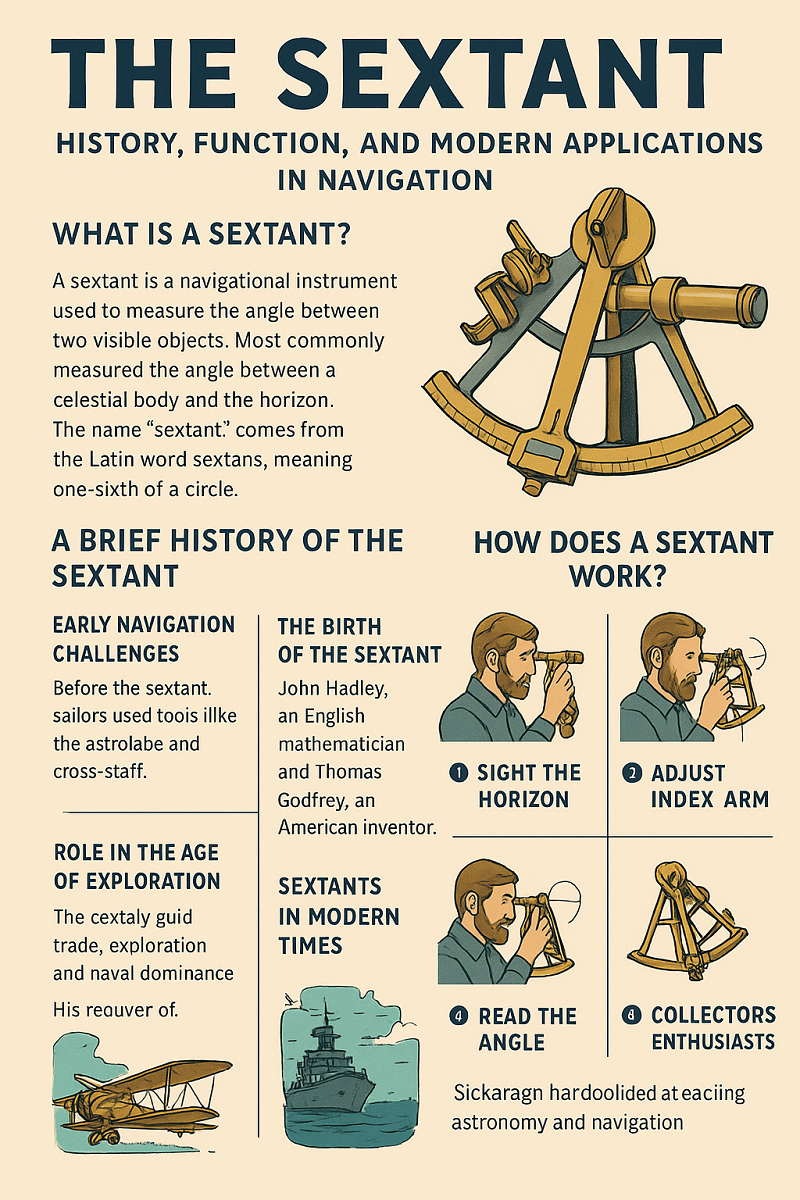
How to Use a Sextant: A Step-by-Step Overview
- Find the Horizon: Hold the sextant so that you can see the horizon clearly through the telescope.
- Locate the Celestial Body: Move the index arm until the celestial body’s reflection appears.
- Align the Images: Adjust the micrometer drum to bring the celestial body down to touch the horizon line.
- Lock and Read: Once aligned, lock the arm and read the angle measurement.
- Record Time: Accurate time is crucial, so note the exact second of observation.
- Calculate Position: Use nautical almanacs and tables to determine latitude and longitude.
This process requires skill, but with practice, navigators can achieve impressive accuracy.
The Legacy of the Sextant
The sextant is more than just a navigational instrument—it is a symbol of exploration, adventure, and human progress. It allowed humans to cross vast oceans, map the globe, and connect distant civilizations. Even in today’s high-tech world, the sextant reminds us of the brilliance of analog innovation and the spirit of discovery.
As we look toward the future of space travel, the principles of sextant navigation are even being reconsidered for deep-space missions, where GPS is not available. NASA has explored the concept of using celestial navigation techniques for astronauts traveling beyond Earth orbit.
Conclusion
The sextant remains a remarkable invention that bridged the gap between ancient navigation and modern technology. Its history, function, and applications highlight the resilience of human ingenuity. While satellites and GPS dominate modern navigation, the sextant endures as a trusted backup, a teaching tool, and a timeless symbol of exploration.
Whether used by mariners on the high seas, students of astronomy, or collectors of maritime artifacts, the sextant continues to shine as one of the greatest tools in human history.