

Capacitor Maintenance Life Expectancy ~ Capacitors are one of the most critical passive components in electronic and electrical systems. From simple power supply circuits to complex industrial automation systems, capacitors are everywhere—storing and releasing energy, filtering signals, and ensuring stability. Despite their small size, capacitors have a finite life expectancy that depends on several factors, including design, operating conditions, and maintenance practices.
This article provides a comprehensive guide on capacitor maintenance and life expectancy, exploring the science behind their durability, the factors that influence longevity, and practical ways to maximize their operational life.
1. Understanding Capacitors and Their Role
Capacitors are devices that store electrical energy in an electric field. They are made of two conductive plates separated by a dielectric material. Depending on their type and construction, capacitors serve different purposes:
- Electrolytic capacitors: Common in power supplies for smoothing voltage fluctuations.
- Ceramic capacitors: Widely used in high-frequency circuits due to low losses.
- Film capacitors: Known for stability and reliability in audio and industrial applications.
- Supercapacitors: Designed for high-capacity energy storage and fast charge-discharge cycles.
Each type has a unique life expectancy and requires different maintenance strategies.
2. Factors Affecting Capacitor Maintenance Life Expectancy
The average capacitor lifespan can range from 1,000 hours to more than 20 years, depending on design and usage. Several factors directly impact their durability:
a. Temperature
Heat is the primary enemy of capacitors. For electrolytic capacitors, every 10°C increase in operating temperature cuts life expectancy in half. Proper cooling, ventilation, or derating is essential for long-lasting performance.
b. Voltage Stress
Operating a capacitor close to or above its rated voltage accelerates dielectric breakdown. Consistently exposing capacitors to overvoltage drastically reduces their lifespan.
c. Ripple Current
In power supply circuits, capacitors handle ripple currents. Excessive ripple generates internal heating, which weakens the electrolyte or dielectric material over time.
d. Humidity and Environment
Moisture, dust, and corrosive gases can degrade capacitor materials. Sealed capacitors may withstand these conditions better, but maintenance in harsh environments is crucial.
e. Mechanical Stress
Vibrations and mechanical shocks may damage capacitor leads, solder joints, or casing, affecting reliability.
3. Typical Capacitor Lifespans by Type
Not all capacitors age equally. Their construction and materials define their life expectancy:
- Aluminum Electrolytic Capacitors: 1,000 – 10,000 hours at rated temperature. With derating and cooling, lifespan can exceed 10 years.
- Ceramic Capacitors: Very long lifespan, often over 20 years, unless exposed to mechanical stress.
- Film Capacitors: High reliability, 15 – 30 years with stable environmental conditions.
- Tantalum Capacitors: Reliable but sensitive to surge currents; lifespan can exceed 15 years.
- Supercapacitors: Typically last between 10 – 15 years or up to one million cycles, depending on usage.
4. Capacitor Failure Modes
When capacitors reach the end of their life expectancy, they exhibit several failure modes:
- Electrolyte Dry-Out (common in electrolytic capacitors)
- Increased ESR (Equivalent Series Resistance) leading to inefficiency
- Loss of Capacitance reducing energy storage ability
- Short Circuit from dielectric breakdown
- Open Circuit due to internal disconnection
Recognizing these signs early is vital to prevent system-wide failures.
5. Best Practices for Capacitor Maintenance
While capacitors are relatively low-maintenance compared to other components, proactive measures can extend their operational life significantly.
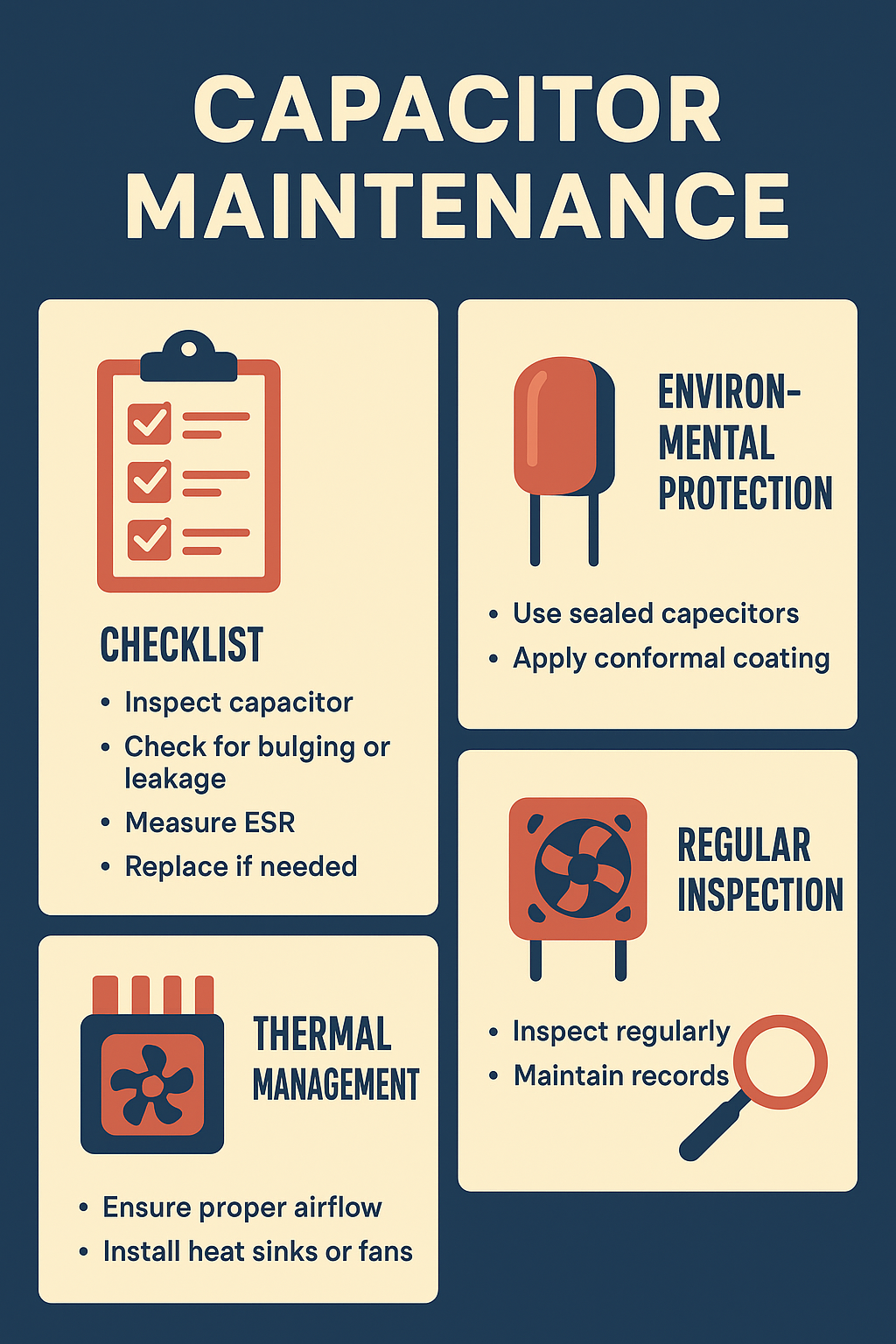
a. Regular Inspection
- Look for bulging, leaking, or discolored capacitors.
- Use ESR meters to measure performance without removing capacitors from the circuit.
b. Thermal Management
- Ensure proper airflow around capacitors.
- Install heat sinks or fans for high-power circuits.
- Place capacitors away from heat sources like transformers or resistors.
c. Voltage and Ripple Control
- Avoid running capacitors near their maximum rated voltage.
- Use capacitors with a voltage rating at least 20–30% higher than the operating voltage.
- Manage ripple currents through appropriate circuit design.
d. Preventive Replacement
- Replace capacitors nearing their rated lifespan, especially in mission-critical equipment.
- Maintain records of installation dates and estimated end-of-life timelines.
e. Environmental Protection
- Use sealed capacitors in humid or corrosive environments.
- Apply conformal coatings to protect PCB-mounted capacitors.

6. Predicting Capacitor Maintenance Life Expectancy
Manufacturers provide life expectancy ratings, often expressed in hours at a given temperature. The Arrhenius rule is commonly applied:
For every 10°C reduction in operating temperature, capacitor life expectancy doubles.
For example, a capacitor rated 2,000 hours at 105°C could last:
- 4,000 hours at 95°C
- 8,000 hours at 85°C
- 16,000 hours at 75°C
This calculation helps engineers estimate replacement schedules and design more reliable systems.
7. Applications Where Maintenance Is Critical
Capacitors are used everywhere, but in certain industries, their life expectancy directly affects system reliability and safety:
- Power Supply Units (PSUs): Aging capacitors cause unstable voltages.
- Industrial Automation: Failure can lead to costly downtime.
- Medical Equipment: Reliability is crucial for patient safety.
- Renewable Energy Systems: Solar inverters and wind turbines rely heavily on capacitors.
- Automotive Electronics: EVs and hybrids use high-performance capacitors for efficiency.
8. Extending Capacitor Maintenance Life Expectancy
To ensure capacitors reach or exceed their rated life expectancy:
- Derating: Use capacitors at 50–70% of their rated voltage and temperature.
- Quality Selection: Invest in capacitors from reputable manufacturers with proven reliability.
- Regular Testing: Implement scheduled maintenance for large-scale systems.
- System Design: Incorporate redundancy or parallel capacitors for safety.
9. Future of Capacitor Technology and Longevity
With advancements in materials science, new capacitor technologies promise longer life expectancy and improved reliability. Solid electrolytic capacitors, polymer capacitors, and graphene-based designs are extending operational lifespans while reducing failure risks.
As industries move toward automation, renewable energy, and electric vehicles, capacitors will remain critical. Enhanced durability and predictive maintenance using AI and IoT sensors will redefine how capacitors are monitored and replaced.
Conclusion of Capacitor Maintenance Life Expectancy
Capacitors, though small, are vital for reliable electronic and electrical systems. Their life expectancy depends on multiple factors, including temperature, voltage, ripple currents, and environmental conditions. With proper maintenance practices—such as thermal management, voltage derating, preventive replacement, and regular inspection—capacitors can last well beyond their rated lifespan.
By understanding capacitor maintenance and predicting life expectancy, engineers and technicians can ensure system reliability, reduce downtime, and extend equipment life. In industries where safety and performance are paramount, capacitor care is not just a recommendation—it’s a necessity.