

Introduction of Experimental Research & Development
In today’s rapidly evolving world, innovation is the lifeblood of progress. From groundbreaking technologies to advanced industrial processes, the driving force behind many of these achievements is Research and Development (R&D). Within the broader scope of R&D, one of the most impactful approaches is Experimental Research & Development (ER&D).
This branch of R&D focuses on systematic experimentation, testing, and scientific exploration to develop new products, processes, or technologies. It bridges the gap between theoretical knowledge and practical application, enabling industries, scientists, and innovators to create solutions that push boundaries.
In this article, we will explore what Experimental Research & Development is, its objectives, methodologies, importance, benefits, and real-world applications.
What is Experimental Research & Development?
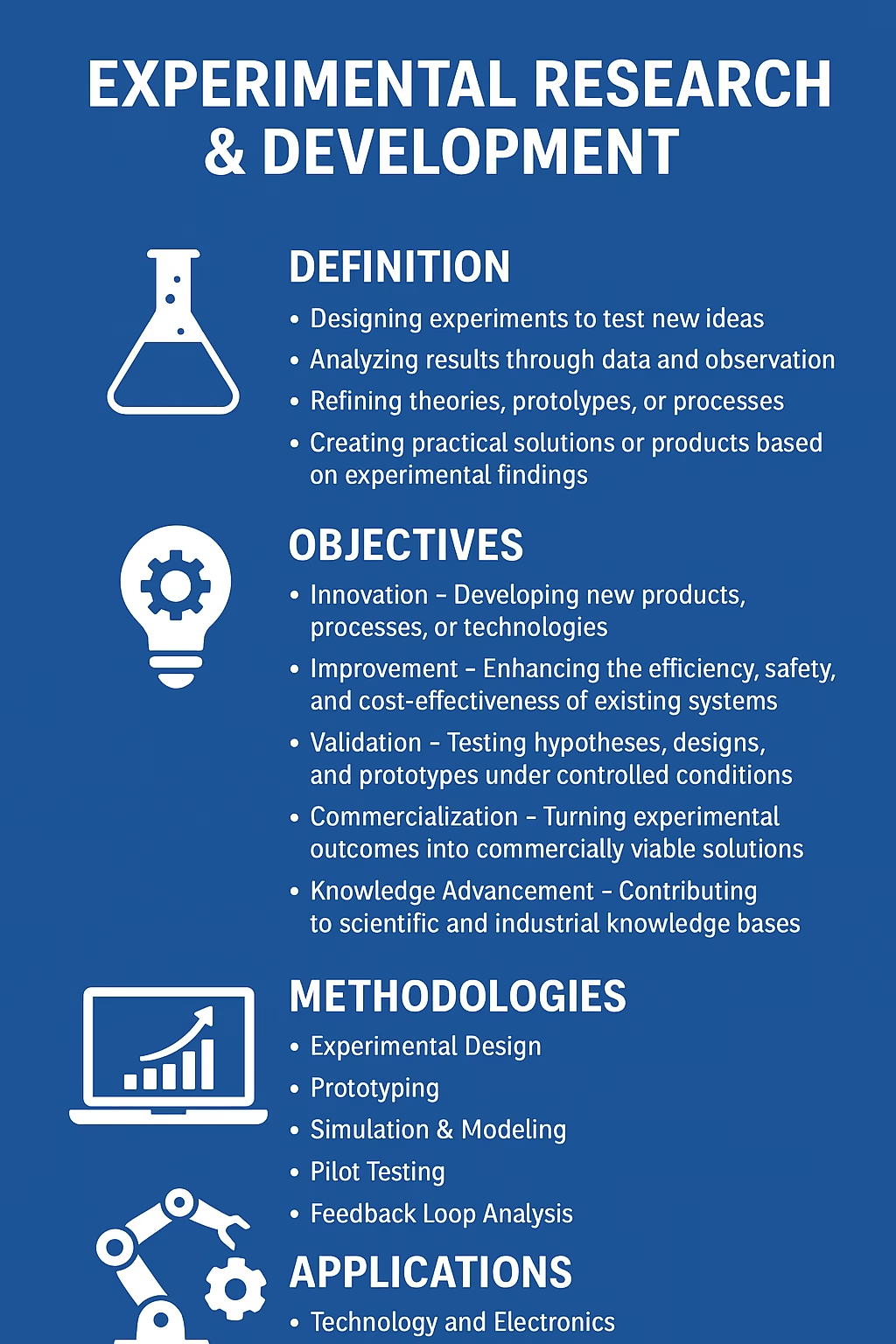
Experimental Research & Development (ER&D) is a structured process of innovation that involves:
- Designing experiments to test new ideas.
- Analyzing results through data and observation.
- Refining theories, prototypes, or processes.
- Creating practical solutions or products based on experimental findings.
Unlike basic research, which aims to expand theoretical knowledge, experimental R&D emphasizes application and implementation. It is where science meets engineering, where ideas transform into market-ready innovations.

Objectives of Experimental Research & Development
The main objectives of experimental research and development include:
- Innovation – Developing new products, processes, or technologies.
- Improvement – Enhancing the efficiency, safety, and cost-effectiveness of existing systems.
- Validation – Testing hypotheses, designs, and prototypes under controlled conditions.
- Commercialization – Turning experimental outcomes into commercially viable solutions.
- Knowledge Advancement – Contributing to scientific and industrial knowledge bases.
Key Characteristics of Experimental R&D
Experimental R&D is distinct from other forms of research. Its characteristics include:
- Controlled Experiments – Variables are carefully managed to isolate results.
- Iterative Process – Continuous testing and refinement improve accuracy and usability.
- Data-Driven – Decisions are based on measurable outcomes.
- Interdisciplinary Approach – Involves collaboration among scientists, engineers, and business experts.
- Risk and Uncertainty – Experiments often involve uncertainty, but failures provide valuable insights.
Methodologies in Experimental Research & Development
Experimental R&D employs systematic methods to ensure accurate, reliable results. Some common methodologies include:
1. Experimental Design
Developing a plan for how experiments will be conducted. This includes identifying variables, control groups, and methods of measurement.
2. Prototyping
Building early models of a product or process to test feasibility and performance.
3. Simulation & Modeling
Using digital tools to simulate real-world conditions and predict outcomes before physical testing.
4. Pilot Testing
Running small-scale trials to evaluate experimental findings in practical environments.
5. Feedback Loop Analysis
Incorporating test results back into the design process for continuous improvement.
Importance of Experimental Research & Development
Experimental R&D is critical in multiple industries because it:
- Drives Technological Advancement – Every major innovation, from semiconductors to renewable energy, stems from experiments.
- Supports Industrial Growth – Businesses use R&D to stay competitive in global markets.
- Improves Quality of Life – Innovations in healthcare, transportation, and communication improve everyday living.
- Encourages Scientific Discovery – Provides a deeper understanding of natural and engineered systems.
- Boosts Economic Development – Countries investing heavily in R&D often lead in global competitiveness.
Benefits of Experimental R&D
- Practical Innovation – Translates theory into real-world solutions.
- Market Competitiveness – Helps businesses create unique products that stand out.
- Risk Reduction – Identifies flaws early through controlled experiments.
- Cost Efficiency – Prevents large-scale failures by validating prototypes first.
- Adaptability – Encourages industries to quickly respond to technological changes.
Applications of Experimental Research & Development
Experimental R&D has vast applications across industries:
1. Technology and Electronics
- Developing semiconductors, transistors, and microprocessors.
- Testing new materials for faster and more energy-efficient devices.
2. Healthcare and Pharmaceuticals
- Conducting clinical trials for new drugs and treatments.
- Innovating medical devices like pacemakers or diagnostic tools.
3. Industrial Engineering
- Improving manufacturing processes for efficiency and sustainability.
- Experimenting with automation, robotics, and control systems.
4. Energy and Environment
- Testing renewable energy technologies such as solar panels and wind turbines.
- Developing carbon capture and green hydrogen systems.
5. Transportation and Aerospace
- Designing experimental aircraft and propulsion systems.
- Innovating electric and autonomous vehicles.
Challenges in Experimental R&D
While Experimental R&D is vital, it comes with challenges:
- High Costs – Equipment, facilities, and skilled labor require large investments.
- Time-Consuming – Experiments may take years before yielding results.
- Uncertainty of Success – Not all experiments lead to viable solutions.
- Intellectual Property Issues – Protecting discoveries is essential to avoid competition.
- Regulatory Hurdles – Especially in healthcare, strict testing protocols must be followed.
Future Trends in Experimental R&D
As technology advances, Experimental R&D is also evolving. Key trends include:
- Artificial Intelligence (AI) in Experimentation – AI accelerates data analysis and experiment design.
- Digital Twins – Virtual replicas of systems allow real-time experimental testing.
- Sustainable R&D – Focus on eco-friendly materials and energy-efficient processes.
- Collaborative Innovation – Cross-industry collaborations for faster development.
- Automation in Laboratories – Robotics streamline repetitive experimental tasks.
Conclusion of Experimental Research & Development
Experimental Research & Development is the foundation of modern innovation. It transforms abstract ideas into tangible products and processes that change industries and improve lives. Despite its challenges, the benefits far outweigh the risks, making it a crucial driver of technological, industrial, and scientific progress.
As industries face growing competition and global challenges, experimental R&D will continue to serve as a guiding light for innovation, enabling humanity to build smarter, safer, and more sustainable futures.