Introduction Definition of Automation
The term automation has become one of the most frequently discussed concepts in the modern era of technology and industry. From household appliances to industrial manufacturing systems, automation plays a central role in shaping efficiency, accuracy, and productivity. But what exactly is the definition of automation? How does it impact industries, businesses, and even our daily lives?
In this article, we will explore the meaning of automation, its historical background, the types and levels of automation, its advantages and challenges, and the real-world applications that make automation a cornerstone of today’s technological progress.
What is the Definition of Automation?
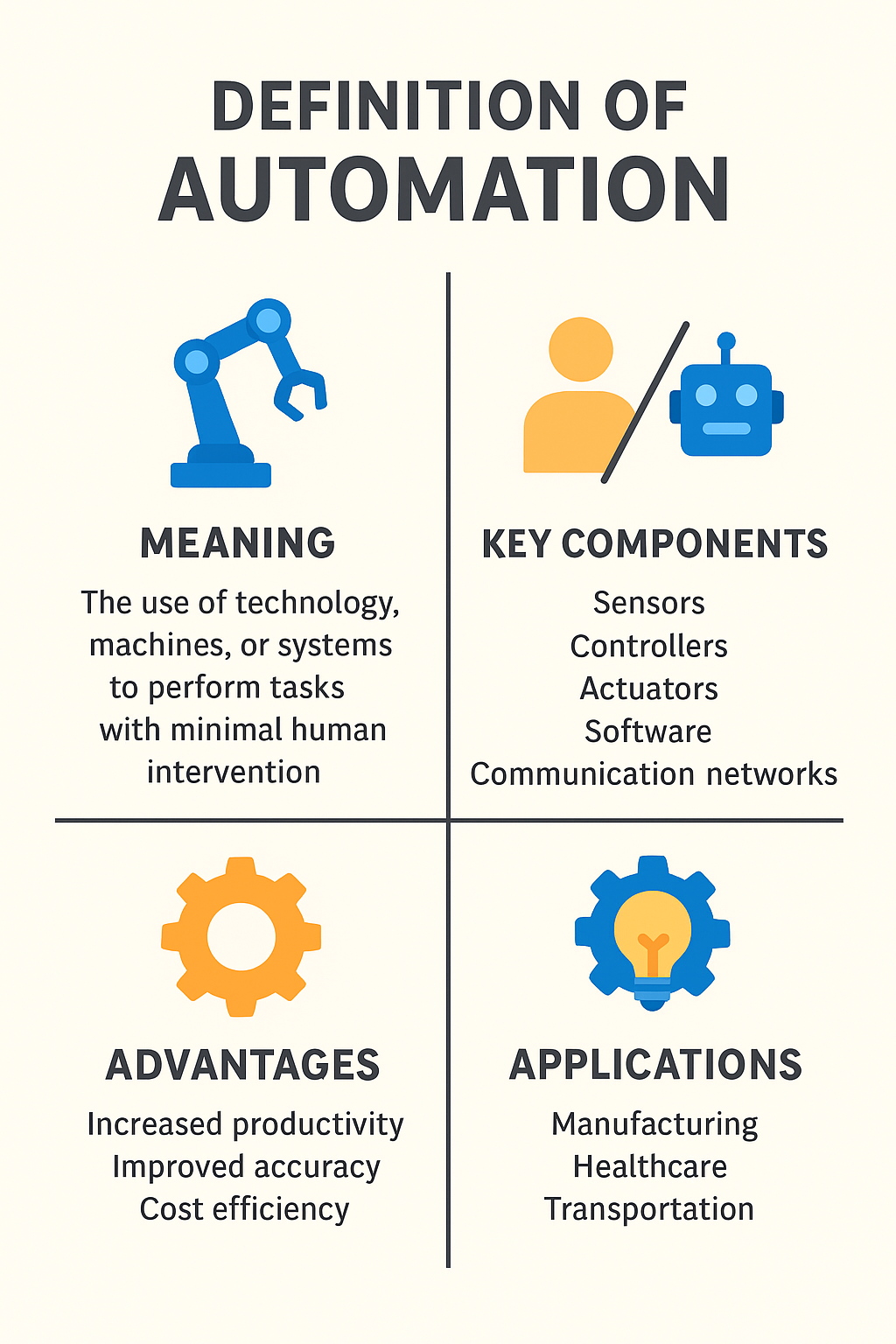
In simple terms, automation refers to the use of technology, machines, or systems to perform tasks with minimal human intervention. It is the process of replacing or supporting human labor with mechanical, electronic, or digital control systems that can function independently or semi-independently.
The word originates from the Greek term “automatos”, meaning “self-moving.” This reflects the essence of automation: systems or processes that operate automatically without constant manual input.
Formal Definition of Automation
According to industrial and technological references:
- Automation is the application of control systems, machines, and information technologies to minimize the need for human work in the production of goods and services.
In short, automation means creating systems that reduce manual effort, increase accuracy, and enhance productivity.
A Brief History of Automation
Automation is not entirely a modern concept. It has roots that stretch back centuries.
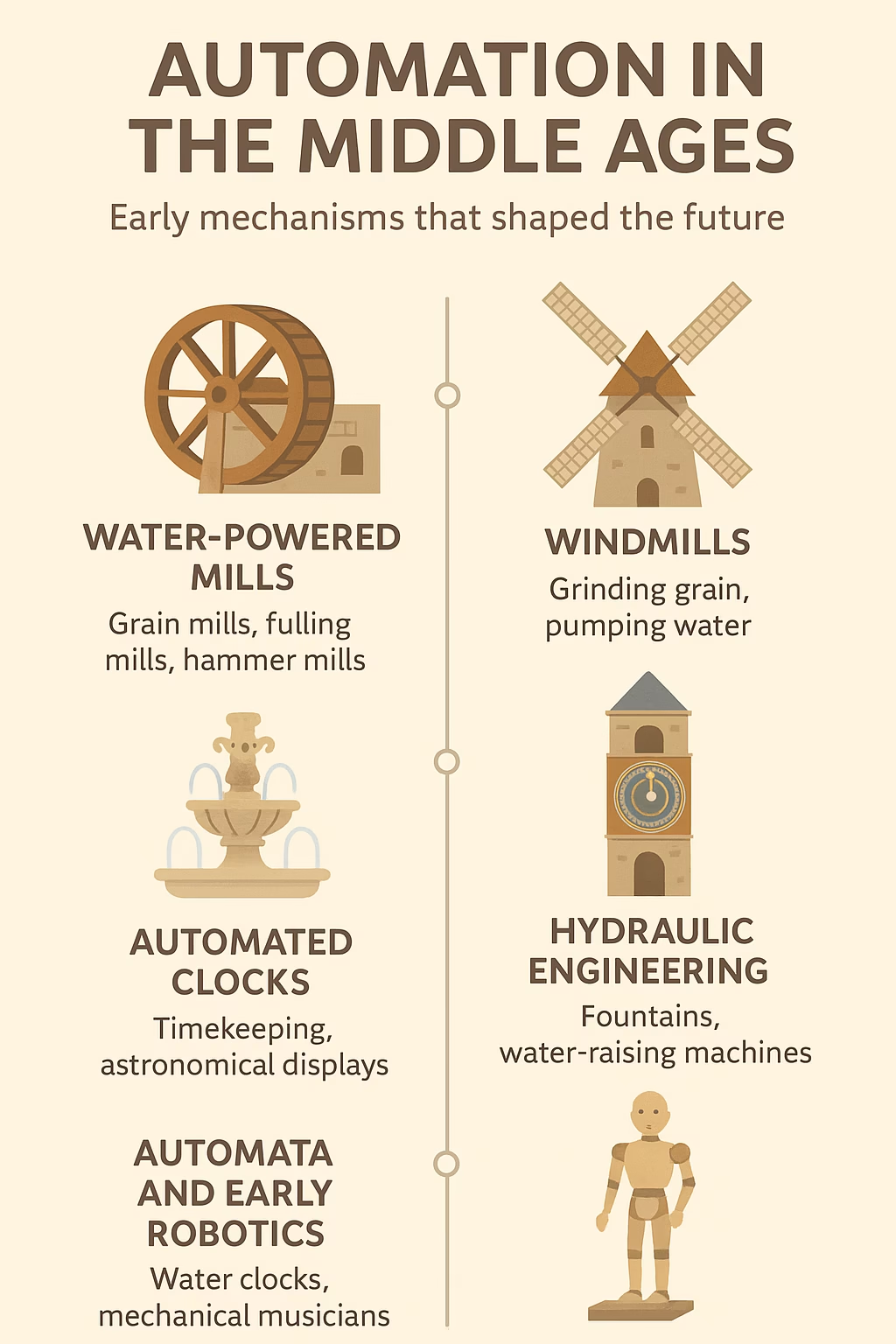
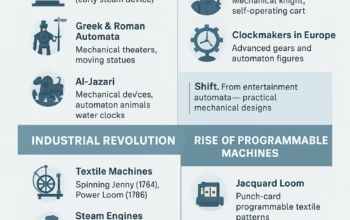
- Ancient Times: The earliest forms of automation were mechanical devices like water clocks and simple machinery.
- Industrial Revolution (18th–19th Century): Steam engines and textile machines marked the beginning of large-scale automation in industry.
- 20th Century: The introduction of assembly lines by Henry Ford and the development of control systems (such as relays and sensors) shaped modern industrial automation.
- Digital Age (20th–21st Century): Computers, robotics, and artificial intelligence expanded automation into areas such as manufacturing, finance, healthcare, and even smart homes.
Today, automation is evolving faster than ever, driven by artificial intelligence (AI), machine learning (ML), robotics, and the Internet of Things (IoT).
Read More: Brief History of Automation: From Ancient Innovations to Modern Industry
Types of Automation
Automation is not a one-size-fits-all concept. It can be categorized into several types depending on the complexity, scope, and purpose.
1. Fixed Automation
- Also called hard automation.
- Designed for high-volume production of a single product.
- Example: Automobile assembly lines.
2. Programmable Automation
- Used where production volume is medium and products may vary.
- Machines can be reprogrammed for new tasks.
- Example: Batch processing in chemical plants.
3. Flexible Automation
- Allows rapid adjustment between different product types.
- Useful in industries that require customization.
- Example: Computer-controlled machine tools.
4. Industrial Automation
- The use of control systems like PLCs (Programmable Logic Controllers), SCADA, and robotics in industrial processes.
5. Office and Business Process Automation
- Software and digital tools that automate repetitive tasks in business.
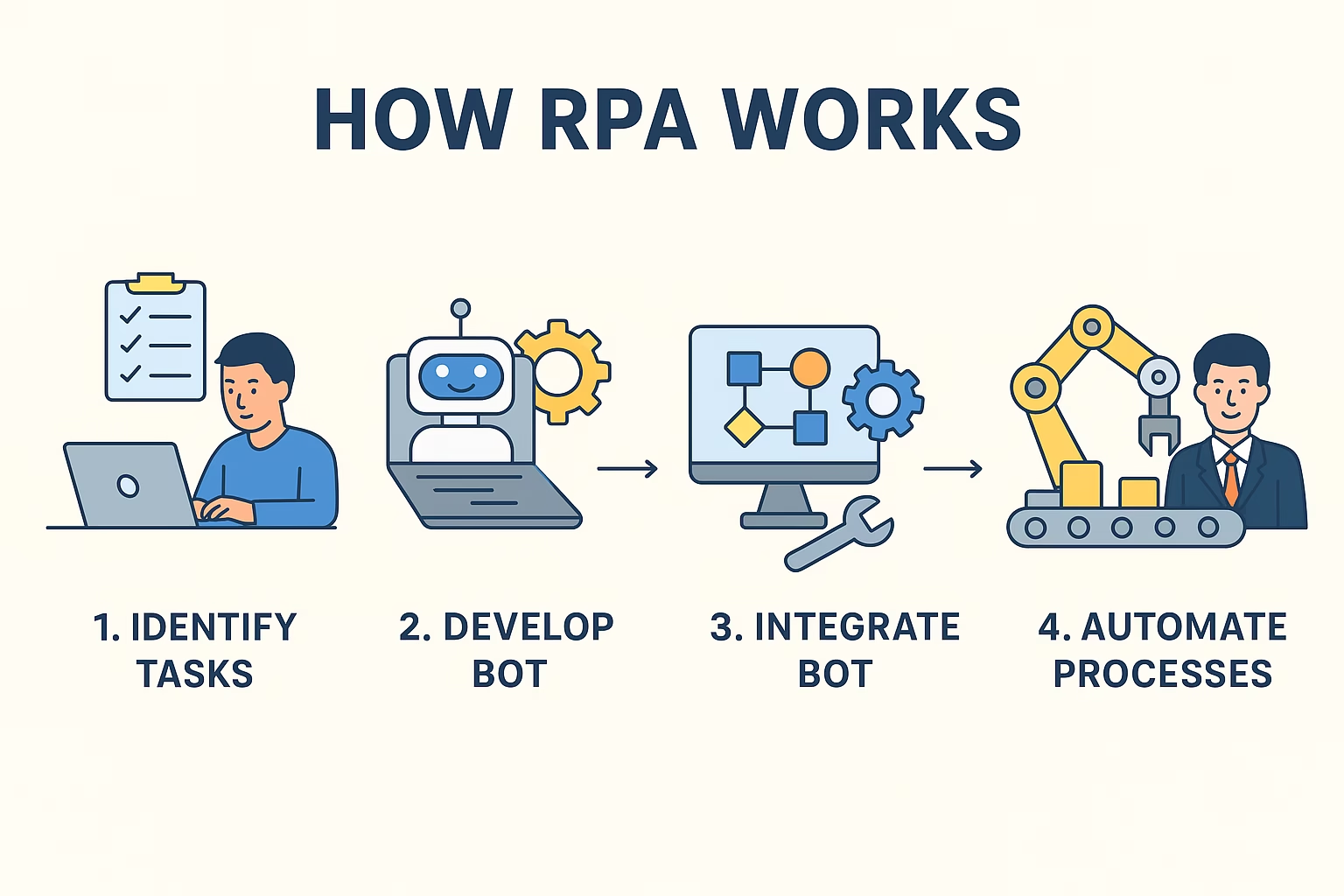
- Example: Data entry automation, chatbots, and robotic process automation (RPA).
Read More: Types of Automation: A Comprehensive Guide to Modern Applications
Key Components of Automation
To fully understand the definition of automation, it is important to look at its key elements:
- Sensors: Detect physical quantities like temperature, pressure, or motion.
- Controllers: Devices like PLCs or microcontrollers that process input data.
- Actuators: Components that perform mechanical actions (motors, valves, etc.).
- Software: Programs that control automation systems.
- Communication Networks: Allow systems to exchange data (e.g., IoT, industrial networks).
Read More: Components of Automation: Building Blocks of Modern Industrial Systems
Advantages of Automation
Automation brings a wide range of benefits across industries and society:
- Increased Productivity – Machines can work continuously without fatigue.
- Improved Accuracy and Consistency – Reduced human error leads to higher-quality outcomes.
- Cost Efficiency – Long-term cost savings due to reduced labor and waste.
- Safety Enhancement – Automation reduces human involvement in dangerous environments.
- Flexibility and Scalability – Advanced automation systems can adapt to changing needs.
Read More: Advantages of Automation: Transforming Industries and Daily Life
Challenges and Disadvantages of Automation
While automation offers tremendous benefits, it also comes with challenges:
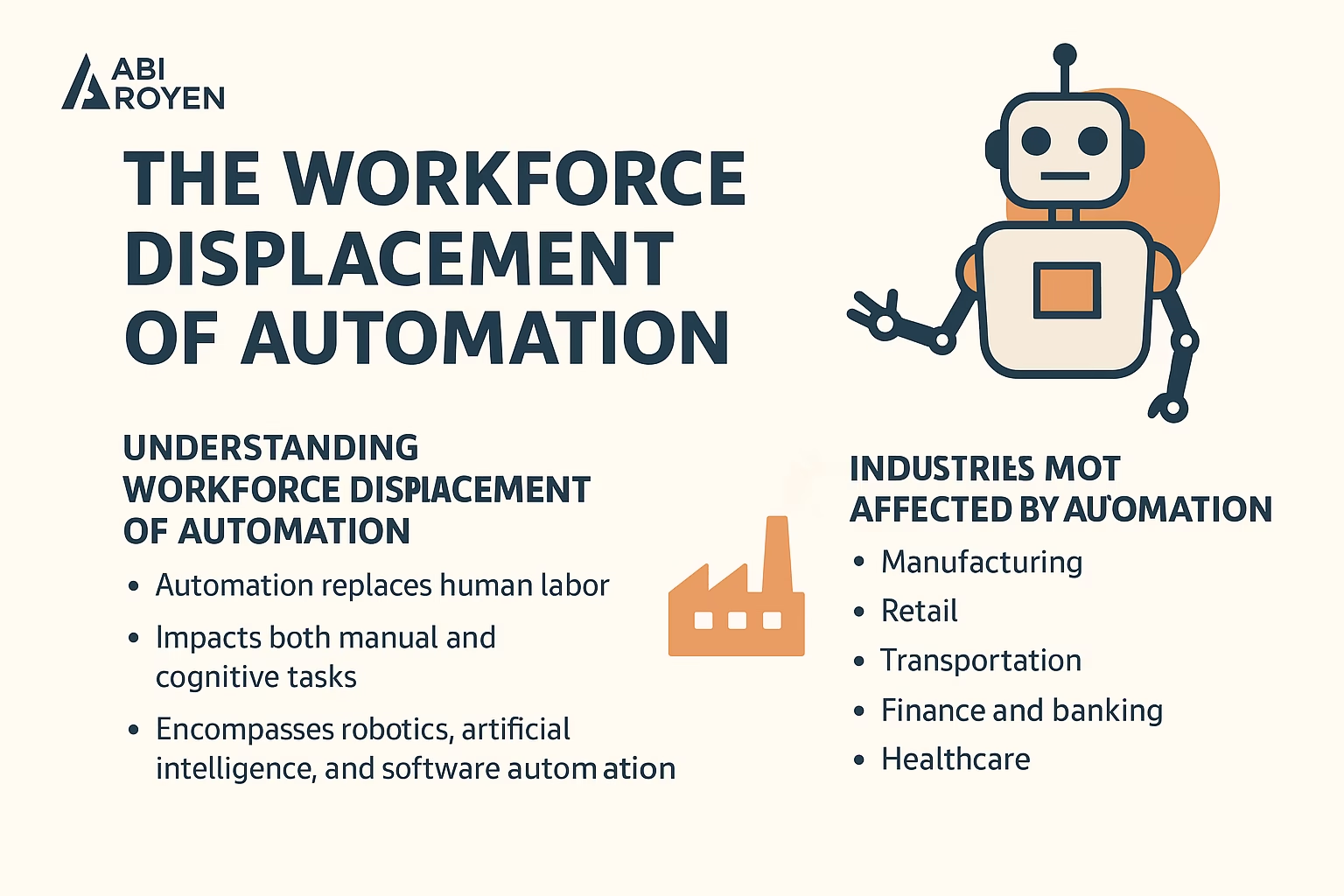
- Job Displacement – Some roles become obsolete, leading to workforce restructuring.
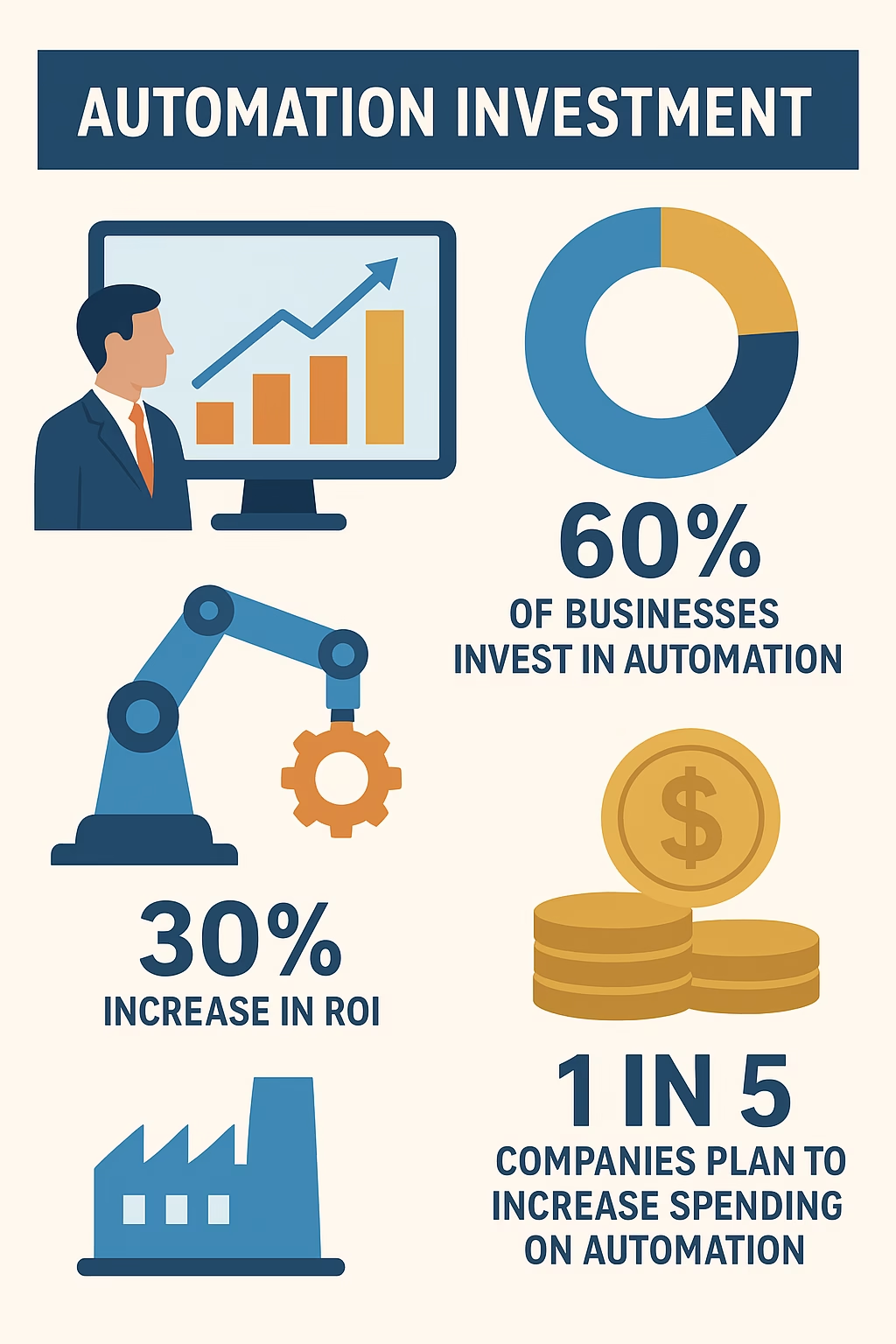
- High Initial Costs – Advanced automation systems require significant investment.
- Maintenance and Technical Expertise – Requires skilled professionals to operate and maintain.
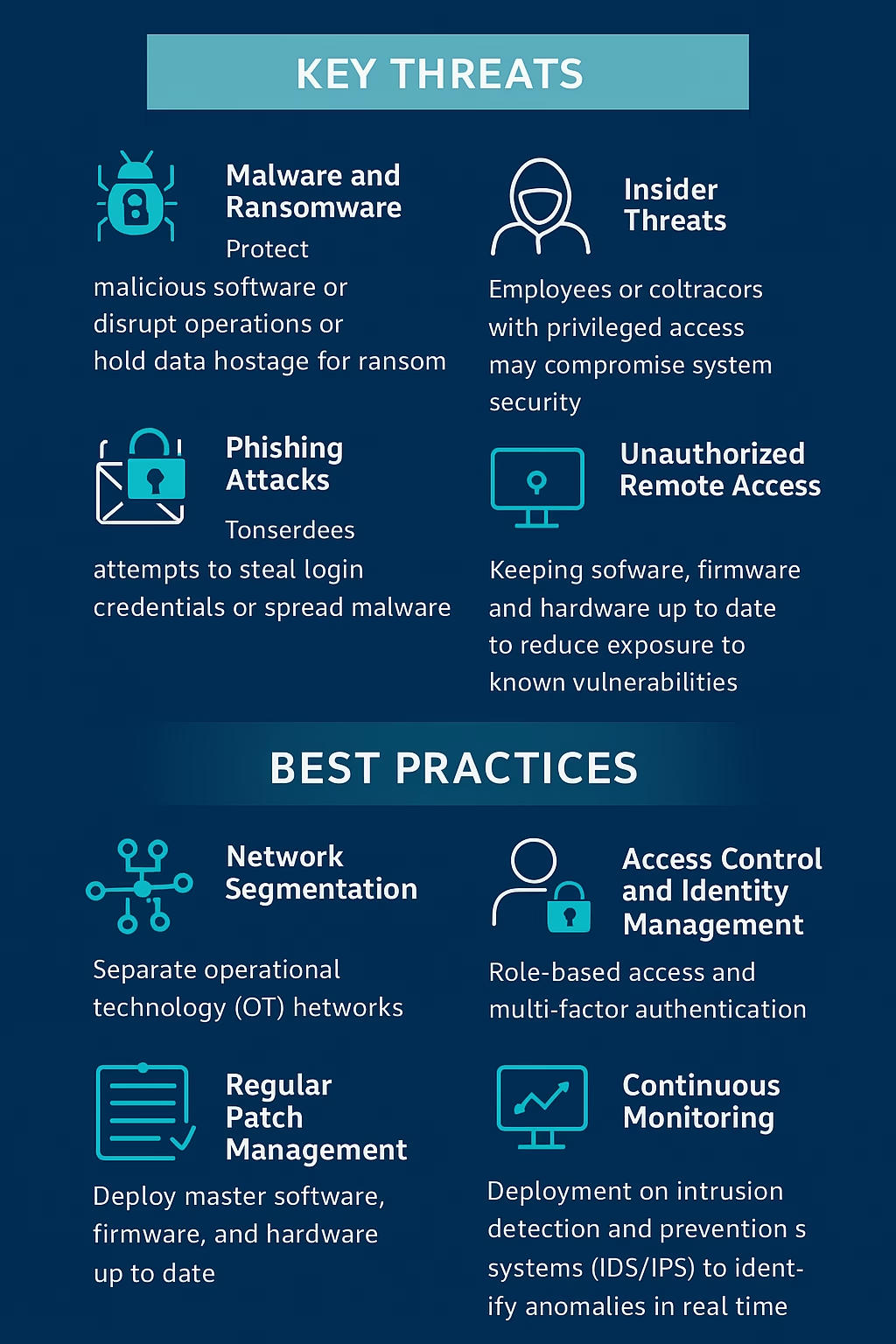
- Cybersecurity Risks – Digital automation systems may be vulnerable to hacking.
Read More: Challenges of Automation: Overcoming Barriers in the Modern Era

Applications of Automation
Automation has penetrated almost every aspect of modern life:
- Manufacturing: Robotics, CNC machines, and automated assembly lines.
- Healthcare: Automated diagnostic tools, robotic surgery, and smart medical devices.
- Transportation: Autonomous vehicles, smart traffic systems, and logistics management.
- Energy: Automated power plants, renewable energy monitoring, and grid management.
- Business Processes: Robotic Process Automation (RPA) for repetitive office tasks.
- Smart Homes: Voice-controlled assistants, smart thermostats, and automated lighting.
Read More: Exploring the Applications of Automation in Modern Industries
Future of Automation
The future of automation is closely tied to the advancement of AI, robotics, and digital transformation. In the coming years, we will see:
- More integration of AI in decision-making.
- Widespread use of collaborative robots (cobots) in workplaces.
- Expansion of smart factories in the era of Industry 4.0.
- Growth in service automation, from customer support to financial systems.
Automation will not only continue to reshape industries but also redefine the relationship between humans and technology.
Read More: Future Trends in Automation: Shaping the Next Industrial Revolution
Conclusion of Definition of Automation
The definition of automation extends beyond just machines and systems—it represents a paradigm shift in how humans interact with technology. From its historical roots to its modern applications, automation has proven to be a critical driver of efficiency, innovation, and progress.
Whether in manufacturing, healthcare, or everyday household use, automation continues to evolve and expand its role in our lives. By understanding its meaning, benefits, and challenges, businesses and individuals can better prepare for the future where automation and human intelligence will work hand in hand.