Introduction of Brief History of Automation
Brief History of Automation ~ Automation has become a defining feature of the modern world, revolutionizing industries, reshaping economies, and altering the way humans live and work. However, the concept of automation is not a product of the digital age alone—it has deep historical roots stretching back thousands of years. From the earliest mechanical devices in ancient civilizations to today’s cutting-edge robotics and artificial intelligence (AI), automation has evolved as a response to humanity’s constant drive for efficiency, productivity, and convenience.
This article explores the brief history of automation, tracing its journey across time and highlighting the key milestones that have transformed it into the sophisticated systems we know today.
Early Beginnings of Automation in Ancient Civilizations
The story of automation begins in antiquity, when inventors and engineers first experimented with mechanical devices designed to reduce human effort.
- Water Clocks and Automata (c. 270 BC)
One of the earliest examples of automated systems was the water clock, developed in ancient Egypt and Greece. These devices regulated the flow of water to measure time, functioning without direct human intervention.
Greek engineer Ctesibius of Alexandria later improved these mechanisms, laying the foundation for automated timekeeping. - Hero of Alexandria (10–70 AD)
Hero, a Greek mathematician and engineer, created some of the earliest known automata—mechanical devices that moved on their own using steam, water, or air pressure. His inventions included self-opening temple doors, coin-operated machines, and theatrical robots, demonstrating the potential of machines to perform tasks automatically. - Chinese Innovations
Ancient China also contributed to automation with remarkable inventions such as the mechanical clock (by Yi Xing in 725 AD) and automated puppets, proving that diverse cultures were exploring the possibilities of mechanical automation.
These early innovations, while simple compared to modern machines, reflected humanity’s enduring desire to replicate and extend human capabilities through technology.
Automation in the Middle Ages and Renaissance
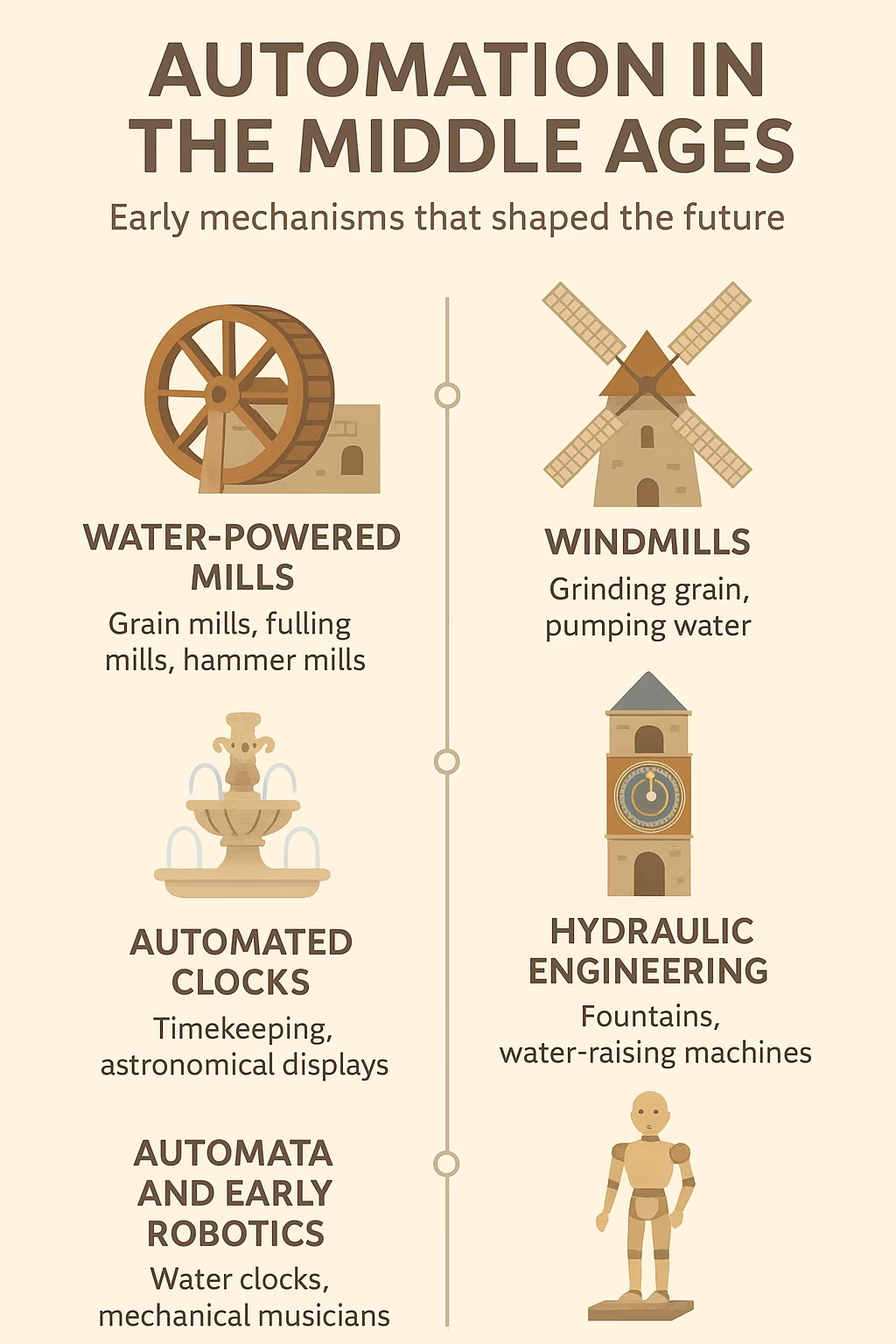
The Middle Ages and Renaissance marked an era of technological progress in Europe and the Islamic world.
- Islamic Golden Age (8th–13th centuries)
Scholars such as Al-Jazari, often called the “father of robotics,” designed intricate mechanical devices like water-raising machines, automated fountains, and programmable humanoid automata. His Book of Knowledge of Ingenious Mechanical Devices (1206) remains one of the most important works in the history of engineering. - Mechanical Clocks and Mills
By the 14th century, mechanical clocks spread across Europe, showcasing precision engineering. Meanwhile, windmills and watermills automated grain grinding and irrigation tasks, reducing manual labor in agriculture. - Renaissance Engineering (15th–16th centuries)
Visionaries like Leonardo da Vinci designed early concepts of mechanical robots and self-propelled carts. Although many remained theoretical, da Vinci’s sketches inspired future generations of engineers to push the boundaries of what machines could achieve.
This period laid the groundwork for the Industrial Revolution, where automation would truly begin to reshape society on a massive scale.
The Industrial Revolution: The Birth of Modern Automation
The 18th and 19th centuries ushered in the Industrial Revolution, a turning point in the history of automation. This era saw the introduction of mechanized production, powered first by steam engines and later by electricity.
- Textile Industry
One of the earliest industries to embrace automation was textiles. The spinning jenny (1764), invented by James Hargreaves, and the power loom (1785), developed by Edmund Cartwright, transformed fabric production. These machines drastically increased output and reduced the need for manual labor. - Steam Engines and Factories
James Watt’s improvements to the steam engine revolutionized manufacturing, transportation, and agriculture. Factories equipped with automated machinery became the backbone of industrial economies. - Control Mechanisms
Automation also advanced through innovations in control systems. James Watt introduced the flyball governor, an early feedback control device that automatically regulated steam engine speed—an essential step toward modern automation systems.
The Industrial Revolution marked the transition from manual craftsmanship to mechanized mass production, setting the stage for the modern concept of automation.
20th Century: The Rise of Industrial Automation
The 20th century witnessed the most significant leaps in automation, driven by electricity, electronics, and computing.
- Assembly Line Production
In 1913, Henry Ford revolutionized manufacturing with the moving assembly line, drastically reducing car production time. This model of mass production inspired industries worldwide. - Programmable Machines and Numerical Control (1940s–1950s)
The development of numerical control (NC) allowed machines to follow coded instructions, leading to the first programmable machine tools. This innovation paved the way for computer numerical control (CNC) systems, still widely used today. - Industrial Robots (1960s)
In 1961, the Unimate robot, developed by George Devol and Joseph Engelberger, became the first industrial robot used in manufacturing. It was employed in General Motors’ factories to handle hot metal parts, marking the beginning of robotic automation in industry. - Electronics and Control Systems
The spread of transistors, microprocessors, and digital controllers transformed automation. Industries adopted programmable logic controllers (PLCs) in the 1960s and 1970s, revolutionizing automated factory operations.
By the end of the 20th century, automation was no longer limited to manufacturing but had expanded into transportation, healthcare, agriculture, and daily life.

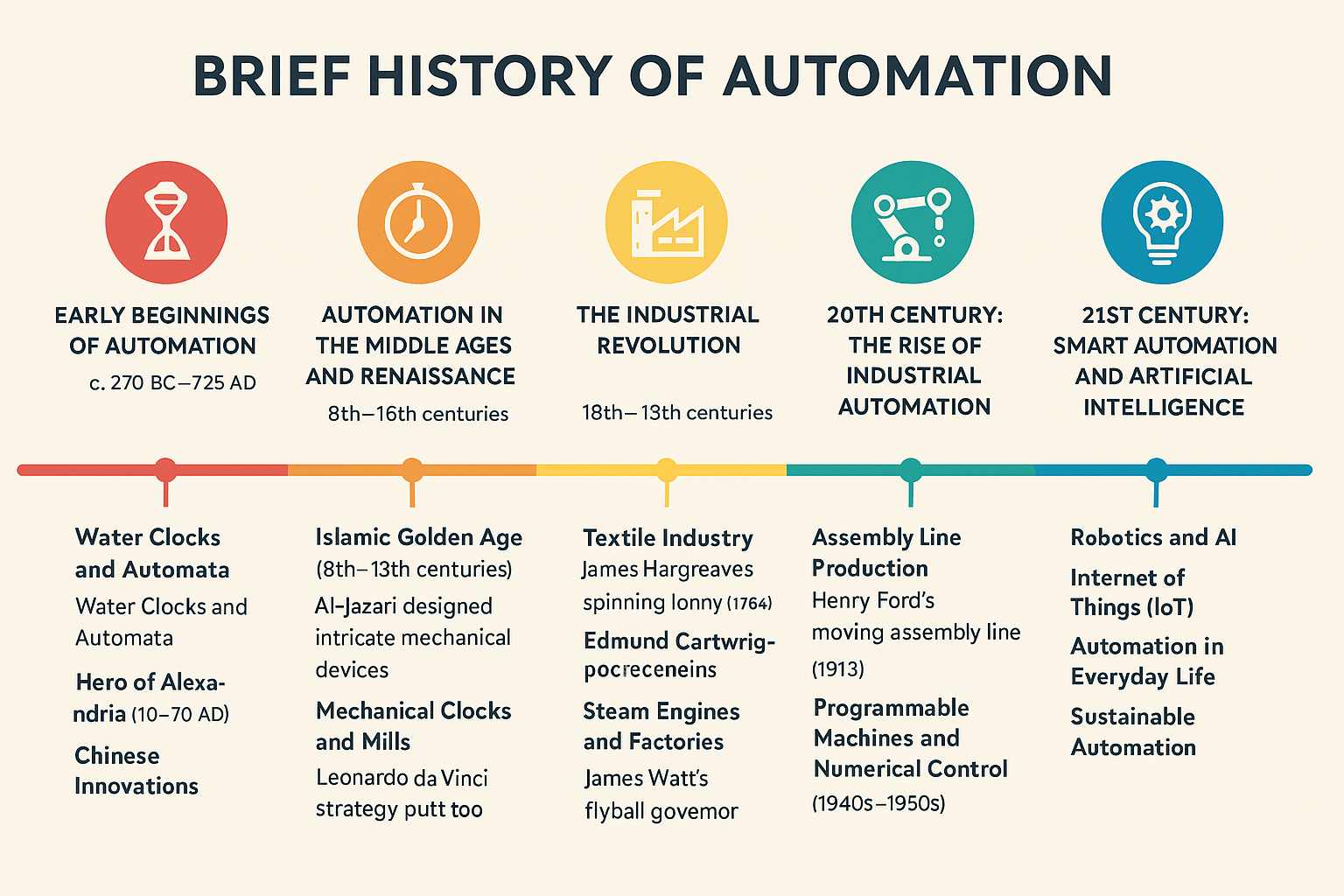
21st Century: Smart Automation and Artificial Intelligence
The 21st century has brought a new era of automation, defined by intelligent systems, connectivity, and data-driven technologies.
- Robotics and AI
Modern robots are no longer just mechanical arms; they are equipped with sensors, machine vision, and AI algorithms that enable them to learn and adapt. Collaborative robots (cobots) now work safely alongside humans in factories and warehouses. - Internet of Things (IoT)
Connected devices form smart factories, where machines communicate with each other, optimize processes, and predict maintenance needs. This marks the rise of Industry 4.0. - Automation in Everyday Life
From smart homes and autonomous vehicles to AI-powered virtual assistants, automation now impacts daily human life more than ever before. - Sustainable Automation
Today, industries also focus on green automation, designing systems that optimize energy use and reduce environmental impact.
The future of automation promises even greater integration of AI, robotics, and human-machine collaboration, pushing the boundaries of innovation.
Conclusion of Brief History of Automation
The history of automation reflects humanity’s continuous pursuit of efficiency, precision, and innovation. From the ancient water clocks and automata of Greece and China to the powerful robots and AI-driven systems of today, automation has evolved into a transformative force shaping every aspect of modern life.
Understanding its historical roots allows us to appreciate the technological journey that brought us here and anticipate the exciting possibilities of the future. As automation continues to advance, it will not only redefine industries but also influence how humans interact with technology and the world around them.