



What is Automation? ~ Automation has become one of the most transformative forces shaping industries, businesses, and daily life. From manufacturing robots and self-driving cars to software that streamlines business operations, automation is everywhere. But what exactly is automation, and why does it matter so much in the digital era?
This article will explore the definition of automation, its types, benefits, challenges, and applications, giving you a complete understanding of its role in modern technology.
Definition of Automation
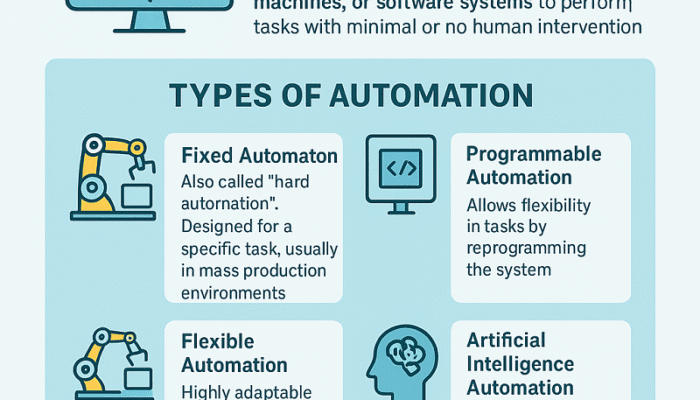
Automation refers to the use of technology, machines, or software systems to perform tasks with minimal or no human intervention. The primary goal of automation is to increase efficiency, improve accuracy, reduce costs, and free humans from repetitive or dangerous tasks.
In simple terms, automation allows processes to run on their own with limited supervision. This can range from a factory machine assembling parts to advanced artificial intelligence (AI) systems managing data-driven decisions.
Read More: Definition of Automation: Meaning, Scope, and Applications
Brief History of Automation
The concept of automation is not entirely new. Humans have always sought ways to make tasks easier and faster.
- 18th Century: The Industrial Revolution introduced mechanical automation such as textile machines and steam engines.
- 20th Century: Assembly lines, pioneered by Henry Ford, revolutionized mass production.
- Late 20th Century: Computers and robotics accelerated automation across industries.
- 21st Century: The rise of AI, machine learning, and the Internet of Things (IoT) has taken automation to new levels, enabling smart factories, digital assistants, and autonomous vehicles.
Read More: Brief History of Automation: From Ancient Innovations to Modern Industry
Types of Automation
Automation comes in different forms depending on its purpose and complexity:
1. Fixed Automation
- Also called “hard automation.”
- Designed for a specific task, usually in mass production environments.
- Example: Assembly line machines in car manufacturing.
2. Programmable Automation
- Allows flexibility in tasks by reprogramming the system.
- Example: CNC machines that can be programmed to cut different shapes.
3. Flexible Automation
- Highly adaptable systems that can handle multiple tasks with minimal changeover time.
- Example: Robotic arms in manufacturing that can switch between different product lines.
4. Industrial Automation
- Uses robotics, sensors, and control systems to automate factory processes.
- Example: Smart factories powered by IoT and AI.
5. Business Process Automation (BPA)
- Focuses on automating repetitive business tasks.
- Example: Software that automates payroll, customer service chatbots, or data entry.
6. IT and Software Automation
- Automates computing tasks such as server management, cybersecurity, and cloud operations.
- Example: Automated backup systems or continuous integration in software development.
7. Artificial Intelligence Automation
- The most advanced type of automation.
- AI systems learn from data and make intelligent decisions.
- Example: Self-driving cars, predictive maintenance systems, AI-driven customer support.
Read More: Types of Automation: A Comprehensive Guide to Modern Applications
Benefits of Automation
Automation brings numerous advantages across industries and everyday life:
- Increased Efficiency – Tasks are completed faster than manual methods.
- Improved Accuracy – Reduces human errors in production and data management.
- Cost Savings – Lower labor costs and reduced operational expenses.
- Enhanced Safety – Removes humans from dangerous work environments.
- Scalability – Businesses can expand without significant increases in workforce.
- 24/7 Operations – Machines and software can run continuously without fatigue.
- Better Quality Control – Consistent results lead to higher product quality.
- Employee Productivity – Workers focus on creative and strategic tasks rather than repetitive ones.
Read More: The Benefits of Automation: Transforming Industries and Daily Life
Challenges of Automation
While automation offers many benefits, it also presents certain challenges:
- Job Displacement: Many fear automation may replace human workers in repetitive jobs.
- High Initial Costs: Implementing automation systems requires significant investment.
- Complexity: Advanced automation systems can be difficult to maintain and program.
- Cybersecurity Risks: As more systems become connected, they are vulnerable to cyberattacks.
- Ethical Concerns: Decisions made by AI-driven automation raise questions about responsibility and fairness.
Read More: Challenges of Automation: Overcoming Barriers in the Modern Era
Applications of Automation
Automation is widely applied across multiple sectors:
1. Manufacturing
- Robotics, assembly lines, and quality control systems.
- Example: Car manufacturing plants using robotic arms.
2. Healthcare
- Automated diagnostics, robotic surgery, and digital patient monitoring.
- Example: AI tools analyzing medical imaging for faster diagnosis.
3. Transportation
- Self-driving cars, automated traffic systems, and drones.
- Example: Tesla’s autopilot technology.
4. Business and Finance
- Chatbots, automated billing, and fraud detection systems.
- Example: Online banks using AI to detect unusual transactions.
5. Agriculture
- Smart irrigation, autonomous tractors, and crop monitoring drones.
- Example: Precision farming using IoT sensors.
6. Smart Homes
- Home automation systems controlling lighting, heating, and security.
- Example: Devices like Google Nest or Amazon Alexa.
7. IT and Cybersecurity
- Automated software updates, threat detection, and cloud management.
- Example: Automated malware detection systems.
Read More: Exploring the Applications of Automation in Modern Industries

The Future of Automation
The future of automation is deeply tied to emerging technologies such as artificial intelligence, machine learning, robotics, and the Internet of Things (IoT).
In the coming decades, we can expect:
- Fully autonomous factories with minimal human supervision.
- Widespread adoption of self-driving vehicles.
- Smarter cities with automated energy and traffic systems.
- Personalized customer service driven by AI.
- Expansion of automation in education, agriculture, and healthcare.
Rather than replacing humans entirely, automation is expected to augment human abilities, allowing workers to focus on innovation, creativity, and problem-solving.
Read More: Future Trends in Automation: Shaping the Next Industrial Revolution
Conclusion of What is Automation?
Automation is more than just machines replacing human labor—it is a fundamental shift in how tasks, industries, and societies operate. From simple repetitive tasks to advanced AI-driven decision-making, automation is shaping the future of work, business, and daily life.
By understanding what automation is, its types, benefits, and challenges, we can better prepare for a future where humans and technology work hand in hand to create smarter, safer, and more efficient systems.