1. Introduction to Thermocouples Type N
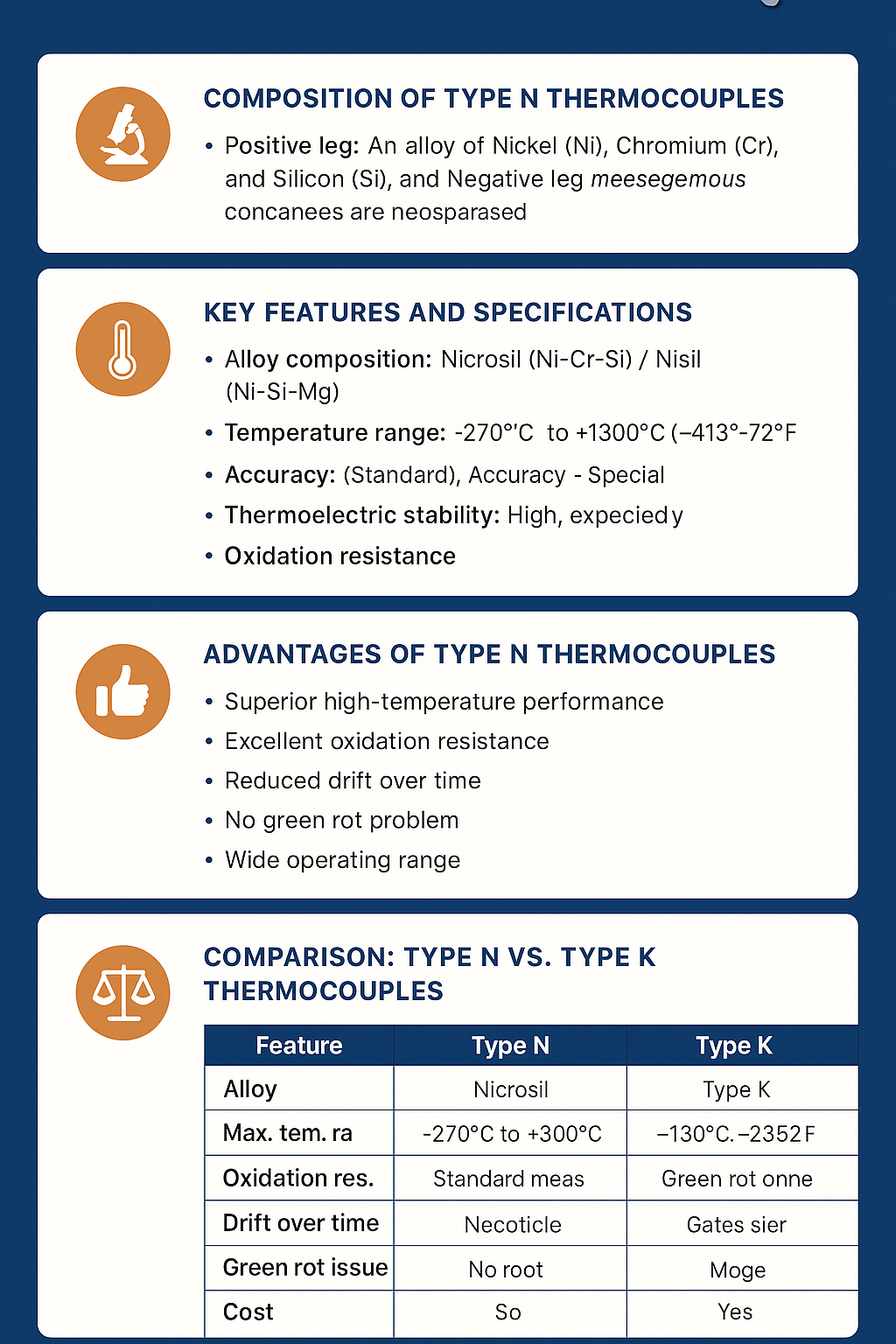
Thermocouples Type N ~ Thermocouples are essential devices in industrial and laboratory temperature measurement. Among the various types, the Type N thermocouple, made from Nicrosil (Nickel-Chromium-Silicon) as the positive leg and Nisil (Nickel-Silicon-Magnesium) as the negative leg, has gained recognition for its superior performance in high-temperature and corrosive environments.
Developed as an improvement over the widely used Type K thermocouple, the Type N offers better stability, resistance to oxidation, and extended lifespan under demanding conditions. It is particularly popular in industries that require continuous, reliable temperature monitoring.
2. Composition of Thermocouples Type N
- Positive Leg (Nicrosil): An alloy of Nickel (Ni), Chromium (Cr), and Silicon (Si).
- Negative Leg (Nisil): An alloy of Nickel (Ni), Silicon (Si), and Magnesium (Mg).
This composition provides the Type N thermocouple with exceptional resistance to drift and degradation even when exposed to prolonged high-temperature operations.
3. Key Features and Specifications
| Parameter | Specification |
|---|---|
| Alloy Composition | Nicrosil (Ni-Cr-Si) / Nisil (Ni-Si-Mg) |
| Temperature Range | -270°C to +1300°C (-454°F to +2372°F) |
| Accuracy (Standard) | ±2.2°C or ±0.75% |
| Accuracy (Special) | ±1.1°C or ±0.4% |
| Thermoelectric Stability | Excellent at high temperatures |
| Oxidation Resistance | High, especially in oxidizing atmospheres |
4. Advantages of Thermocouples Type N
- Superior High-Temperature Performance
Unlike Type K, the Type N thermocouple is more stable at temperatures above 1000°C, reducing drift and ensuring accurate readings. - Excellent Oxidation Resistance
The silicon and magnesium content enhances its resistance to oxidation, even in oxygen-rich environments. - Reduced Drift Over Time
Type N thermocouples maintain accuracy longer, minimizing recalibration needs. - No Green Rot Problem
Unlike Type K, which suffers from “green rot” in certain conditions, Type N is immune to this degradation. - Wide Operating Range
Suitable for cryogenic applications as well as extreme high-temperature monitoring.
5. Common Applications
Type N thermocouples are widely used in industries where long-term stability and high-temperature endurance are crucial:
- Aerospace Industry: Engine testing and turbine monitoring.
- Metallurgy: Furnace temperature control and steel production.
- Power Generation: Gas turbine exhaust monitoring.
- Petrochemical Industry: Reactor temperature measurement.
- Ceramics and Glass Manufacturing: Kiln and melting furnace control.
- Scientific Research: High-temperature laboratory experiments.

6. Comparison: Thermocouples Type N vs. Type K Thermocouples
| Feature | Type N | Type K |
|---|---|---|
| Alloy | Nicrosil / Nisil | Nickel-Chromium / Nickel-Aluminium |
| Max Temp Range | ~1300°C | ~1260°C |
| Oxidation Resistance | Higher | Moderate |
| Drift Over Time | Lower | Higher |
| Green Rot Issue | No | Yes |
| Cost | Slightly higher | Lower |
The small cost difference is often outweighed by the extended lifespan and reduced maintenance requirements of Type N thermocouples.
7. Installation Guidelines
To ensure accurate and reliable readings, follow these best practices when installing a Type N thermocouple:
- Use Proper Sheathing: Choose materials such as Inconel or stainless steel for high-temperature and corrosive environments.
- Avoid Mechanical Stress: Bending the thermocouple wire excessively can cause signal errors.
- Minimize Electrical Noise: Use shielded cables and proper grounding.
- Calibrate Periodically: Although drift is minimal, periodic calibration ensures optimal performance.
8. Maintenance and Longevity Tips
- Keep thermocouples clean from deposits or corrosion.
- Replace damaged or worn-out insulation.
- Store spare thermocouples in a dry, clean environment.
- Avoid exposure to reducing atmospheres for prolonged periods unless specifically designed for them.
9. Selecting the Right Thermocouples Type N
When selecting a Type N thermocouple for your application, consider:
- Temperature Range – Match with your process requirements.
- Sheath Material – Choose based on the environment (oxidizing, reducing, or inert).
- Accuracy Class – Standard or special limits of error.
- Probe Design – Bare wire, grounded, or ungrounded junction.
- Lead Wire Insulation – Fiberglass for high temperatures, Teflon for chemical resistance.
10. Conclusion
Thermocouples Type N (Nicrosil / Nisil) are a reliable, accurate, and long-lasting solution for temperature measurement in challenging industrial environments. Their high oxidation resistance, superior stability, and immunity to green rot make them an excellent alternative to Type K thermocouples, especially in high-temperature operations.
Whether you are in aerospace, metallurgy, power generation, or research, Type N thermocouples can help ensure that your temperature monitoring is both accurate and durable, reducing maintenance costs and increasing operational efficiency.
Published on: AbiRoyen.com
Author: Abi Royen – Industrial Instrumentation Insights