

Introduction
Thermocouples type R ~ In industrial processes where extreme precision and durability are essential, thermocouples are one of the most reliable temperature sensing devices. Among the various types, the Type R thermocouple—made from Platinum and Rhodium alloys—is specifically designed for high-temperature applications requiring exceptional stability and accuracy.
This article will explore the composition, working principles, specifications, benefits, limitations, and applications of Type R thermocouples, making it a complete guide for engineers, technicians, and industry professionals.
What is a Thermocouples Type R?
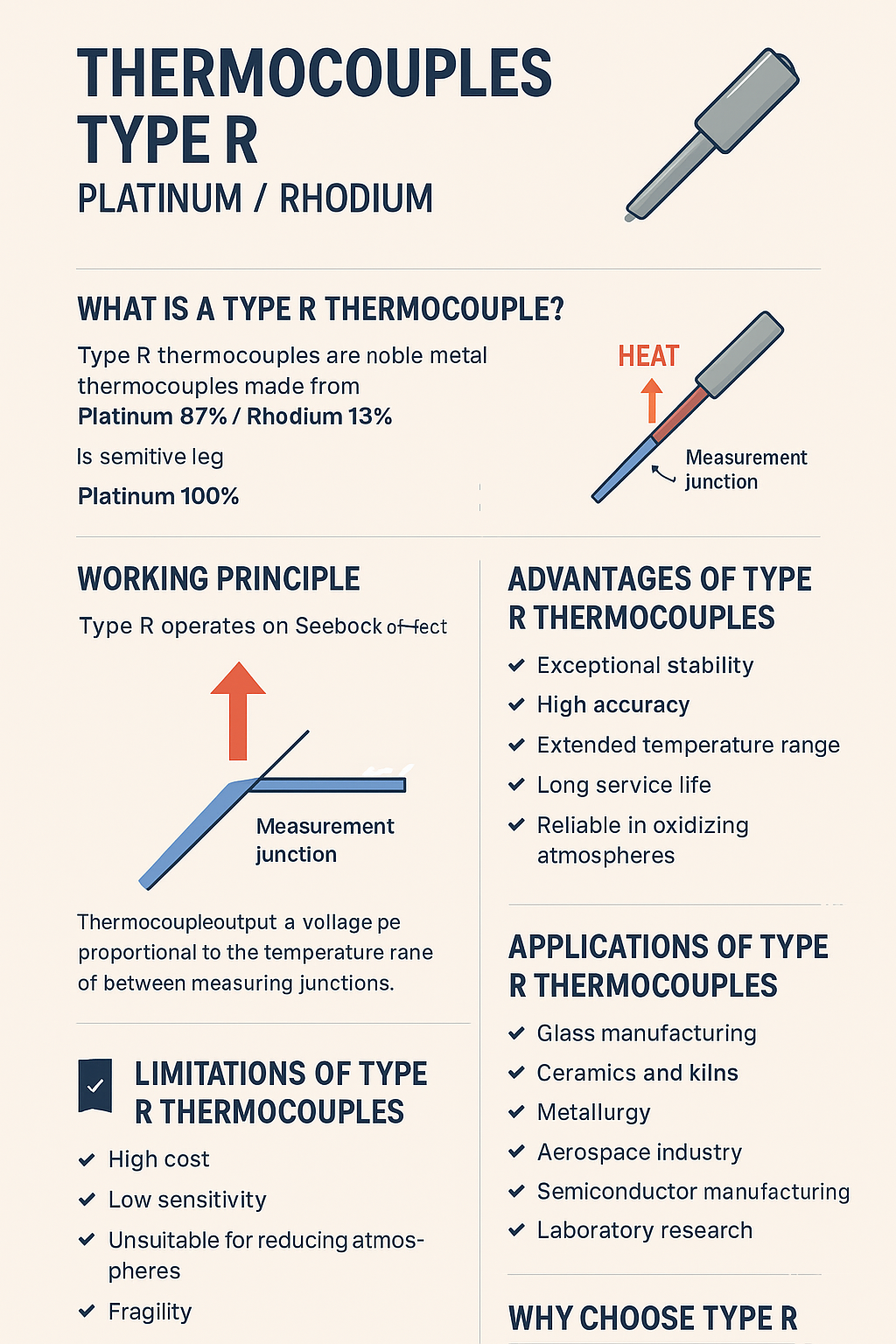
A Type R thermocouple is a noble metal thermocouple made from:
- Positive leg (Platinum 87% / Rhodium 13%)
- Negative leg (Platinum 100%)
It is similar in design to Type S thermocouples, but with a slightly higher rhodium content in the positive leg. This increases its EMF (Electromotive Force) output and makes it slightly more sensitive.
Working Principle
Like all thermocouples, Type R operates on the Seebeck effect. When two dissimilar metals are joined at one end (the measuring junction) and exposed to heat, a voltage is generated that is proportional to the temperature difference between the measuring junction and the reference junction.
In the case of Type R:
- Heat is applied to the measurement junction (platinum/rhodium).
- The temperature difference generates a small voltage.
- The thermocouple output is measured and converted into a temperature reading using standard reference tables.
Because Type R thermocouples generate a relatively low voltage per degree Celsius (about 10 µV/°C), they require high-quality instrumentation for accurate readings.
Specifications of Thermocouples Type R
| Parameter | Specification |
|---|---|
| Material – Positive | Platinum 87% / Rhodium 13% |
| Material – Negative | Platinum 100% |
| Temperature Range | 0°C to 1600°C (continuous use) |
| Output (Seebeck Coefficient) | ~10 µV/°C |
| Accuracy | ±1.5°C or ±0.25% of reading |
| Stability | Excellent long-term stability |
| Atmosphere | Suitable for oxidizing and inert environments |
Advantages of Thermocouples Type R
- Exceptional Stability – Platinum and rhodium are highly resistant to oxidation and corrosion.
- High Accuracy – Excellent performance in critical applications.
- Extended Temperature Range – Operates up to 1600°C, making it ideal for extreme environments.
- Long Service Life – Noble metals maintain stability over time.
- Reliable in Oxidizing Atmospheres – Suitable for clean, oxidizing, and inert environments.
Limitations of Thermocouples Type R
- High Cost – Platinum and rhodium are expensive metals.
- Low Sensitivity – Lower EMF output compared to base metal thermocouples like Type K or Type J.
- Not Suitable for Reducing Atmospheres – Can be damaged in strongly reducing or metallic vapor environments.
- Fragility – Platinum wires are softer and can be mechanically delicate.
Applications of Thermocouples Type R
Type R thermocouples are widely used in industries that require accurate high-temperature measurements, such as:
- Glass Manufacturing – Monitoring molten glass temperatures.
- Ceramics and Kilns – Firing processes at extreme heat.
- Metallurgy – Melting and refining precious metals.
- Aerospace Industry – High-precision engine and exhaust testing.
- Semiconductor Manufacturing – High-temperature furnace monitoring.
- Laboratory Research – Scientific experiments requiring precise thermal data.

Comparison: Thermocouples Type R vs. Type S vs. Type B Thermocouples
| Feature | Type R | Type S | Type B |
|---|---|---|---|
| Positive Leg | Pt-13%Rh | Pt-10%Rh | Pt-30%Rh |
| Negative Leg | Pt | Pt | Pt-6%Rh |
| Max Temp | 1600°C | 1600°C | 1700°C |
| Stability | Excellent | Excellent | Superior at >1500°C |
| Cost | High | High | Very High |
| Sensitivity | Slightly higher than S | Slightly lower than R | Lower at low temps |
Best Practices for Using Thermocouples Type R
- Use in Clean Environments – Avoid contamination from metallic vapors or reducing gases.
- Proper Protection – Install ceramic or alumina protection tubes.
- Avoid Mechanical Stress – Platinum wires can deform under pressure.
- Calibrate Regularly – Ensures ongoing accuracy over time.
- Use with High-Quality Instrumentation – Necessary for accurate readings due to low EMF output.
Why Choose Thermocouples Type R?
If your process involves extreme heat, requires high stability, and justifies the investment, Type R thermocouples are a top choice. While more expensive than base-metal types, their long lifespan, stability, and accuracy often make them more cost-effective in the long run.
Conclusion
The Type R thermocouple stands out as one of the most reliable and accurate temperature sensors for high-temperature industrial applications. With its Platinum/Rhodium composition, it offers excellent resistance to oxidation, long-term stability, and precise measurement capabilities.
For applications where accuracy and stability matter more than cost, Type R thermocouples are the gold standard—literally and figuratively.