In the maritime industry, ship’s deck equipment plays a critical role in the safety, efficiency, and operability of vessels. These equipment types, which are installed and used on the deck of ships, serve a wide variety of functions—ranging from anchoring and mooring to cargo handling and safety. Understanding their applications is essential not only for marine engineers and seafarers but also for stakeholders in shipbuilding, port operations, and shipping logistics.
This article provides an in-depth look at various deck equipment on ships, including their types, core functions, and significance in daily marine operations.
1. What is Ship’s Deck Equipment?
Ship’s deck equipment refers to all machinery, devices, and tools located or operated on the upper deck of a vessel. These systems are essential for managing ship functions related to:
- Anchoring
- Mooring
- Cargo handling
- Towing
- Safety and emergency response
- Communication and navigation support
Without properly functioning deck equipment, a ship’s ability to anchor, dock, or even respond to emergencies could be severely compromised.
2. Key Categories of Ship’s Deck Equipment
Let’s explore the most important categories and examples of ship deck equipment used in marine environments.
2.1 Anchoring Equipment
Anchoring systems are designed to hold a ship in place, either temporarily or permanently. The primary components include:
- Anchor: Typically made of high-strength steel; buried in seabed to resist movement.
- Anchor Chain or Cable: Transfers tension from the ship to the anchor.
- Windlass: Mechanical system used to raise or lower the anchor.
- Chain Stopper: Holds the anchor chain in place and absorbs tension during anchoring.
Function: Enables ships to maintain position in harbors, near coasts, or during offshore operations.
2.2 Mooring Equipment
Mooring equipment is used to secure the ship to a dock, jetty, or another vessel.
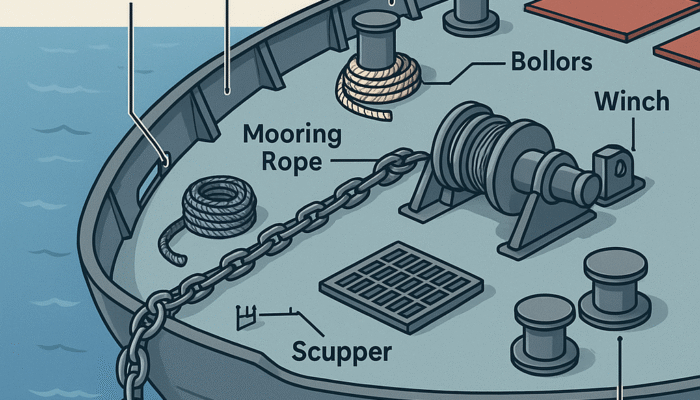
- Bollards: Cylindrical posts used to fasten mooring ropes.
- Winches: Motor-driven or manual devices used to tighten mooring lines.
- Mooring Lines: Ropes or cables connecting the ship to shore or buoys.
- Fairleads and Rollers: Guide ropes to prevent abrasion or entanglement.
Function: Ensures the ship remains stationary while docked or anchored, preventing drift or collision.
2.3 Cargo Handling Equipment
For cargo ships, deck-based equipment is crucial for loading and unloading operations.
- Cranes and Derricks: Used for hoisting cargo containers or goods on and off the vessel.
- Hatch Covers: Provide access to cargo holds and protect them from water ingress.
- Ramps and Lifts: Found on Ro-Ro vessels for moving vehicles and heavy goods.
- Lashing Equipment: Secures cargo during transit to prevent shifting or damage.
Function: Streamlines port operations and improves the efficiency of cargo transfer.
2.4 Towing and Lifting Gear
Towing equipment is vital for vessels like tugboats or for emergency operations.
- Towing Winches: High-capacity winches designed for towing operations.
- Hooks and Chains: Link towing vessels or objects together.
- Capstans: Vertical-axle winches for pulling ropes or chains.
Function: Allows ships to tow other vessels, buoys, or marine structures efficiently and safely.
2.5 Safety and Emergency Equipment
The deck is often the main platform for emergency and lifesaving gear.
- Life Rafts and Life Boats: Positioned on the main deck for quick deployment.
- Fire Hoses and Extinguishers: Located throughout the deck for emergency response.
- Rescue Boats and Cranes: For man-overboard situations.
- Escape Routes and Muster Stations: Clearly marked paths and gathering points.
Function: Ensures preparedness during fire, flooding, or abandon-ship scenarios.
2.6 Deck Fittings and Supporting Hardware
These components may seem minor but are crucial for ship integrity and crew safety.
- Cleats and Chocks: Used for guiding or tying down ropes.
- Scuppers and Drains: Remove water from deck surfaces.
- Deck Gratings: Provide a non-slip surface for crew movement.
Function: Enhances the operational utility and safety of the ship’s deck area.
3. Importance of Ship’s Deck Equipment
The significance of ship deck equipment extends beyond mechanical function. Its proper use and maintenance are crucial for:
- Ship Safety: Prevents collisions, drifting, or grounding.
- Operational Efficiency: Reduces time spent on anchoring, mooring, and cargo operations.
- Crew Safety and Ergonomics: Ensures ease of operation and reduces injury risk.
- Regulatory Compliance: Meets maritime safety standards from IMO and classification societies.

4. Maintenance of Ship’s Deck Equipment
Deck equipment is exposed to harsh environmental conditions—saltwater, UV radiation, temperature fluctuations. Therefore, regular maintenance is mandatory:
- Lubrication of moving parts
- Inspection for rust, corrosion, or wear
- Pressure testing for winches and towing gear
- Hydraulic and electrical system checks
- Replacement of worn ropes or chains
Neglecting maintenance can lead to equipment failure, delays, or serious accidents.
5. Future Trends in Ship’s Deck Equipment Technology
With the rise of smart ships and automation, deck equipment is also evolving:
- Remote-controlled winches and cranes
- Digital monitoring systems for tension and pressure
- Environmentally friendly materials and coatings
- Hybrid-powered winches for fuel efficiency
- AI-powered fault detection systems
These innovations aim to reduce crew workload, increase safety, and meet environmental regulations.
6. Conclusion of Ship’s Deck Equipment
The deck of a ship is more than just an open space—it is a functional platform equipped with critical systems that support maritime operations. From anchoring to emergency response, ship’s deck equipment is indispensable for the performance and safety of any vessel.
By understanding and properly maintaining this equipment, ship operators can ensure smoother operations, reduce risk, and uphold maritime standards. As technology advances, we can expect deck equipment to become smarter, safer, and more sustainable.
🔗 Want more insights about ship engineering, marine systems, and vessel operation tools?
Visit Abi Royen for trusted articles and technical guides in the maritime industry.