Introduction to Satellite Communication Systems (SATCOM)
Satellite Communication Systems (SATCOM), are one of the most critical infrastructures enabling global connectivity. From television broadcasting and internet access in remote areas to military operations and weather forecasting, SATCOM plays an essential role in modern society.
Unlike traditional terrestrial communication systems, SATCOM utilizes artificial satellites orbiting Earth to relay signals between different locations. This provides coverage to areas where terrestrial networks are either unavailable or impractical to deploy, such as oceans, deserts, and isolated regions.
This article provides a comprehensive exploration of SATCOM: how it works, its components, applications, advantages, challenges, and the future of satellite-based communications.
How Satellite Communication Systems (SATCOM) Work
Satellite communication relies on the transmission and reception of signals via space-based platforms. The process involves three main components:
- The Uplink
The ground station sends a signal from Earth to a satellite orbiting in space. This process is called an uplink. - The Satellite Transponder
Once the signal reaches the satellite, it passes through a transponder, which amplifies and changes the frequency to avoid interference with the incoming signal. - The Downlink
The modified signal is then sent back to another ground station or directly to end-user terminals such as satellite phones, VSATs (Very Small Aperture Terminals), or satellite internet devices.
This entire process happens almost instantly, enabling real-time communication across vast distances.
Types of Satellite Communication Systems (SATCOM)
Different types of satellites are deployed for various communication needs, depending on their orbit and purpose:
- Geostationary Earth Orbit (GEO) Satellites
- Orbit altitude: ~35,786 km above the equator.
- Advantages: Provide constant coverage over a large area, ideal for broadcasting, satellite TV, and weather monitoring.
- Limitation: High latency due to distance from Earth.
- Medium Earth Orbit (MEO) Satellites
- Orbit altitude: 2,000–35,000 km.
- Advantages: Lower latency compared to GEO, commonly used in navigation systems like GPS.
- Low Earth Orbit (LEO) Satellites
- Orbit altitude: 500–2,000 km.
- Advantages: Very low latency, high-speed communication, and global coverage through satellite constellations.
- Example: Starlink, OneWeb, and Iridium.
Applications of Satellite Communication Systems (SATCOM)
1. Telecommunication Services
SATCOM enables telephone calls, internet services, and video conferencing in remote and rural areas. With LEO constellations, satellite internet is becoming more affordable and widely accessible.
2. Broadcasting and Media
Satellite TV and radio broadcasting rely on GEO satellites, providing consistent and reliable coverage to millions of users worldwide.
3. Navigation and GPS
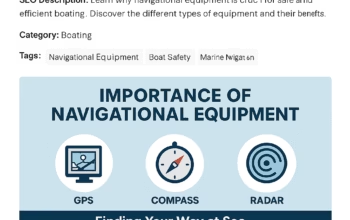
Global Navigation Satellite Systems (GNSS), such as GPS, GLONASS, and Galileo, use satellites to provide precise location and timing information for aviation, shipping, and personal navigation.
4. Military and Defense
SATCOM plays a critical role in military operations, offering secure communication, reconnaissance, and surveillance capabilities across the globe.
5. Disaster Management and Emergency Response
In areas affected by natural disasters where terrestrial networks are destroyed, SATCOM provides critical communication channels for rescue operations and coordination.
6. Maritime and Aviation Industries
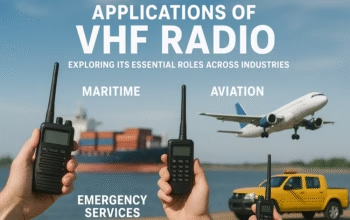
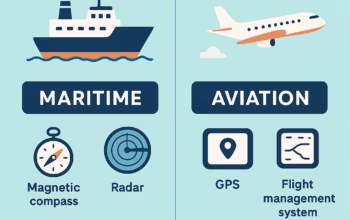
Ships and aircraft rely on SATCOM for navigation, real-time communication, and internet connectivity while traveling across oceans and airspace where terrestrial networks cannot reach.
Advantages of Satellite Communication Systems (SATCOM)
- Global Coverage: Reaches remote and isolated regions where traditional communication systems cannot.
- High Reliability: Less affected by natural disasters compared to terrestrial infrastructure.
- Wide Bandwidth: Supports multiple communication channels simultaneously.
- Scalability: Can handle a growing number of users without the need for extensive ground infrastructure.


Challenges and Limitations of Satellite Communication Systems (SATCOM)
While SATCOM offers numerous benefits, it also faces several challenges:
- High Latency: Especially in GEO satellites, signal delay can affect real-time communication.
- Cost: Building and launching satellites require significant investment.
- Signal Interference: Weather conditions such as heavy rain (rain fade) can degrade signal quality.
- Space Debris: Increasing satellite launches contribute to space congestion and collision risks.
Future Trends in Satellite Communication Systems (SATCOM)
The future of SATCOM is being shaped by technological advancements and increasing demand for high-speed, low-latency connectivity. Some key trends include:
- Satellite Mega-Constellations
Companies like SpaceX (Starlink), OneWeb, and Amazon (Project Kuiper) are deploying thousands of LEO satellites to provide global broadband internet access. - 5G and Beyond Integration
SATCOM is expected to integrate with 5G networks, ensuring seamless global coverage and connectivity. - Miniaturized Satellites (CubeSats)
Small, cost-effective satellites are being deployed for research, communication, and IoT (Internet of Things) applications. - Artificial Intelligence (AI) in SATCOM
AI is being applied for predictive maintenance, traffic management, and optimizing satellite communication efficiency. - Quantum Communication
Future SATCOM may leverage quantum cryptography to ensure secure and unbreakable communication channels.
Conclusion
Satellite Communication Systems (SATCOM) are indispensable for modern communication and connectivity. From enabling internet access in rural areas to supporting military operations and powering GPS navigation, SATCOM continues to transform global communication.
As advancements in satellite technology accelerate, the future promises faster, more reliable, and more secure satellite-based communication systems. With the rise of mega-constellations, AI integration, and quantum encryption, SATCOM is set to play an even greater role in shaping the digital age.
For industries, governments, and individuals alike, understanding SATCOM technology is essential for leveraging its potential in the rapidly evolving landscape of global communication.