Introduction of Orbiting Carbon Observatory-2
The fight against climate change depends heavily on accurate data about greenhouse gases, especially carbon dioxide (CO₂), which is the primary driver of global warming. One of the most important missions in this effort is NASA’s Orbiting Carbon Observatory-2 (OCO-2) satellite. Launched in July 2014, OCO-2 was designed to provide precise, global measurements of atmospheric CO₂, offering scientists an unparalleled view of Earth’s carbon cycle.
In this article, we will explore the history, mission objectives, scientific instruments, and global significance of OCO-2 in addressing climate change.
Background of the Orbiting Carbon Observatory-2 Mission
The original Orbiting Carbon Observatory (OCO) mission was planned for launch in 2009 but unfortunately failed due to a rocket malfunction. Recognizing the importance of the mission, NASA quickly developed OCO-2, a replacement with enhanced reliability and advanced carbon-monitoring technologies.
OCO-2 was launched aboard a Delta II rocket from Vandenberg Air Force Base in California on July 2, 2014. It became part of the A-Train satellite constellation, a group of Earth observation satellites that fly in formation to collect synchronized climate and atmospheric data.
Objectives of Orbiting Carbon Observatory-2
The OCO-2 satellite was built with a clear scientific goal: to measure and understand carbon dioxide distribution in Earth’s atmosphere with high precision. Its key objectives include:
- Measuring Atmospheric CO₂:
Provide global measurements of carbon dioxide concentrations with unmatched accuracy. - Identifying Sources and Sinks:
Detect natural and human-made CO₂ emissions, as well as absorption by oceans and forests. - Improving Climate Models:
Enhance predictive models for climate change by providing real-time, high-quality data. - Monitoring Seasonal Variations:
Track how carbon dioxide levels change with seasons, vegetation cycles, and human activities.
How Orbiting Carbon Observatory-2 Works
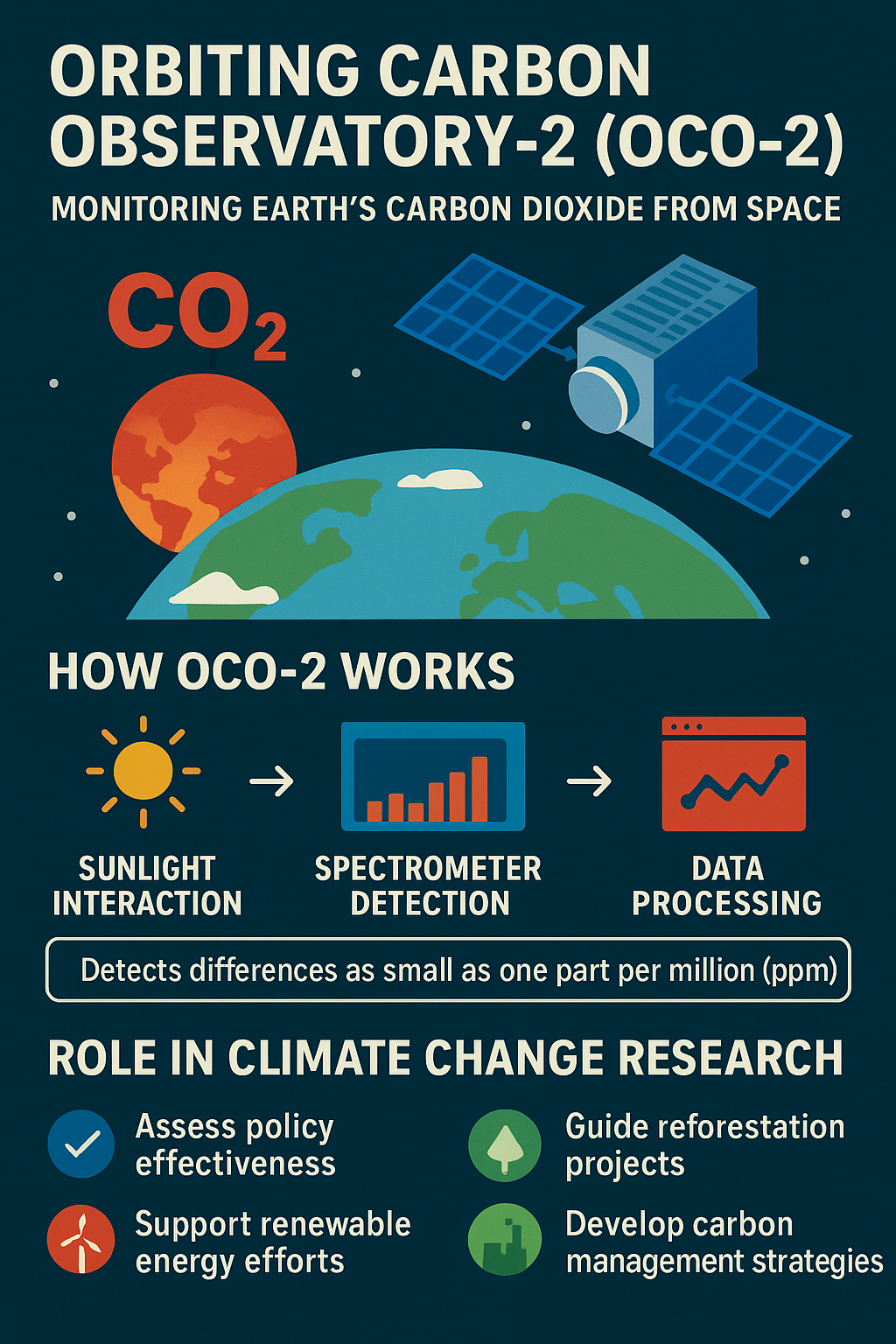
OCO-2 is equipped with three high-resolution spectrometers designed to measure sunlight reflected from Earth’s surface. These instruments detect subtle variations in the absorption of specific wavelengths of light by carbon dioxide molecules.
Here’s how the process works:
- Sunlight Interaction: Sunlight passes through the atmosphere, where gases like CO₂ absorb certain wavelengths.
- Spectrometer Detection: The spectrometers measure the intensity of the absorbed light.
- Data Processing: By analyzing the absorption patterns, scientists can determine CO₂ concentrations with remarkable precision.
This method allows OCO-2 to detect differences as small as one part per million (ppm), making it one of the most accurate carbon-monitoring satellites ever launched.
Achievements of Orbiting Carbon Observatory-2
Since its launch, OCO-2 has made several groundbreaking contributions to climate science:
- Mapping Global CO₂ Hotspots:
OCO-2 has provided detailed maps showing where carbon dioxide emissions are most concentrated, such as urban areas, industrial zones, and regions affected by wildfires. - Tracking Seasonal Carbon Cycles:
The satellite has confirmed seasonal variations in CO₂ levels, with decreases during the Northern Hemisphere’s growing season (as plants absorb CO₂) and increases during winter. - Identifying Natural Sinks:
OCO-2 has helped scientists understand the role of oceans, forests, and wetlands in absorbing carbon dioxide, providing insight into the balance between natural processes and human activity. - Wildfire and Volcano Monitoring:
By detecting sudden CO₂ spikes, OCO-2 has tracked emissions from major wildfires and volcanic eruptions, offering valuable data for environmental response strategies.

Role in Climate Change Research
The data collected by OCO-2 is vital in shaping our understanding of climate change. Unlike ground-based monitoring stations, which provide local measurements, OCO-2 offers a global perspective. This allows scientists to:
- Assess Policy Effectiveness: Evaluate the success of international agreements such as the Paris Climate Accord.
- Support Renewable Energy Efforts: Inform policymakers about the impact of fossil fuel emissions.
- Guide Reforestation Projects: Identify areas where forest growth has the greatest potential to offset emissions.
- Develop Carbon Management Strategies: Improve methods for carbon capture and storage (CCS).
Challenges Faced by Orbiting Carbon Observatory-2
Although highly successful, OCO-2 has faced some challenges:
- Cloud Cover Interference: Clouds can block the satellite’s view of Earth’s surface, limiting measurements.
- Calibration Issues: Maintaining accuracy requires ongoing calibration against ground-based observations.
- Short Mission Life: Originally designed for two years, the satellite has operated well beyond its expected lifespan, but future replacements are needed.
The Future: OCO-3 and Beyond
Following OCO-2’s success, NASA launched the OCO-3 instrument in May 2019, mounted on the International Space Station (ISS). OCO-3 continues the mission with improved observation angles and more frequent coverage of urban regions.
Future carbon-monitoring satellites are being planned by NASA and other space agencies worldwide, reflecting the global urgency of tracking greenhouse gases. OCO-2 paved the way for a new era of climate observation, and its legacy will continue to shape Earth science for decades.
Conclusion
The Orbiting Carbon Observatory-2 (OCO-2) satellite has revolutionized our ability to monitor and understand carbon dioxide levels across the globe. From identifying emissions hotspots to revealing the vital role of forests and oceans, OCO-2 has provided data critical for combating climate change.
As humanity faces increasing environmental challenges, missions like OCO-2 underscore the importance of space technology in preserving our planet. By continuing to invest in satellite-based monitoring, the world gains the knowledge needed to build a sustainable, climate-resilient future.