Introduction of Israel Strikes Syrian Reactor
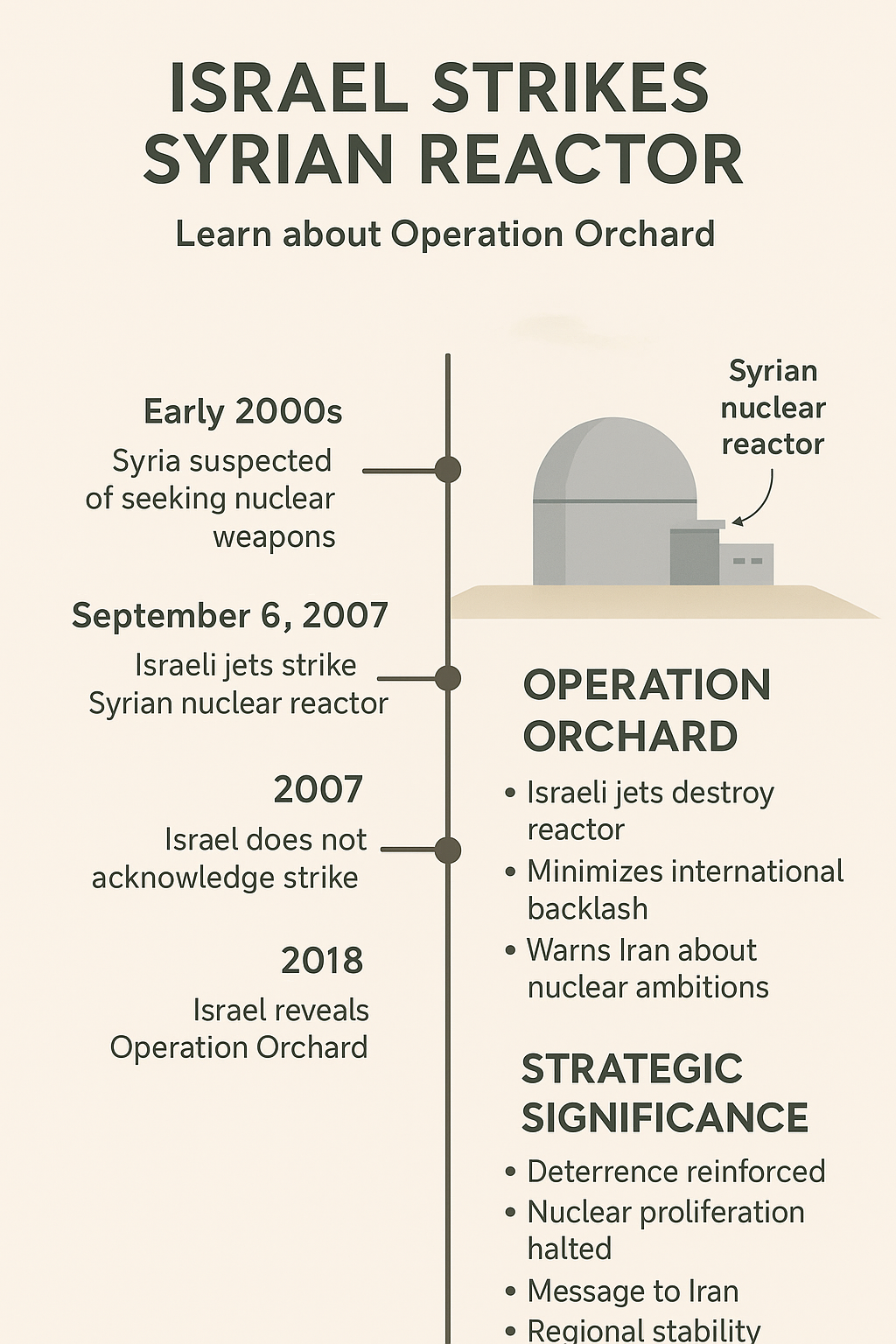
Israel Strikes Syrian Reactor ~ On the night of September 6, 2007, the world witnessed one of the most decisive and secretive military operations of the 21st century. The Israeli Air Force (IAF) carried out an airstrike against a nuclear facility in Deir ez-Zor, Syria, suspected of being developed with North Korean assistance. Known as Operation Orchard, the mission was a preemptive strike aimed at preventing Syria from acquiring nuclear weapons capabilities.
This bold move reshaped regional dynamics, highlighted Israel’s defense doctrine, and raised global debates about nuclear proliferation, military preemption, and international diplomacy.
In this article, we will explore the background, execution, and consequences of Israel’s strike on the Syrian reactor, analyzing its impact on Middle East geopolitics and global security.
Background: Syria’s Nuclear Ambitions
During the early 2000s, Western intelligence agencies began suspecting Syria of pursuing nuclear weapons. The suspicions were fueled by satellite images and intelligence reports suggesting that Syria, with North Korea’s technical assistance, was building a plutonium-producing nuclear reactor at al-Kibar, in eastern Syria.
Unlike Iran, which openly pursued nuclear technology under international scrutiny, Syria kept its project secret. This secrecy raised alarms, particularly in Israel, a country that has historically followed the Begin Doctrine—a policy that Israel will not allow hostile neighbors to acquire weapons of mass destruction.
For Israel, a nuclear-armed Syria would pose an existential threat, given decades of conflict and hostile relations between the two nations.
Operation Orchard: The Airstrike
Planning the Mission
Intelligence gathering played a key role in preparing the operation. Mossad, Israel’s intelligence agency, reportedly infiltrated networks in Europe and acquired critical evidence of Syria’s reactor program. When this intelligence was shared with the United States, Israel sought international backing. However, the U.S. under President George W. Bush opted not to strike, leaving the decision to Israel.
The Execution
In the early hours of September 6, 2007, Israeli fighter jets—believed to be F-15s and F-16s equipped with advanced electronic warfare systems—entered Syrian airspace undetected. Israel allegedly used sophisticated technology to disable Syrian radar systems, ensuring minimal resistance.
The strike destroyed the nearly completed nuclear reactor in al-Kibar, preventing it from becoming operational. Within minutes, the mission was over, and Israeli jets returned safely.
Immediate Aftermath
Syria initially downplayed the event, describing it as an attack on an “unused military facility.” However, international intelligence later confirmed that the site was indeed a nuclear reactor under construction.
Israel, following a policy of strategic ambiguity, did not officially acknowledge the operation until 2018, more than a decade later.
International Reactions
The United States
While initially cautious, the U.S. later supported Israel’s actions, stating that the destroyed facility was a plutonium-producing reactor with North Korean involvement. Washington viewed the operation as a successful example of preventing nuclear proliferation.
Syria
Syria condemned the strike as an act of aggression and a violation of its sovereignty. However, it avoided escalating the conflict militarily, likely due to concerns over further Israeli retaliation.
The Global Community
The operation triggered mixed reactions worldwide. Some praised Israel for acting decisively to prevent nuclear proliferation, while others criticized the unilateral military strike, arguing it undermined international law and the authority of the International Atomic Energy Agency (IAEA).
Strategic Significance
The Israeli strike on Syria’s reactor had far-reaching consequences:
- Deterrence Reinforced – Israel demonstrated its capability and willingness to act unilaterally to defend its national security interests.
- Nuclear Proliferation Halted – The operation prevented Syria from potentially joining the ranks of nuclear-armed states.
- Message to Iran – Many analysts viewed Operation Orchard as a warning to Iran regarding its nuclear ambitions.
- Regional Stability – While risky, the strike arguably prevented a more dangerous future scenario where Syria could possess nuclear weapons during the civil war that erupted in 2011.
Operation Orchard and the Begin Doctrine
The 2007 strike was a continuation of Israel’s Begin Doctrine, first demonstrated in 1981 with Operation Opera, when Israel destroyed Iraq’s Osirak nuclear reactor. The doctrine is rooted in the belief that Israel cannot allow hostile neighbors to acquire nuclear weapons, given its small size and security vulnerabilities.
Operation Orchard reaffirmed this principle, showing that Israel would take preemptive action when necessary, even at the risk of international criticism.

The Role of North Korea
One of the most concerning aspects of the Syrian reactor was North Korea’s involvement. Evidence suggested that North Korean engineers provided technical expertise and possibly materials to help Syria construct the facility.
This revelation highlighted the global nature of nuclear proliferation networks, raising concerns about rogue states collaborating to spread nuclear technology in volatile regions.
Long-Term Consequences
Looking back nearly two decades later, the strike on Syria’s reactor has several long-term implications:
- Syrian Civil War: If Syria had succeeded in developing nuclear weapons, the ongoing conflict since 2011 could have been far more catastrophic.
- Strengthened Israeli Security: Israel eliminated a direct nuclear threat, reinforcing its military superiority.
- Global Counter-Proliferation Model: The operation has been studied by military strategists and policymakers as an example of decisive action against nuclear proliferation.
- Continued Tensions: The event added another layer of hostility between Syria and Israel, contributing to the long-standing regional conflict.
Conclusion of Israel Strikes Syrian Reactor
The Israeli strike on Syria’s nuclear reactor in 2007—Operation Orchard—was more than a tactical military success. It was a strategic masterstroke that reshaped Middle East security, prevented nuclear proliferation, and reinforced Israel’s defense doctrine.
While the legality of preemptive strikes remains debated under international law, the operation undeniably changed the course of history in the region. Today, it serves as a case study in intelligence coordination, military precision, and the delicate balance between sovereignty and security in international affairs.
Israel’s decisive action ensured that Syria never joined the nuclear club—a fact that, given the chaos of the Syrian Civil War, may have prevented one of the world’s greatest security nightmares.