Introduction of Google Is Founded
Google Is Founded ~ In today’s digital age, it is nearly impossible to imagine life without Google. From searching for information to navigating roads, managing emails, and even running businesses, Google has become an integral part of daily life. But how did this technology giant come into existence? The story of Google’s founding is not just about creating a company—it is a tale of innovation, determination, and vision that reshaped the internet forever.
This article explores the origins of Google, from its early beginnings at Stanford University to its official founding in 1998, and how it became the world’s most influential search engine.
The Birth of an Idea at Stanford University
The journey of Google began in 1995 at Stanford University, where two Ph.D. students—Larry Page and Sergey Brin—met. Although they initially had different personalities and often debated each other, their shared passion for data and the internet brought them together.
At the time, the internet was rapidly expanding, and existing search engines struggled to organize the vast amounts of data online. Search results were often unreliable, cluttered, and unorganized. Larry Page began working on a research project called “BackRub,” which analyzed the relationships between different websites by tracking backlinks. Sergey Brin soon joined the project, and together, they developed a groundbreaking idea: ranking web pages based on their importance and relevance.
This system would later evolve into the core of Google’s search algorithm.
Google Is Founded From BackRub to Google
“BackRub” was the first version of their search engine project, running on Stanford servers in 1996. However, it quickly used too much bandwidth, leading the university to encourage them to find a new platform.
The name “Google” came about as a play on the mathematical term “googol,” which represents the number 1 followed by 100 zeros. This name perfectly reflected their mission: to organize an enormous amount of information on the internet and make it universally accessible.
In 1997, they officially registered the domain name google.com. The following year, in September 1998, Google was incorporated as a private company in Menlo Park, California, with an initial investment of $100,000 from Andy Bechtolsheim, a co-founder of Sun Microsystems.
Early Struggles and Breakthroughs
Like many startups, Google faced challenges in its early years. Competing against established search engines like Yahoo, AltaVista, and Lycos was not easy. However, Google’s clean interface, fast search results, and superior algorithm quickly made it stand out.
Unlike its competitors, which were cluttered with advertisements and distractions, Google focused solely on providing the best possible search results. Word of mouth helped spread its popularity among internet users, and soon, Google was gaining traction across the globe.
By 1999, Google had received significant investments from venture capital firms Kleiner Perkins and Sequoia Capital, which allowed the company to expand its team and operations.
The Rise of a Tech Giant
As the internet grew, so did Google. In 2000, Google became the default search engine for Yahoo, marking a major breakthrough. That same year, Google launched its advertising program, Google AdWords, which became the foundation of its business model.
Google’s mission—“to organize the world’s information and make it universally accessible and useful”—drove continuous innovation. Beyond search, the company began developing products and services such as Gmail, Google Maps, Google News, and eventually the Android operating system.
By 2004, Google went public with its initial public offering (IPO), raising over $1.6 billion and cementing its place as a leader in the technology industry.

Why Google Changed the World
The founding of Google marked a turning point in the history of the internet. Its unique algorithm not only improved the accuracy of search results but also transformed how people access and use information. Today, Google processes billions of searches every day and has expanded into countless industries, from artificial intelligence to cloud computing.
Google’s success lies in its commitment to innovation, simplicity, and user experience. By staying ahead of technological trends and anticipating user needs, Google has grown from a university project into one of the world’s most valuable companies.
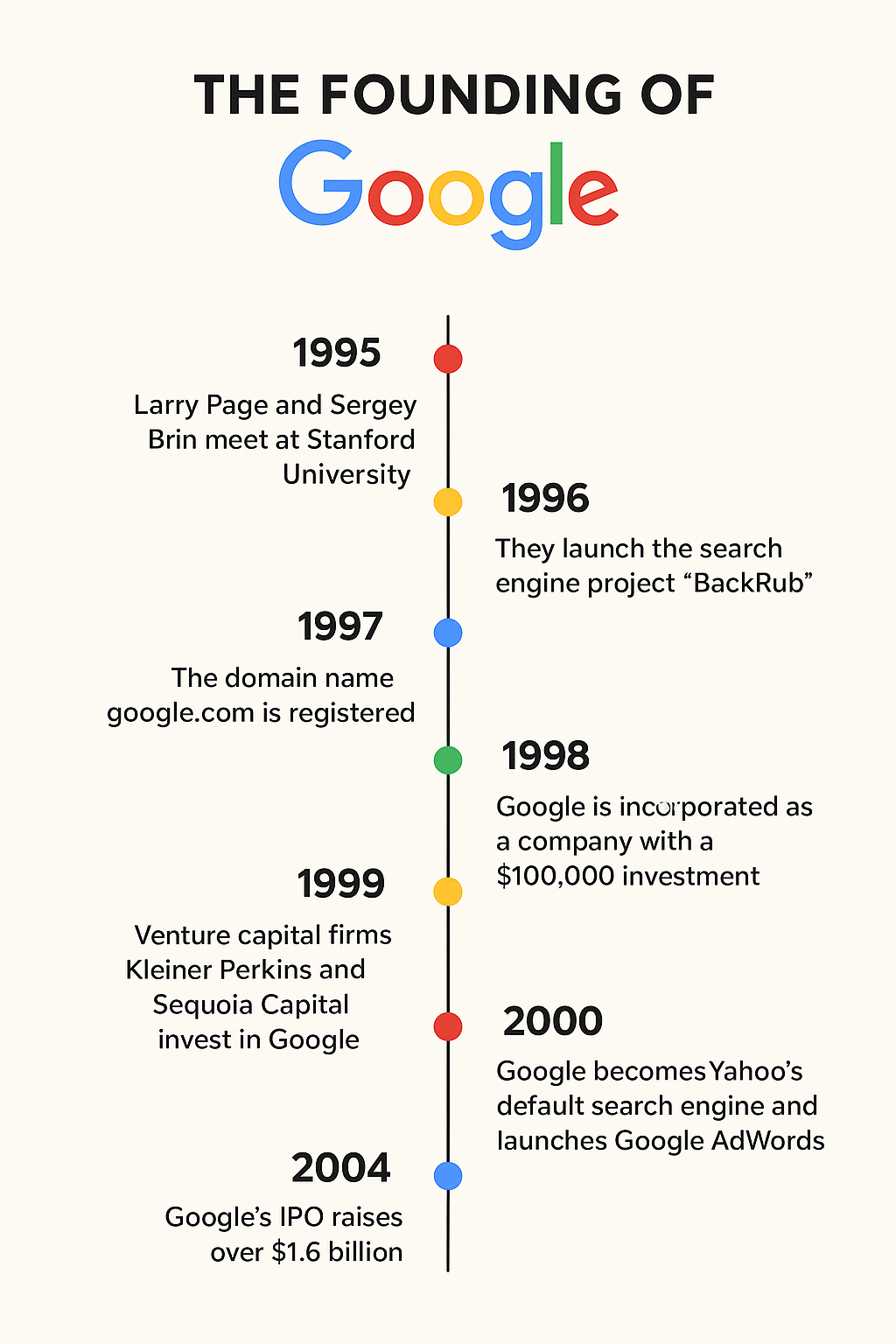
Timeline of Key Events in Google Is Founded
- 1995: Larry Page and Sergey Brin meet at Stanford University.
- 1996: They launch the search engine project “BackRub.”
- 1997: The domain name google.com is registered.
- 1998: Google is incorporated as a company with a $100,000 investment.
- 1999: Venture capital firms Kleiner Perkins and Sequoia Capital invest in Google.
- 2000: Google becomes Yahoo’s default search engine and launches Google AdWords.
- 2004: Google’s IPO raises over $1.6 billion.
Conclusion of Google Is Founded
The story of Google’s founding is a remarkable example of how vision, innovation, and persistence can reshape the world. What began as a university project by two curious students has become one of the most influential companies in history.
Google’s impact on technology, business, and daily life is undeniable, and its founding continues to inspire entrepreneurs, innovators, and dreamers around the globe.
By understanding the origins of Google, we not only learn about the history of a company but also about the power of ideas and how they can change the course of human history.