How Radio Works ~ Radio technology is one of the most important inventions in human history. It connects people across the globe, enabling communication without the need for physical wires. From broadcasting music to enabling emergency communications, radio waves have transformed our world. But how radio work? To understand this, we need to dive into the science behind it — exploring electromagnetic waves, signal modulation, transmission, and reception.
1. The Basics of Radio Communication
At its core, radio communication relies on electromagnetic waves — invisible forms of energy that travel at the speed of light. These waves can carry information over long distances, making them perfect for broadcasting and communication.
The process of radio communication involves two key components:
- A transmitter – which generates and sends the signal.
- A receiver – which captures and interprets the signal.
When you listen to a radio station or talk on a walkie-talkie, these two devices are working together to transfer information through the air.
2. Understanding Electromagnetic Waves
Electromagnetic waves are made up of oscillating electric and magnetic fields. They are categorized based on their frequency and wavelength. Radio waves have the longest wavelength and lowest frequency compared to other types of electromagnetic radiation, such as microwaves, infrared, visible light, and X-rays.
- Frequency (Hz): The number of wave cycles per second.
- Wavelength (m): The distance between two peaks of the wave.
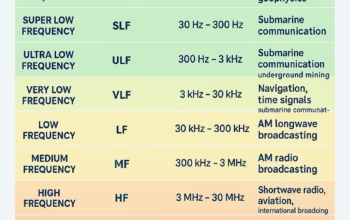
Radio frequencies are divided into bands, such as:
- LF (Low Frequency): 30–300 kHz
- MF (Medium Frequency): 300 kHz–3 MHz
- HF (High Frequency): 3–30 MHz
- VHF (Very High Frequency): 30–300 MHz
- UHF (Ultra High Frequency): 300 MHz–3 GHz
These frequency bands determine how far the radio signal can travel and what it can be used for.
3. How Radio Works: Transmission
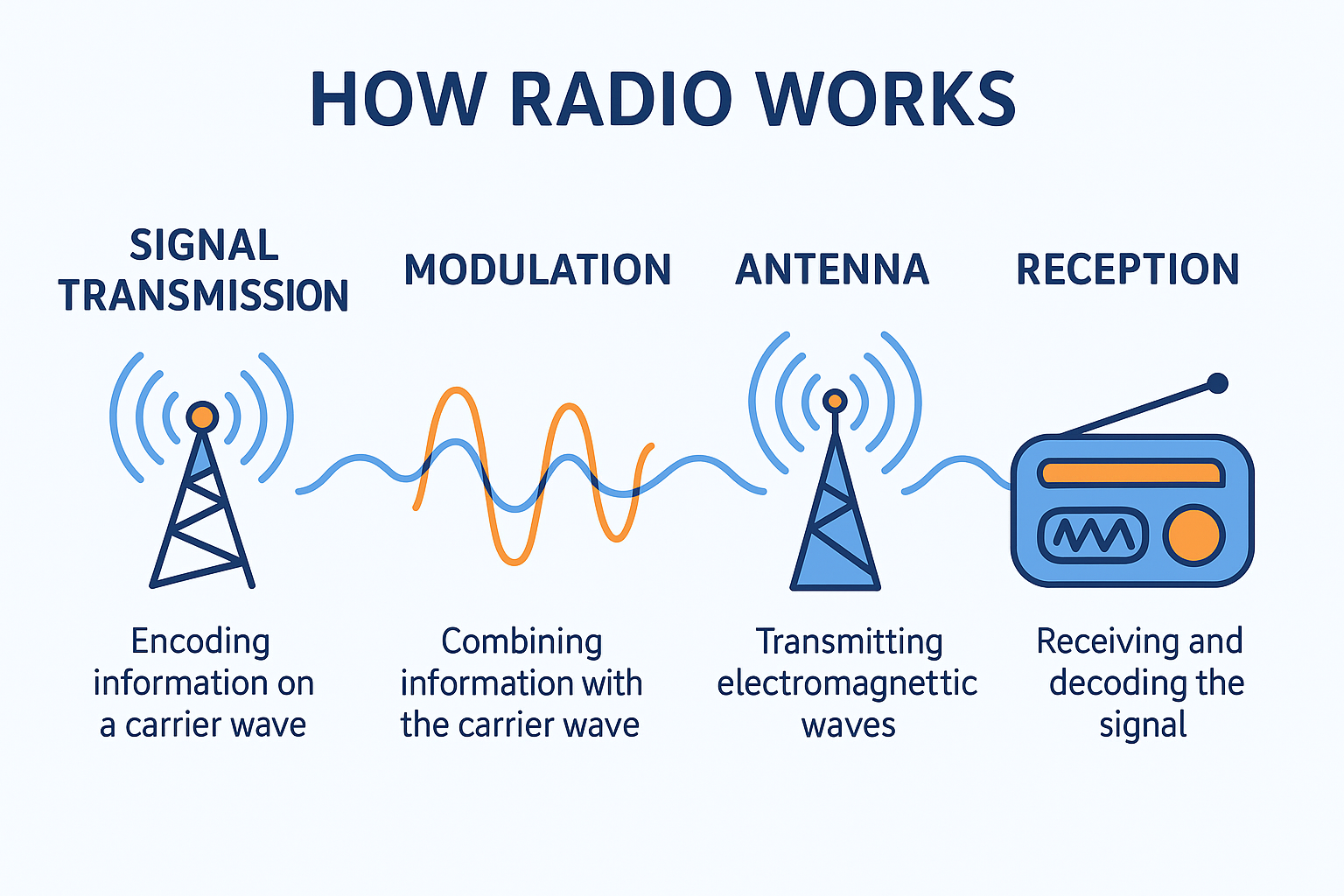
The radio transmission process begins with encoding information onto a carrier wave. The carrier wave is a pure electromagnetic wave with a fixed frequency. Information — whether it’s music, speech, or data — is combined with the carrier wave using a process called modulation.
Types of Modulation
- AM (Amplitude Modulation) – Changes the amplitude (strength) of the carrier wave to encode the signal.
- Used in AM radio broadcasting.
- Can travel long distances but is more susceptible to static and interference.
- FM (Frequency Modulation) – Changes the frequency of the carrier wave to encode the signal.
- Used in FM radio broadcasting.
- Offers better sound quality and is less affected by noise.
- Digital Modulation – Converts signals into digital data for transmission.
- Used in modern communication like digital radio and mobile phones.
Once the signal is modulated, the transmitter sends it out through an antenna, converting electrical signals into electromagnetic waves that travel through the air.
4. How Radio Works: Reception
On the receiving end, a radio receiver detects the electromagnetic waves using an antenna. The receiver’s job is to:
- Capture the signal – The antenna picks up radio waves in the desired frequency range.
- Amplify the signal – Weak signals are strengthened for processing.
- Demodulate the signal – The receiver extracts the original information from the modulated carrier wave.
- Convert to sound or data – The processed signal is turned back into audio or digital data.
For example, when you tune your radio to 101.5 MHz FM, the receiver focuses only on that frequency, filtering out all others.
5. The Role of Antennas
Antennas are essential for both transmitting and receiving radio waves. Their design depends on the frequency being used.
- Long antennas are suitable for low-frequency signals.
- Short antennas work better for high-frequency signals.
In broadcasting, large towers are used to maximize coverage. In portable devices, small internal antennas are designed to be compact yet efficient.
6. Factors Affecting Radio Signals
Radio waves don’t always travel in a straight line — they can be reflected, refracted, or absorbed depending on environmental conditions. Factors include:
- Terrain – Mountains, buildings, and forests can block signals.
- Weather – Rain, fog, and atmospheric conditions can cause interference.
- Frequency – Lower frequencies travel further and can bend around obstacles better than higher frequencies.
- Power of transmission – Stronger transmitters can send signals farther.

7. Applications of Radio Technology
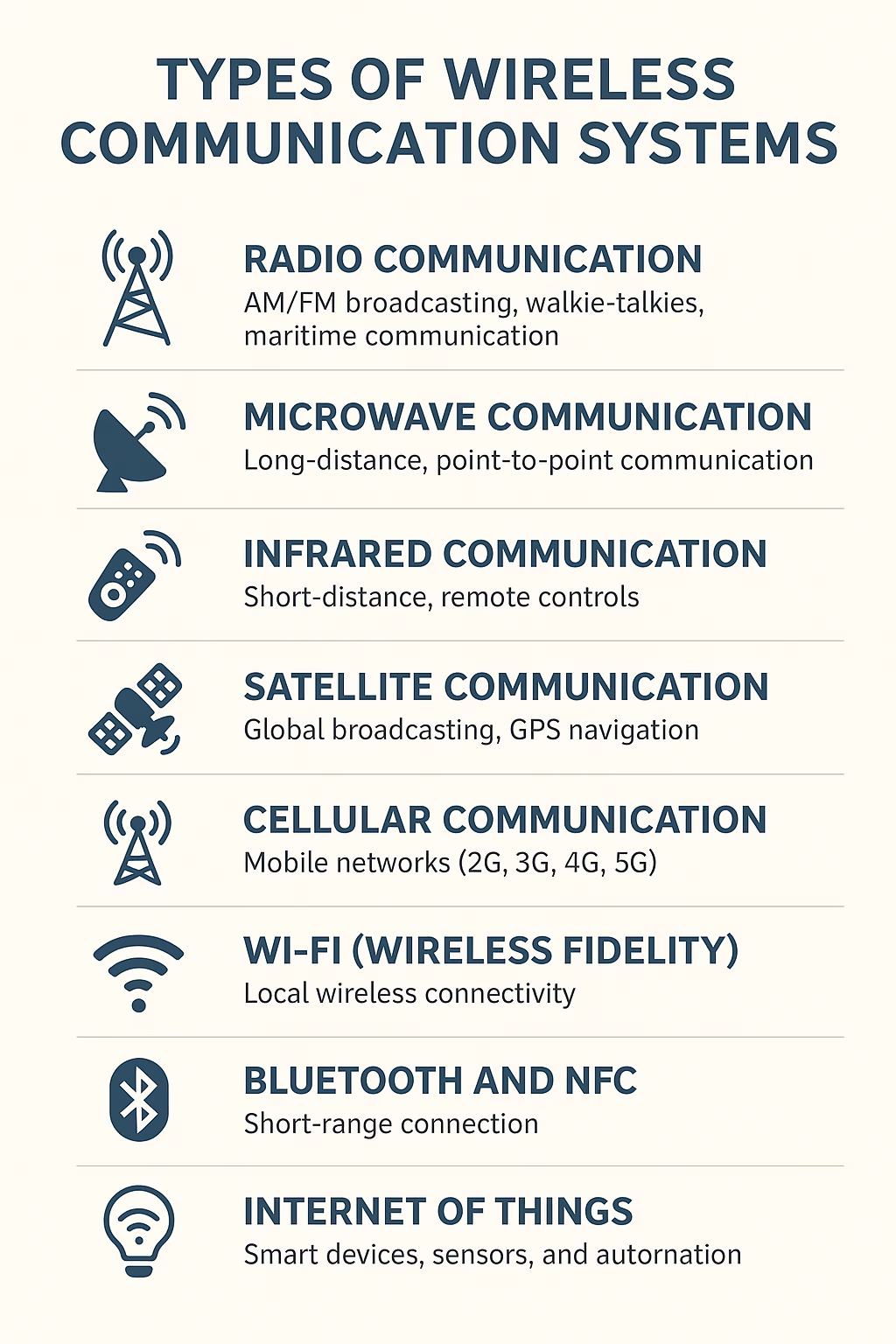
Radio is everywhere in our daily lives, often without us realizing it. Common applications include:
- Broadcasting – AM/FM radio, digital radio, satellite radio.
- Communication – Walkie-talkies, mobile phones, emergency services.
- Navigation – GPS uses radio signals from satellites to determine location.
- Remote control – Garage door openers, drones, wireless devices.
- Military and aviation – Secure communication and radar systems.
8. The Evolution of Radio Technology
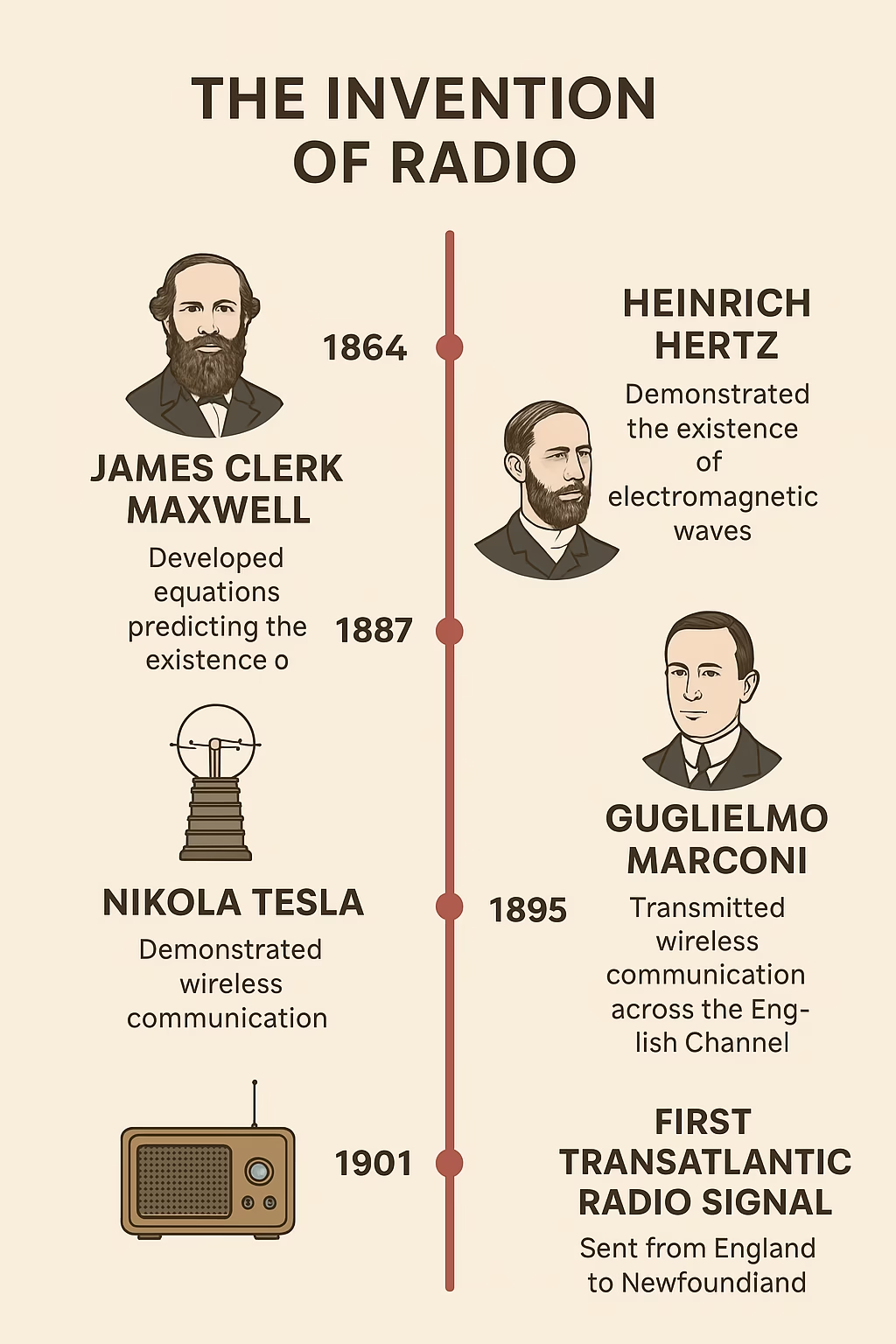
The history of radio dates back to the late 19th century, with pioneers like Guglielmo Marconi, Nikola Tesla, and Reginald Fessenden making groundbreaking discoveries. Over time, radio evolved from simple Morse code transmissions to high-definition digital broadcasts.
Today, radio is adapting to modern needs:
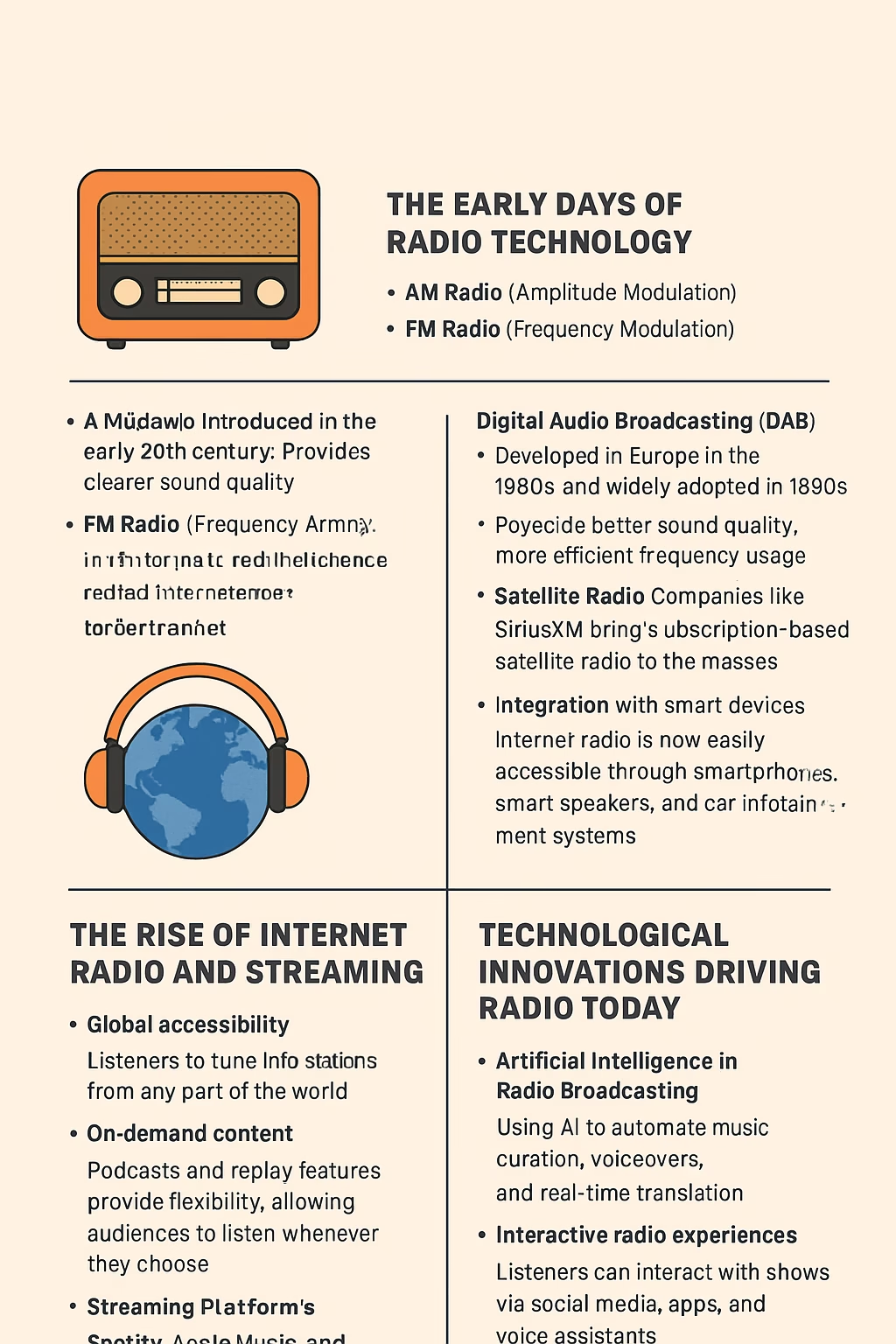
- Internet radio allows global streaming.
- Digital Audio Broadcasting (DAB) offers better sound quality.
- Software-Defined Radio (SDR) enables flexible and programmable communication systems.
9. The Future of Radio Communication
Even with the rise of the internet and advanced communication systems, radio remains relevant. Emerging technologies like 5G and IoT (Internet of Things) still rely heavily on radio waves. The future will likely bring:
- Smarter, more efficient modulation techniques.
- Integration with AI for signal optimization.
- Expansion of satellite-based radio services.
Conclusion of How Radio Works
Radio technology may seem simple when you press a button and hear music or a news broadcast, but the science behind it is a fascinating combination of physics, engineering, and innovation. From the generation of electromagnetic waves to their precise reception, radio remains one of humanity’s most impactful inventions — connecting people across distances both near and far.