The late 19th century marked a revolutionary moment in human history—the birth of motion pictures. Before streaming platforms, cinemas, and even black-and-white silent films, there was a device that introduced people to moving images for the very first time: the Kinetoscope, invented by Thomas Edison and his assistant William Kennedy Laurie Dickson. This remarkable invention of 1897 is widely recognized as the first film projector, shaping the future of entertainment, storytelling, and communication.
In this article, we will explore the history of the Kinetoscope, how it worked, the vision of Edison, and its lasting impact on the modern film industry.
1. The Background: Edison’s Vision for Moving Pictures
Thomas Alva Edison was already a famous inventor by the time he developed the Kinetoscope. Known for the phonograph and the incandescent light bulb, Edison constantly sought new ways to merge science with entertainment. Inspired by earlier experiments in photography, he wanted to create a device that could “do for the eye what the phonograph does for the ear.”
Edison believed that motion pictures could not only entertain but also educate, document history, and become a major commercial enterprise. This vision led him to assign his assistant, W.K.L. Dickson, to work on a machine that could capture and display moving images.
2. The Birth of the Kinetoscope (1897)
By 1897, the Kinetoscope was ready to be introduced to the world. Unlike modern projectors that cast images onto a screen for an audience, the Kinetoscope was a single-viewer device. A person would look through a peephole on top of the machine to watch short films, typically lasting 20 to 30 seconds.
The device used a strip of film running on rollers inside the cabinet, illuminated by an electric lamp. The film contained sequential images that, when moved at a rapid speed, created the illusion of motion.
3. How the Kinetoscope Worked
The Kinetoscope’s mechanism was simple but brilliant for its time. Here’s how it functioned:
- Film Strip – A continuous loop of perforated film ran through the machine.
- Electric Bulb – Provided illumination to project light through the film frames.
- Magnifying Lens – Allowed the viewer to clearly see the moving images.
- Shutter System – Created the illusion of motion by showing images in rapid succession.
This design allowed people to experience moving images for the first time, which was nothing short of magical in the 1890s.
4. The First Films Shown on the Kinetoscope
Edison’s team produced a variety of short films specifically for the Kinetoscope. These included everyday scenes, vaudeville acts, boxing matches, and dancing performances. Some of the most famous early recordings were of athletes, magicians, and theater performers.
Audiences were fascinated. For the price of a nickel, people could step up to the machine and watch a tiny moving picture. This is why early film parlors became known as nickelodeons—the very first movie theaters.
5. Public Reception and Commercial Success
The Kinetoscope quickly gained popularity after its introduction. In 1897, Kinetoscope parlors were established in major American cities, allowing multiple machines to be placed side by side. Each machine played a different short film, and viewers paid to watch them individually.
Although it was not a projector in the modern sense, the Kinetoscope laid the foundation for the film exhibition industry. By the end of the 19th century, people were already dreaming of larger screens and shared experiences, leading to the invention of true film projectors in the early 1900s.
6. Limitations of the Kinetoscope
Despite its innovation, the Kinetoscope had several limitations:
- Individual Viewing – Only one person could watch at a time.
- Short Film Length – Films lasted less than a minute due to technical constraints.
- Limited Distribution – Machines were expensive, and film reels were fragile.
These limitations highlighted the need for projection technology that could display films to a larger audience simultaneously.

7. The Transition to Projection Technology
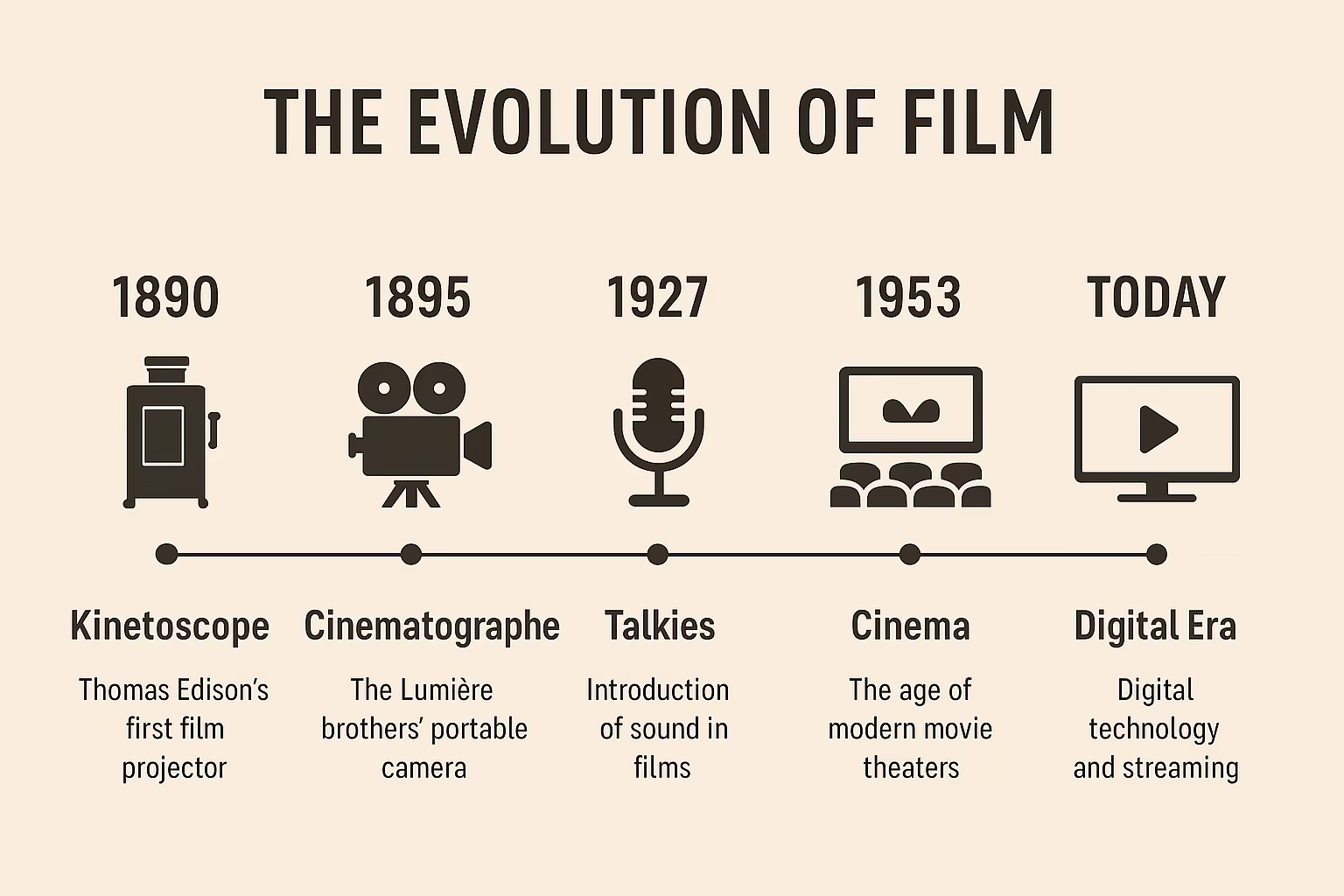
The success of the Kinetoscope inspired inventors worldwide to improve on Edison’s concept. Soon after, devices such as the Lumière brothers’ Cinématographe in France and the Vitascope in the United States made it possible to project films onto large screens for group viewing.
While Edison’s Kinetoscope was not the final form of motion picture technology, it served as the crucial stepping stone that inspired future innovations.
8. The Kinetoscope’s Legacy
Today, the Kinetoscope is celebrated as a milestone in film history. Museums around the world preserve original Kinetoscope machines as part of cinema heritage. It represents:
- The birth of motion pictures.
- The intersection of science and art.
- The foundation of the film industry we know today.
From Edison’s invention came the global phenomenon of cinema, evolving from silent black-and-white films to the colorful, high-definition, and digital experiences of today.
9. Interesting Facts About the Kinetoscope
- The word “Kinetoscope” comes from the Greek words kineto (movement) and scope (to view).
- The films were produced in Edison’s Black Maria Studio, often called the first movie studio.
- The very first Kinetoscope films included dancers, boxers, and vaudeville performers—showing how entertainment was central to early cinema.
10. Conclusion: The Dawn of Modern Cinema
The invention of the Kinetoscope in 1897 by Thomas Edison marked the beginning of a new era in human culture. For the first time, people could watch moving pictures—a technology that transformed not just entertainment but also communication, education, and art.
Although limited in design, the Kinetoscope opened the door for future innovations, eventually leading to theaters, Hollywood, and the global film industry. It was the spark that ignited the world’s love affair with movies, an art form that continues to evolve today.
Edison’s Kinetoscope reminds us that every great revolution begins with a small invention, and in this case, it was a box with a peephole that forever changed the way humanity tells stories.