Introduction
The invention and development of the first commercial electrical lighting system marked a turning point in human history. Before electricity, societies relied on candles, oil lamps, and gas lighting, which were costly, dangerous, and limited in efficiency. The arrival of electrical lighting not only changed how people lived and worked but also fueled the rapid industrial growth of the late 19th and early 20th centuries. This article explores the origins, development, and impact of the first commercial electrical lighting system that forever transformed the modern world.
The Need for Electrical Lighting
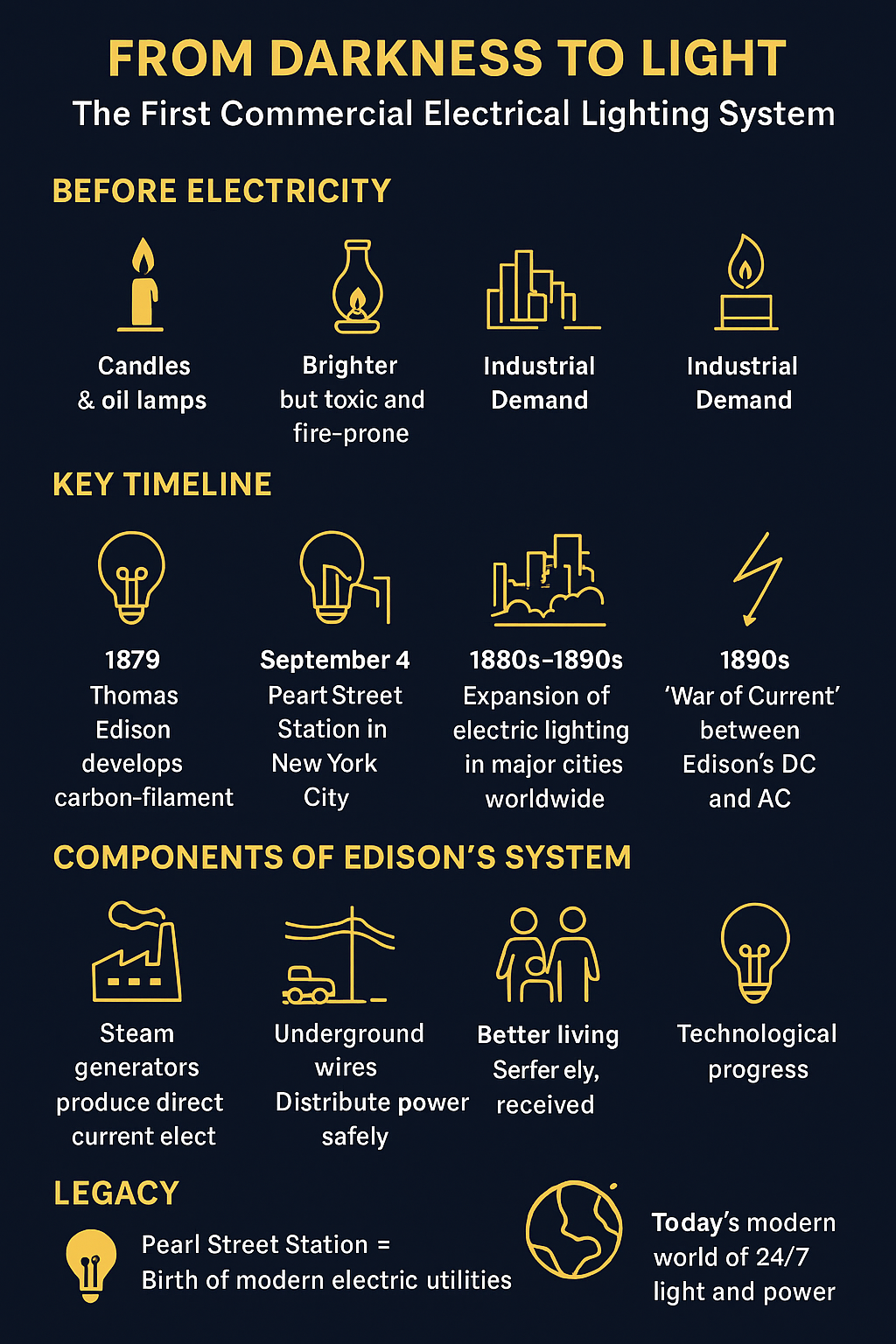
Prior to electricity, lighting was a major challenge for households, businesses, and cities. Gas lamps provided some improvement over candles and oil lamps, but they came with risks such as fire hazards, toxic fumes, and high operational costs. As industrialization expanded, the demand for safer, brighter, and more efficient lighting solutions grew. Factories required well-lit environments to increase productivity, while cities sought better street lighting for safety and urban development. These needs laid the foundation for the pursuit of a new form of illumination—electrical lighting.
The Role of Thomas Edison
Although many inventors contributed to the development of electric lighting, Thomas Alva Edison is often credited with creating the first practical and commercially viable electrical lighting system. In 1879, Edison successfully developed a carbon-filament light bulb that could last up to 40 hours. However, a light bulb alone was not enough; Edison understood that a complete system was necessary to distribute electricity safely and reliably to homes, businesses, and public spaces.
By 1882, Edison had developed an entire electrical distribution network, including generators, wiring, fuses, and switches. His vision was not just to create a light bulb but to revolutionize how people used energy.
The Pearl Street Station: Birth of the Commercial Electrical Lighting System
On September 4, 1882, Edison’s Pearl Street Station in Lower Manhattan, New York City, officially began operation. This power plant was the first commercial central power station in the world. It supplied electricity to 59 customers in the area, powering around 400 lamps.
The Pearl Street Station operated using direct current (DC) and demonstrated for the first time that a centralized power plant could deliver reliable electricity to multiple consumers. Although limited in range, it proved the feasibility of an integrated electrical lighting system, combining generation, distribution, and consumption.
Components of the First Electrical Lighting System
Edison’s system was groundbreaking because it was not just about the light bulb. It consisted of several key components that made large-scale electrical distribution possible:
- Power Generation:
Pearl Street Station used steam-driven dynamos (generators) to produce direct current electricity. - Distribution Network:
Underground copper wires carried electricity to nearby homes and businesses, reducing fire hazards compared to overhead lines. - Safety Mechanisms:
Edison’s design included fuses and switches, ensuring that the system was safer than gas lighting. - End-Use Devices:
The incandescent light bulb was the centerpiece of the system, offering longer-lasting, brighter, and safer illumination.
Competition and the “War of Currents”
Although Edison pioneered the commercial electrical lighting system, he faced competition from inventors like Nikola Tesla and George Westinghouse, who promoted alternating current (AC) systems. Unlike Edison’s direct current, AC allowed electricity to be transmitted over longer distances with less energy loss.
This rivalry, famously known as the War of Currents, shaped the evolution of the electrical industry. Eventually, AC power became the standard for long-distance transmission, but Edison’s system laid the foundation for centralized power generation and commercial electricity use.
Impact on Society and Industry
The introduction of the first commercial electrical lighting system had profound effects on society:
- Extended Working Hours:
Factories and businesses could operate after sunset, boosting productivity and economic growth. - Urban Transformation:
Cities became safer and more vibrant at night, fostering nightlife, public activities, and urban expansion. - Health and Safety Improvements:
Electrical lighting reduced the fire hazards and harmful emissions associated with gas lamps and candles. - Technological Progress:
The system paved the way for the electrification of homes, appliances, and eventually entire industries. - Cultural Impact:
Access to reliable lighting changed how people lived, studied, and socialized, ushering in a new era of modern life.

Global Spread of Electrical Lighting
After the success of Pearl Street Station, electrical lighting systems quickly spread across the United States and Europe. By the late 19th century, many major cities had adopted electric lighting for streets, factories, and public buildings. The momentum continued into the 20th century, with electrical infrastructure becoming a cornerstone of urban development and industrial power.
Legacy of the First Commercial Electrical Lighting System
Edison’s Pearl Street Station was more than just a technical achievement—it was the birth of the modern electric utility industry. It demonstrated that electricity could be generated, distributed, and consumed on a large scale, setting the stage for the global electrification that followed.
Today, electrical power is an essential part of daily life, powering everything from lighting to communication systems, industries, and transportation. The first commercial electrical lighting system laid the foundation for this technological revolution, making it one of the most important milestones in human history.
Conclusion
The first commercial electrical lighting system was not merely an invention but a transformation of civilization. From Edison’s Pearl Street Station in 1882 to the vast power grids of today, the evolution of electrical lighting demonstrates how innovation can reshape industries, societies, and human progress. Without this breakthrough, the modern world as we know it—bright, connected, and electrified—would not exist.