

Introduction of First African American in Space
On August 30, 1983, history was made when Guion S. Bluford Jr. became the First African American in Space aboard the Space Shuttle Challenger (STS-8 mission). His groundbreaking journey symbolized not only a major achievement in the U.S. space program but also an important milestone in the fight for equality and representation in science, technology, engineering, and mathematics (STEM).
Bluford’s career spanned decades of military service, aerospace engineering, and space exploration, making him a true pioneer who inspired generations of future astronauts and scientists. This article explores his life, career, and legacy as the first African American in space.
Early Life and Education
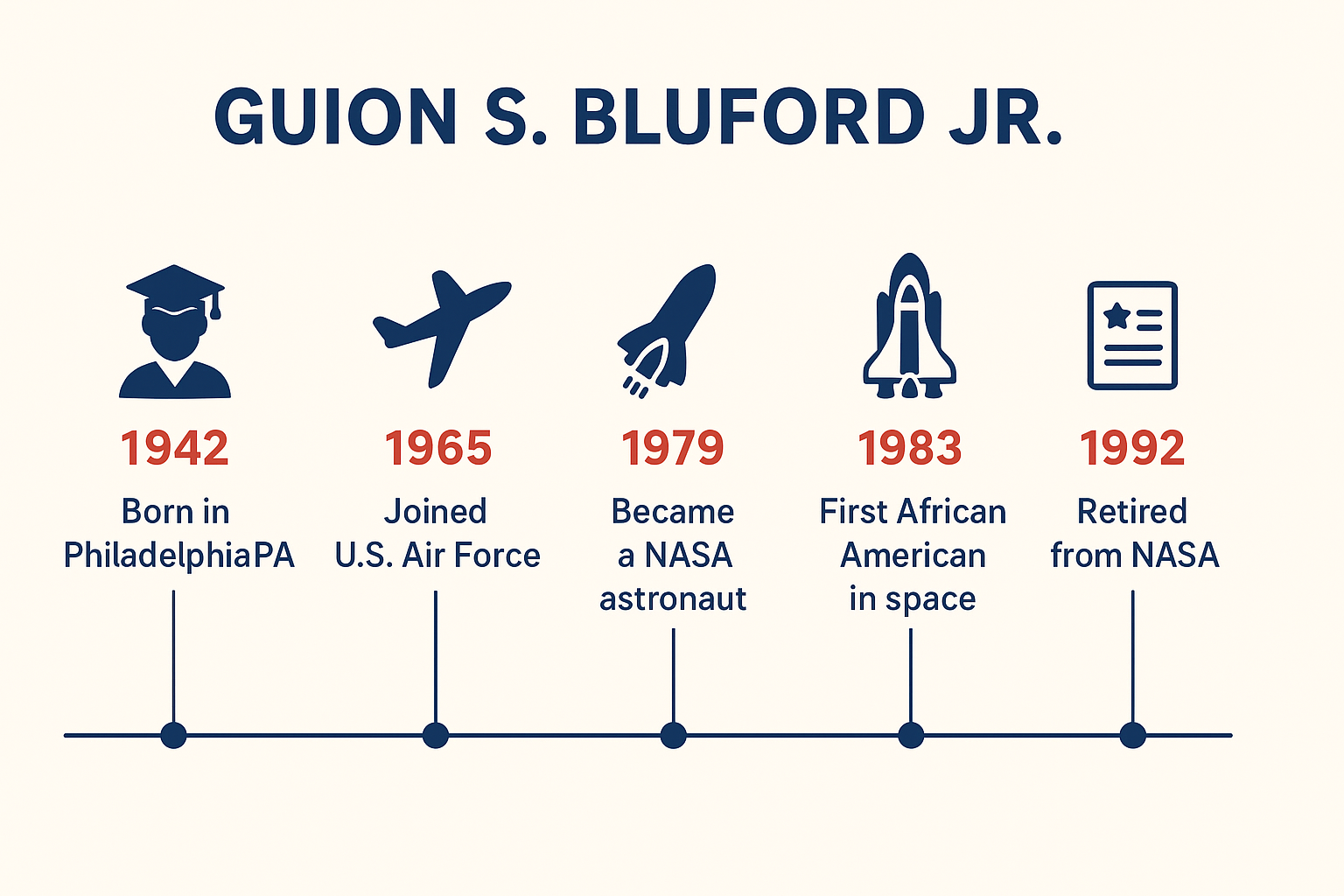
Guion Stewart Bluford Jr. was born on November 22, 1942, in Philadelphia, Pennsylvania. Growing up in an era of racial segregation, Bluford’s success was the result of determination, family support, and resilience against barriers.
- He graduated from Overbrook High School in 1960.
- He earned a Bachelor of Science degree in Aerospace Engineering from Pennsylvania State University in 1964.
- Bluford later earned a Master’s degree (1974) and a Ph.D. in Aerospace Engineering (1978) from the Air Force Institute of Technology.
- He also obtained a Master of Business Administration (MBA) from the University of Houston–Clear Lake in 1987.
His academic achievements alone placed him among the top aerospace engineers of his generation, preparing him for a future role at NASA.
Military and Aviation Career
Before joining NASA, Bluford served as a U.S. Air Force pilot. After graduating from Officer Training School in 1965, he earned his wings and went on to become a skilled fighter pilot.
- He flew 144 combat missions during the Vietnam War.
- He logged over 5,200 hours of jet flight time in aircraft such as the F-4C Phantom II.
- Bluford worked as a flight instructor and test pilot, where he developed expertise in aerospace technology.
This extensive aviation background helped him stand out as an astronaut candidate when NASA was seeking highly skilled pilots and engineers for the Space Shuttle program.
Becoming a NASA Astronaut
In 1978, NASA selected Bluford as one of 35 astronauts in Group 8, the first group to include women and minorities. Out of thousands of applicants, Bluford’s experience as a pilot, engineer, and academic made him an ideal candidate.
Becoming an astronaut in the late 1970s was not only a personal achievement but also a breakthrough moment for African Americans. At that time, few Black scientists or engineers were represented in NASA’s highest ranks. Bluford’s selection symbolized progress in inclusion within the space program.
The Historic STS-8 Challenger Mission
Bluford made history on August 30, 1983, when he launched aboard the Space Shuttle Challenger as a mission specialist on STS-8.
Key facts about the mission:
- Launch Date: August 30, 1983, from Kennedy Space Center.
- Crew: Five astronauts, including Commander Richard Truly.
- Bluford’s Role: Mission specialist, responsible for operating experiments and testing new equipment.
- Mission Highlights:
- Deployed the INSAT-1B communications satellite for India.
- Conducted experiments on night launches and space conditions.
- Carried out biomedical tests to study the effects of space on the human body.
STS-8 lasted 6 days, 23 hours, and 59 minutes, before successfully landing at Edwards Air Force Base in California on September 5, 1983.
Bluford described the experience as “a great ride,” becoming a global symbol of achievement and hope for minorities in STEM.
Later NASA Missions
Bluford’s space career did not end with STS-8. He went on to participate in three more missions, contributing significantly to shuttle operations and space research.
- STS-61A (October 1985) – West German Spacelab mission, focused on scientific experiments.
- STS-39 (April 1991) – A classified Department of Defense mission aboard Discovery.
- STS-53 (December 1992) – Another Department of Defense mission, marking Bluford’s fourth and final flight.
In total, Bluford logged 688 hours in space, establishing himself as one of NASA’s most experienced astronauts of his era.

Achievements and Legacy
Guion S. Bluford Jr. achieved many “firsts” in his career, but his legacy extends far beyond being the first African American astronaut.
- Role Model: Inspired countless students, particularly African Americans, to pursue careers in STEM.
- Awards: Received numerous honors, including the NASA Distinguished Service Medal and induction into the U.S. Astronaut Hall of Fame (1997).
- Academic Contributions: After leaving NASA, Bluford held leadership roles in the aerospace industry and continued to support education initiatives.
Bluford’s pioneering journey proved that space exploration was open to all people, regardless of race or background, and paved the way for future astronauts such as Mae Jemison (first African American woman in space) and Charles Bolden (first African American NASA Administrator).
Cultural and Historical Impact
The significance of Bluford’s first flight cannot be overstated. At a time when African Americans were still fighting for representation in many professional fields, his success became a symbol of progress.
His story is often highlighted during Black History Month and is taught in schools as part of the history of space exploration. He showed that representation matters—and that diversity strengthens science and discovery.
Conclusion of First African American in Space
Guion S. Bluford Jr.’s journey to space on August 30, 1983, marked a turning point in both NASA history and American history. As the First African American in Space, he broke barriers, inspired future astronauts, and demonstrated that perseverance, talent, and dedication could overcome the obstacles of inequality.
Today, his legacy continues to motivate young scientists, engineers, and dreamers to reach for the stars—both figuratively and literally.