Discovery of Electromagnetic Induction ~ In the history of science and technology, few discoveries have had as profound an impact as Michael Faraday’s breakthrough in 1831. With a series of brilliant experiments, Faraday uncovered the principle of electromagnetic induction, which would become the foundation for electric generators, transformers, and countless technologies that shape our modern world. His work not only transformed physics but also laid the groundwork for the electrification of society.
This article explores the historical context, Faraday’s experiments, the principle of induction, its applications, and why this discovery remains one of the most important scientific milestones in human history.
The Historical Context: Electricity in the Early 19th Century
By the early 1800s, electricity was still a mysterious force. Scientists such as Alessandro Volta had invented the Voltaic pile in 1800, providing a continuous source of electrical current. Hans Christian Ørsted’s discovery in 1820—that an electric current could deflect a compass needle—revealed the connection between electricity and magnetism.
André-Marie Ampère expanded on this, developing mathematical laws describing electromagnetism. However, the reverse question remained unanswered: Could magnetism produce electricity?
It was Michael Faraday who would provide the groundbreaking answer.
Michael Faraday: The Self-Taught Scientist
Born in 1791 in England to a poor family, Michael Faraday had little formal education. He worked as a bookbinder’s apprentice, where he read scientific books that fueled his curiosity. His talent and dedication eventually earned him a position as an assistant to Humphry Davy at the Royal Institution.
Despite his humble background, Faraday developed into one of the greatest experimental scientists in history. His practical mindset and intuition for natural laws allowed him to make discoveries that eluded many of his contemporaries.
The Discovery of Electromagnetic Induction (1831)
In 1831, Faraday conducted a series of experiments to test whether a magnetic field could generate an electric current.
The Experiment
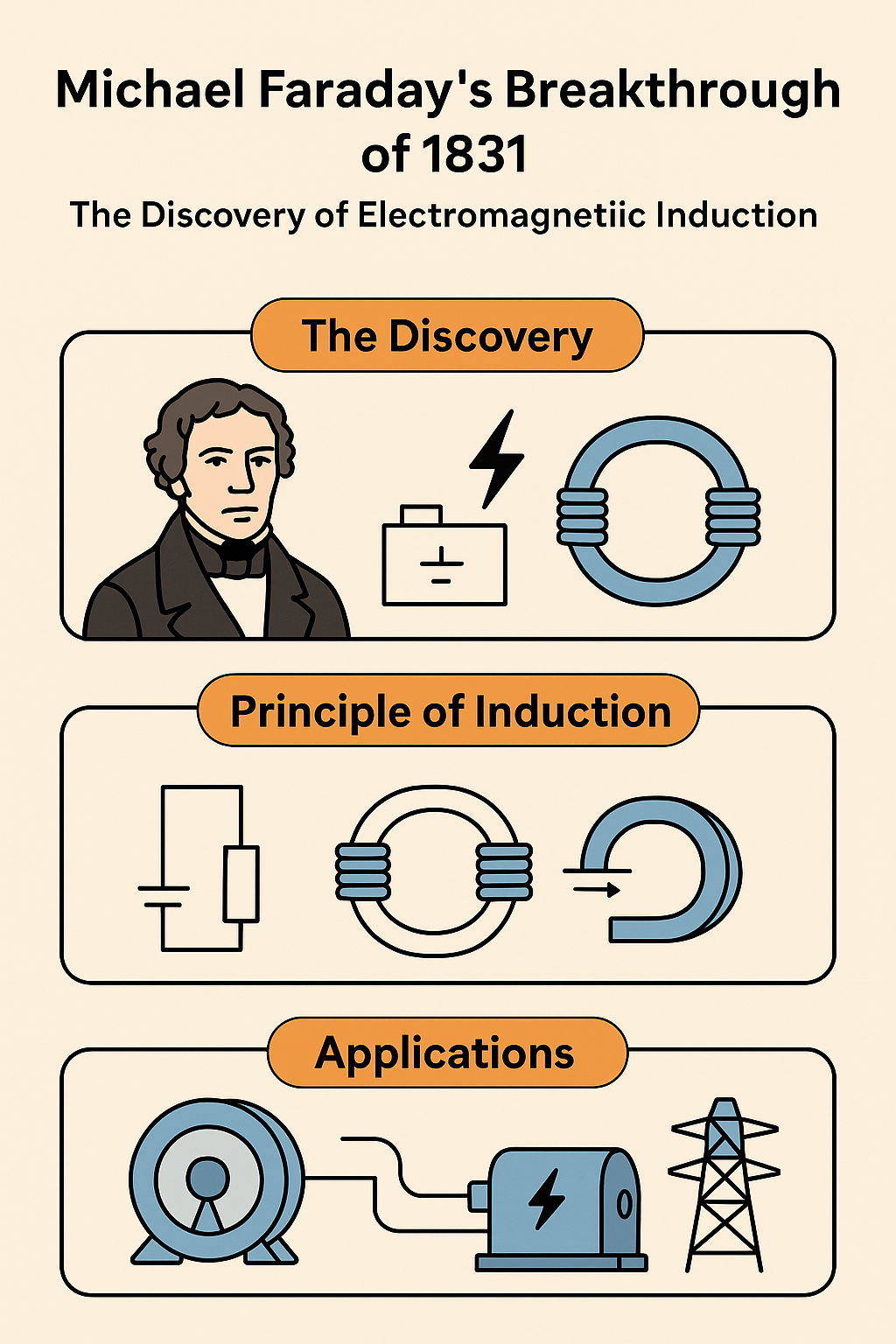
Faraday wound two coils of insulated wire around opposite sides of an iron ring. When he connected one coil to a battery, he observed that a momentary current was induced in the other coil—even though they were not directly connected.
This showed that a changing magnetic field in one coil could induce an electric current in the other. He had discovered electromagnetic induction.
Key Findings
- A changing magnetic field can induce an electric current.
- The strength of the induced current depends on the rate of change of the magnetic field.
- Motion between a conductor and a magnetic field produces electricity.
This principle became known as Faraday’s Law of Induction and remains a cornerstone of electromagnetism.
Scientific Impact of Faraday’s Law
Faraday’s discovery provided the missing link in the chain of electricity and magnetism. While Ørsted and Ampère had shown that electricity could produce magnetism, Faraday showed that magnetism could produce electricity.
This symmetry completed the foundation of electromagnetic theory, which James Clerk Maxwell would later formalize in his famous equations. Faraday’s discovery also moved science from theoretical curiosity toward practical technology.
Applications: From Discovery to Everyday Technology
The principle of electromagnetic induction is the basis of many technologies that define modern civilization.
1. Electric Generators
By rotating a coil within a magnetic field, mechanical energy is converted into electrical energy. This principle powers hydroelectric dams, wind turbines, and power plants worldwide. Without Faraday’s discovery, the generation of large-scale electricity would not be possible.
2. Transformers
Faraday’s principle also explains how transformers work—devices that transfer electrical energy between circuits and adjust voltage levels. They are essential for distributing electricity over long distances.
3. Induction Motors
Nikola Tesla later built upon Faraday’s work to design induction motors, which revolutionized industry and household appliances.
4. Wireless Charging and Induction Heating
Modern innovations, such as wireless charging for smartphones and induction cooking, directly rely on the principle Faraday discovered nearly two centuries ago.

Why Faraday’s Breakthrough Still Matters
Faraday’s discovery is not just a historical curiosity—it is a living foundation of modern technology. Every time you turn on a light, charge your phone, or use an appliance, Faraday’s principle is at work.
Moreover, his experiments demonstrated the power of scientific curiosity and practical experimentation. Despite lacking advanced mathematics, Faraday relied on intuition, careful observation, and persistence to unlock one of nature’s greatest secrets.
Legacy of Michael Faraday
Michael Faraday’s contribution goes beyond induction. He introduced key concepts such as the electric field and lines of force, which became central to physics. His humility, devotion to science, and ability to communicate complex ideas inspired generations of scientists.
Today, his name is honored in scientific units such as the Farad (capacitance) and in institutions worldwide. His 1831 breakthrough remains a shining example of how human curiosity can reshape civilization.
Conclusion of Discovery of Electromagnetic Induction
Michael Faraday’s 1831 discovery of electromagnetic induction was a turning point in human history. It bridged electricity and magnetism, laid the foundation for modern power systems, and continues to influence technologies we use daily.
Without Faraday’s insight, the modern world—powered by electric generators, transformers, and countless applications—would look entirely different. His breakthrough was not just a scientific discovery; it was the birth of the electrical age.