Introduction to Basic R&D
In today’s fast-paced and competitive global market, Research and Development (R&D) plays a crucial role in driving progress and innovation. While many organizations focus heavily on applied R&D—developing practical solutions and market-ready products—it is Basic R&D that forms the bedrock of long-term success.
Basic R&D, sometimes referred to as fundamental research, is not aimed directly at immediate commercial applications. Instead, it focuses on expanding knowledge, exploring new ideas, and understanding the underlying principles of science and technology. Without this essential stage, the groundbreaking technologies we use daily—from smartphones to renewable energy systems—would not exist.
This article explores the meaning of Basic R&D, its importance, methods, challenges, and how businesses and governments benefit from investing in it.
What is Basic R&D?
Basic R&D refers to the systematic study and investigation into fundamental principles without targeting immediate practical outcomes. Unlike applied R&D, which focuses on solving specific problems or creating commercial products, basic research is about curiosity-driven exploration.
For example:
- Physicists studying quantum mechanics without knowing how it could later revolutionize computing.
- Biologists researching genetic codes without predicting its impact on biotechnology and medicine.
These discoveries eventually lead to groundbreaking technologies, but their initial purpose is simply to understand rather than to apply.
Key Objectives of Basic R&D
The primary goals of basic research and development can be summarized as:
- Advancing Scientific Knowledge
Expanding our understanding of natural phenomena, materials, or processes. - Creating a Knowledge Foundation
Providing the theoretical framework for applied research and industrial development. - Fostering Innovation
Enabling unexpected breakthroughs that can be transformed into revolutionary products and services. - Training and Development
Building expertise and training scientists, engineers, and innovators.
The Role of Basic R&D in Innovation
Many of the technologies that shape our modern lives were born out of basic R&D efforts. For example:
- The Internet: Originally developed from research into computer networking.
- GPS: Evolved from fundamental studies in satellite technology and physics.
- Medical Imaging (MRI): Rooted in quantum mechanics research.
These examples highlight how long-term investments in basic research eventually result in transformative applications. Even though the process may take years or decades, it ensures sustainable innovation.
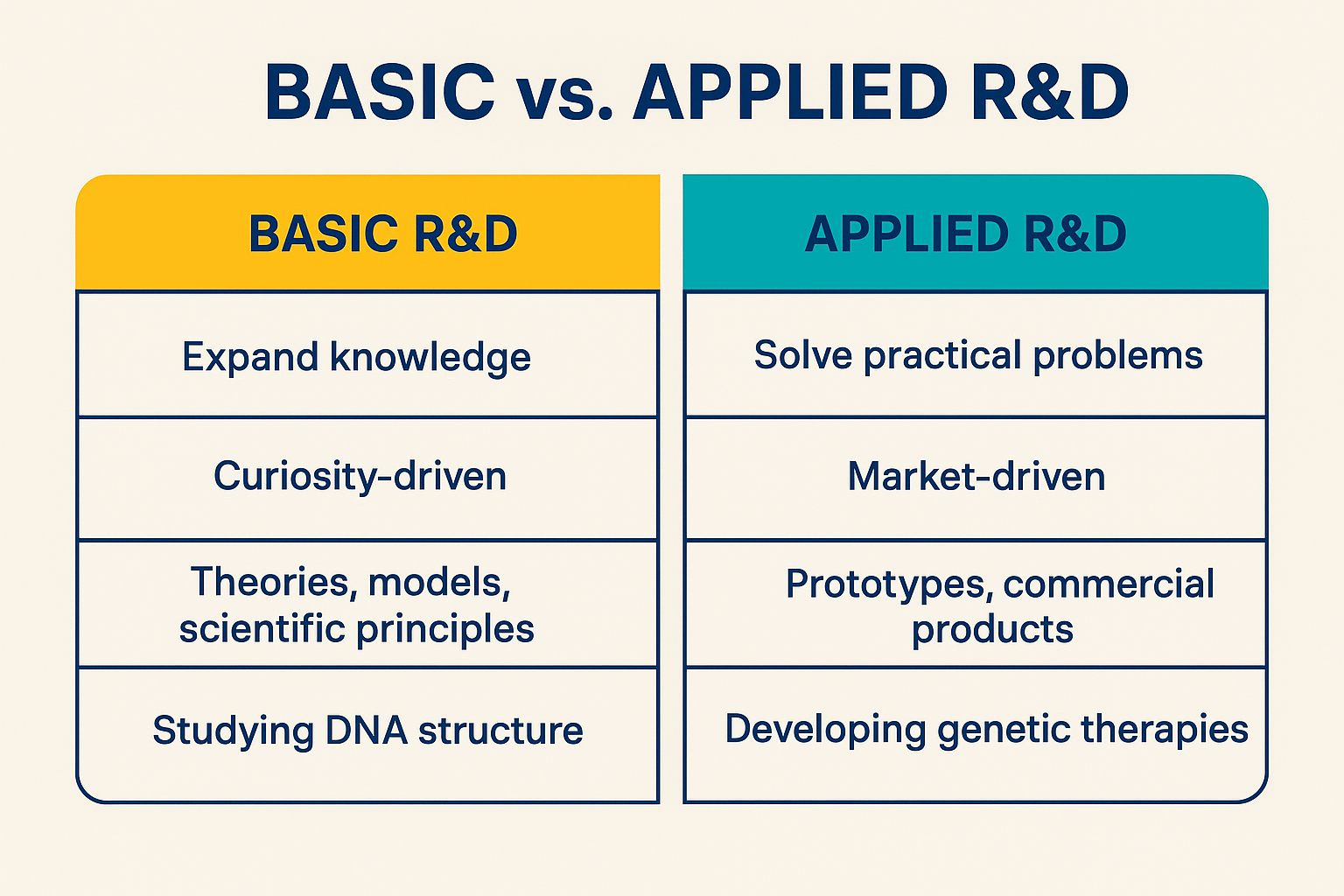
Difference Between Basic and Applied R&D
It is important to differentiate between basic and applied research:
| Aspect | Basic R&D | Applied R&D |
|---|---|---|
| Objective | Expand knowledge | Solve practical problems |
| Focus | Curiosity-driven | Market-driven |
| Output | Theories, models, scientific principles | Prototypes, commercial products |
| Example | Studying DNA structure | Developing genetic therapies |
Both are essential and interconnected. Basic research creates knowledge, while applied research uses that knowledge to develop real-world solutions.
Methods of Conducting Basic R&D
Basic R&D follows a systematic process that typically includes:
- Identifying Research Questions
Scientists ask fundamental questions such as “How does this phenomenon work?” - Theoretical Research
Developing models, frameworks, and simulations. - Experimental Research
Conducting lab experiments to test hypotheses. - Data Analysis
Using statistical tools and computational models to interpret results. - Publishing Findings
Sharing knowledge through scientific journals, conferences, and collaborations.
Why Businesses Should Invest in Basic R&D
Many companies hesitate to invest in basic R&D because of the long time horizon before results become profitable. However, organizations that support fundamental research often become industry leaders.
Benefits include:
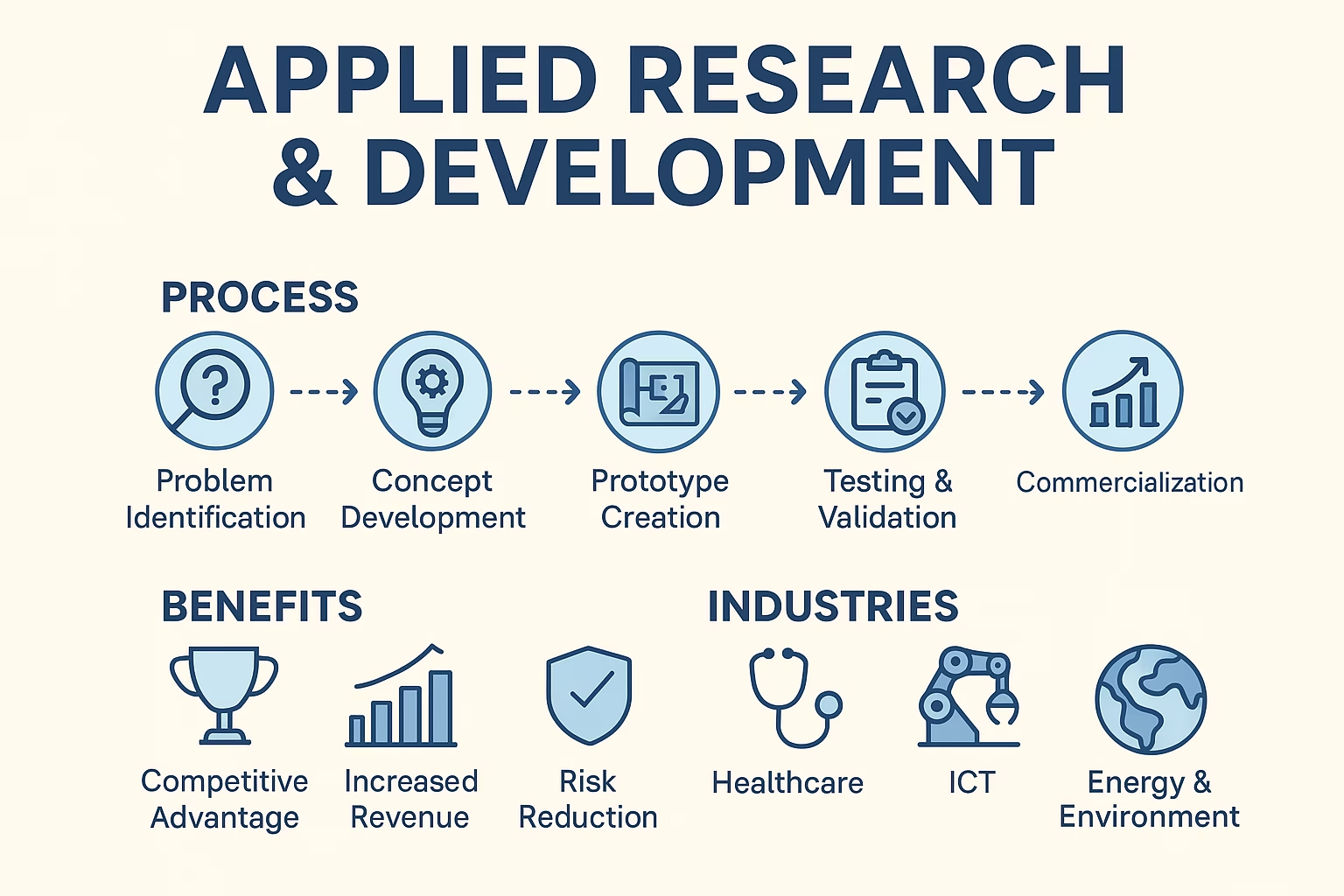
- Competitive Advantage: Gaining early access to groundbreaking discoveries.
- Sustainable Innovation: Ensuring long-term technological leadership.
- Collaboration Opportunities: Partnering with universities, research labs, and governments.
- Brand Reputation: Being recognized as an innovative and forward-thinking company.
For example, companies like IBM, Google, and Pfizer have invested heavily in basic research, resulting in innovations in computing, artificial intelligence, and pharmaceuticals.
Government and Institutional Role in Basic R&D
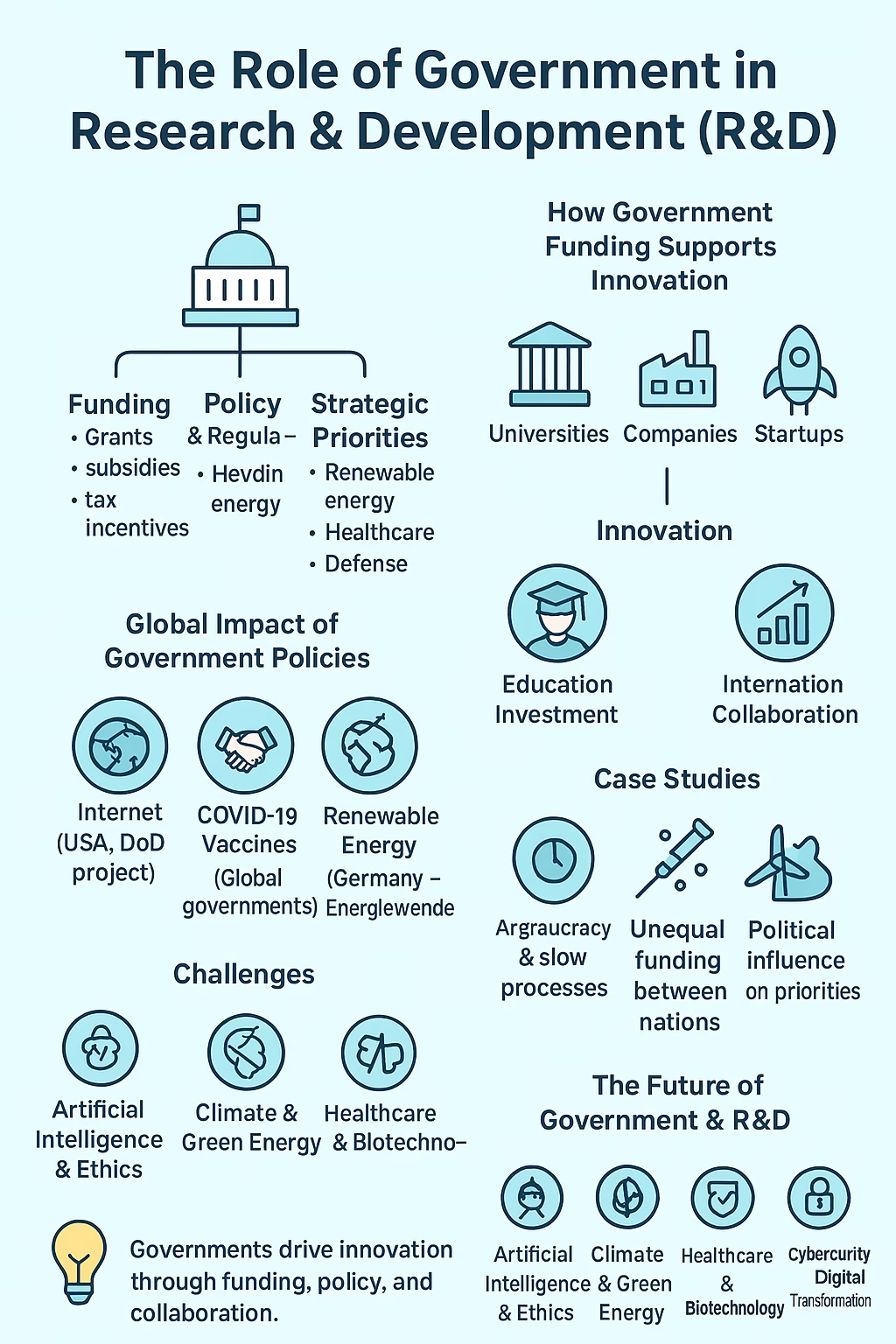
Governments and academic institutions often play a central role in funding and supporting basic research. Since private companies may not always see short-term profit in fundamental studies, public investments are critical.
Examples include:
- NASA funding space science research.
- National Institutes of Health (NIH) supporting medical research.
- European Union’s Horizon Program funding multi-disciplinary scientific studies.
These initiatives create a knowledge ecosystem that fuels industrial innovation later on.

Challenges in Basic R&D
Despite its importance, basic R&D faces several challenges:
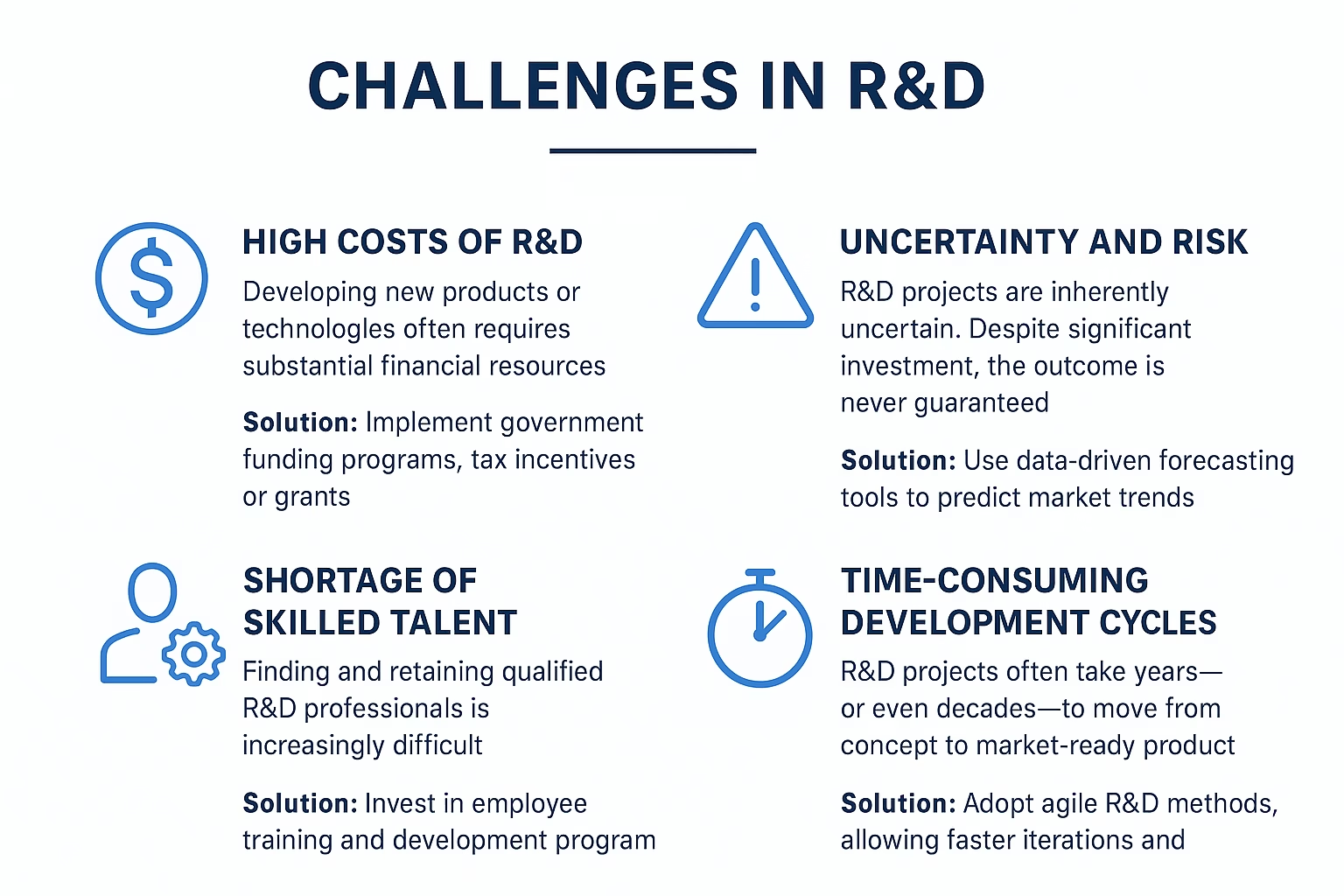
- Funding Limitations: Securing consistent financial support is difficult.
- Long Development Cycles: Results may take decades to reach commercial use.
- High Uncertainty: No guarantee of immediate practical benefits.
- Talent Retention: Attracting and retaining top researchers can be costly.
Still, the potential rewards far outweigh the risks, making basic research a necessary investment for long-term growth.
The Future of Basic Research
With rapid technological progress, basic R&D is becoming more critical than ever. Emerging fields like artificial intelligence, quantum computing, nanotechnology, and biotechnology all rely heavily on ongoing basic research.
In the future, we can expect:
- More global collaboration between universities, industries, and governments.
- Integration of AI and big data to accelerate research processes.
- Sustainable innovation driven by renewable energy and green technologies.
Organizations that embrace basic research today will be the pioneers of tomorrow’s technological revolutions.
Conclusion
Basic R&D is the foundation of scientific and technological progress. While it may not produce immediate commercial products, its role in expanding knowledge, fostering innovation, and shaping the future cannot be overstated.
Companies, governments, and institutions must continue to invest in fundamental research if they wish to stay ahead in an increasingly competitive and innovation-driven world. By supporting basic R&D, we lay the groundwork for transformative discoveries that will improve industries, societies, and global development.