5G and IoT integration ~ In the digital age, connectivity is the lifeblood of innovation. As our world grows increasingly dependent on data and real-time interaction between devices, two transformative technologies—5G and the Internet of Things (IoT)—are converging to shape a future that is faster, smarter, and more interconnected than ever before.
This article delves into the synergy between 5G and IoT, highlighting the technical advancements, industry use cases, challenges, and the vast potential they hold for the future of technology.
Understanding 5G and IoT Integration: A Quick Primer
What is 5G?
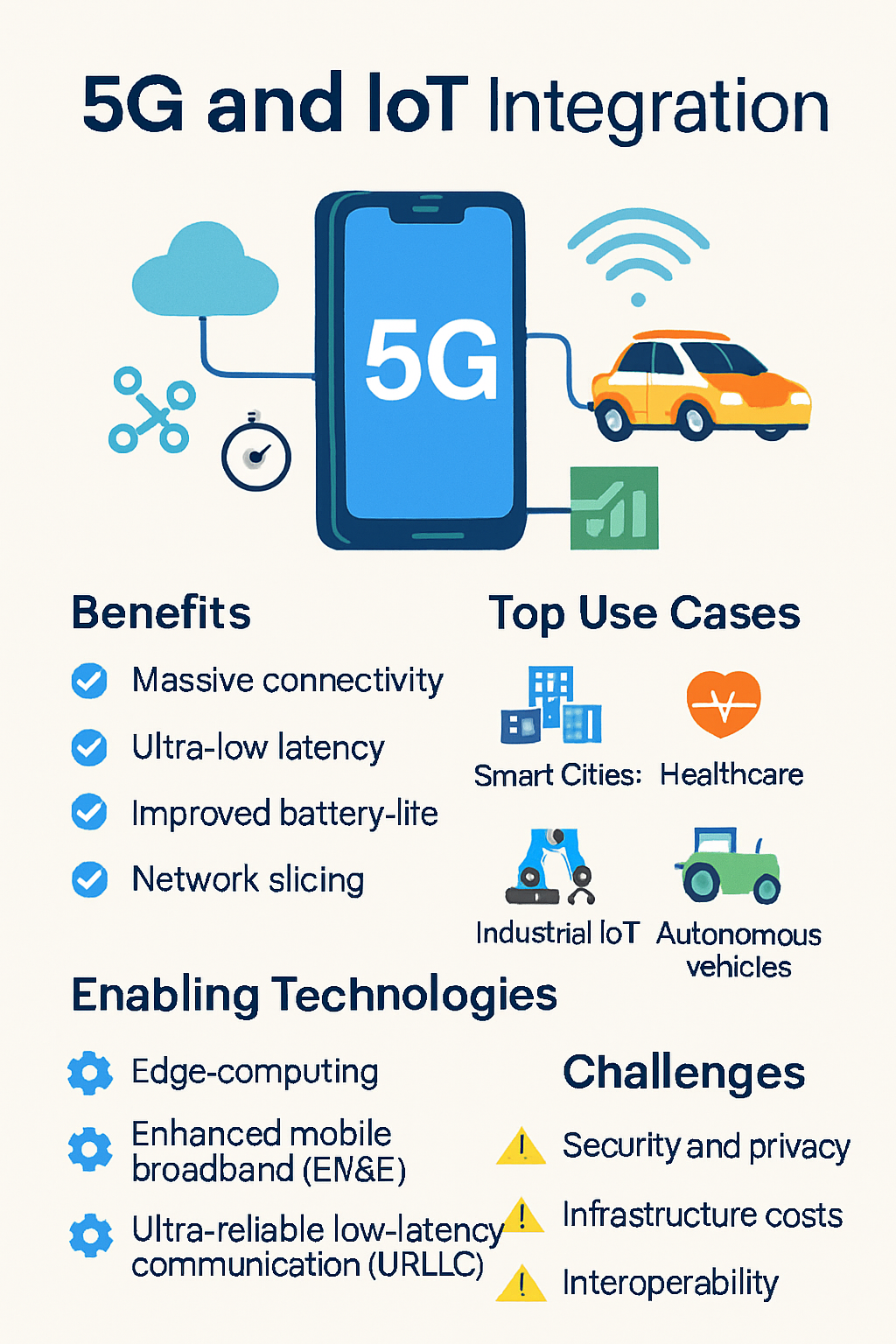
5G is the fifth generation of wireless cellular technology. It offers:
- Higher data transfer speeds (up to 100x faster than 4G)
- Ultra-low latency (as low as 1ms)
- Massive device connectivity
- Improved reliability and network slicing
What is IoT?
The Internet of Things (IoT) refers to a network of interconnected devices that can collect, share, and analyze data without human intervention. These devices include sensors, wearables, smart appliances, vehicles, industrial machines, and more.
Why the 5G and IoT Integration Matters
While IoT has been around for years, its true potential is unlocked with 5G. Here’s why:
- Massive Connectivity Support
5G networks can support up to 1 million devices per square kilometer, a critical enabler for densely populated smart cities and industrial environments. - Ultra-Low Latency for Real-Time Applications
IoT applications like autonomous vehicles, remote surgeries, and smart factories require real-time responses. 5G’s latency as low as 1 millisecond enables these time-sensitive operations. - Improved Battery Life for IoT Devices
5G allows efficient power use, helping low-power IoT sensors last longer—sometimes up to 10 years on a single battery. - Network Slicing for Dedicated Services
Through 5G network slicing, specific IoT use cases can run on custom virtual networks optimized for speed, reliability, or capacity.
Top Use Cases of 5G and IoT Integration
1. 5G and IoT Integration: Smart Cities
IoT devices such as traffic sensors, smart lighting, environmental monitors, and surveillance systems become exponentially more effective with 5G. Cities can:
- Reduce traffic congestion using real-time analytics
- Monitor air quality continuously
- Manage energy usage efficiently
- Improve public safety with smart surveillance
2. Healthcare and Remote Monitoring
- Wearable health monitors transmit real-time data to doctors
- Remote robotic surgeries become possible with low-latency 5G
- Smart ambulances stream patient data en route to hospitals
3. Industrial IoT (IIoT) and Smart Manufacturing
Factories use connected sensors and machines to optimize productivity. 5G enables:
- Real-time monitoring and automation
- Predictive maintenance using AI and data from IoT sensors
- Augmented reality (AR) for remote diagnostics and training
4. 5G and IoT Integration: Autonomous Vehicles
Self-driving cars need to communicate with each other (V2V), infrastructure (V2I), and pedestrians (V2P). 5G ensures:
- Low-latency data exchange
- Continuous updates from maps and cloud services
- Safer and faster decision-making
5. 5G and IoT Integration: Agriculture
Smart farming with IoT sensors tracks soil moisture, crop health, and livestock. Combined with 5G, farmers get:
- Real-time analytics for precision farming
- Automated machinery
- Drone-based surveillance and delivery
The Technical Backbone: How It Works
Edge Computing
5G enhances edge computing, allowing data processing closer to the source (e.g., factory floors, vehicles), minimizing latency and reducing the load on cloud infrastructure.
Enhanced Mobile Broadband (eMBB)
Supports high-data-rate applications such as HD surveillance, real-time video streaming, and AR/VR.
Ultra-Reliable Low-Latency Communication (URLLC)
Enables mission-critical applications like autonomous driving and smart grids with <1ms latency.
Massive Machine-Type Communication (mMTC)
Handles the connection of billions of low-power, low-data-rate IoT devices across large areas.

Challenges in 5G and IoT Integration
1. Security and Privacy Concerns
More connected devices mean a larger attack surface. Without proper encryption and monitoring, vulnerabilities can lead to data breaches or system failures.
2. Infrastructure Costs
Deploying 5G infrastructure (small cells, towers, edge computing nodes) requires significant investment, especially in rural areas.
3. Interoperability Issues
IoT ecosystems involve multiple vendors and standards. Ensuring compatibility and seamless data sharing is still a challenge.
4. Spectrum Regulation
Countries have different approaches to 5G spectrum allocation, which may slow down global harmonization of IoT networks.
Future Outlook: What’s Next?
By 2030, the IoT market is projected to exceed $1.5 trillion, and 5G connections are expected to surpass 5 billion globally. Their integration will pave the way for:
- AI-powered autonomous systems
- Decentralized energy and smart grids
- Hyperconnected healthcare systems
- Digital twins for infrastructure and manufacturing
- Seamless human-machine collaboration
Conclusion: 5G and IoT Integration
The fusion of 5G and IoT is not just an upgrade—it’s a revolution. It promises to redefine how humans, machines, and data interact, opening up a world where instant communication, automation, and intelligent decision-making are the norm.
For businesses, governments, and tech innovators, investing in this integration is not optional—it’s essential for staying relevant in the ever-evolving digital landscape.
✅ Want to explore more about smart technologies and future innovations?
Visit Abi Royen and stay updated with the latest in R&D, IoT, AI, and automation trends.