Introduction of What is a Transformer?
What is a Transformer? ~ Electricity is the backbone of modern civilization, powering everything from household appliances to massive industrial plants. One of the most important devices that make the transmission and distribution of electricity possible is the transformer. Without transformers, it would be nearly impossible to transfer electrical power efficiently across long distances.
So, what is a transformer? In simple terms, a transformer is an electrical device that changes the voltage of alternating current (AC) while maintaining the same frequency. It can either increase voltage (step-up) or decrease voltage (step-down), making it essential in power systems, electronics, and industrial operations.
This article provides a comprehensive explanation of transformers, their working principles, functions, types, and applications.
What is a Transformer?
A transformer is a static electrical device that transfers electrical energy between two or more circuits through the principle of electromagnetic induction. It does not generate power but instead modifies voltage levels to suit different applications.
Transformers are crucial in:
- Power Generation: Increasing voltage for long-distance transmission.
- Power Distribution: Reducing voltage to safe levels for household or industrial use.
- Electronics: Ensuring devices receive the correct voltage and isolation.
In essence, transformers bridge the gap between power production and consumption.
How Does a Transformer Work?
The basic principle of a transformer relies on Faraday’s Law of Electromagnetic Induction, which states that a changing magnetic field induces an electromotive force (EMF) in a nearby coil.
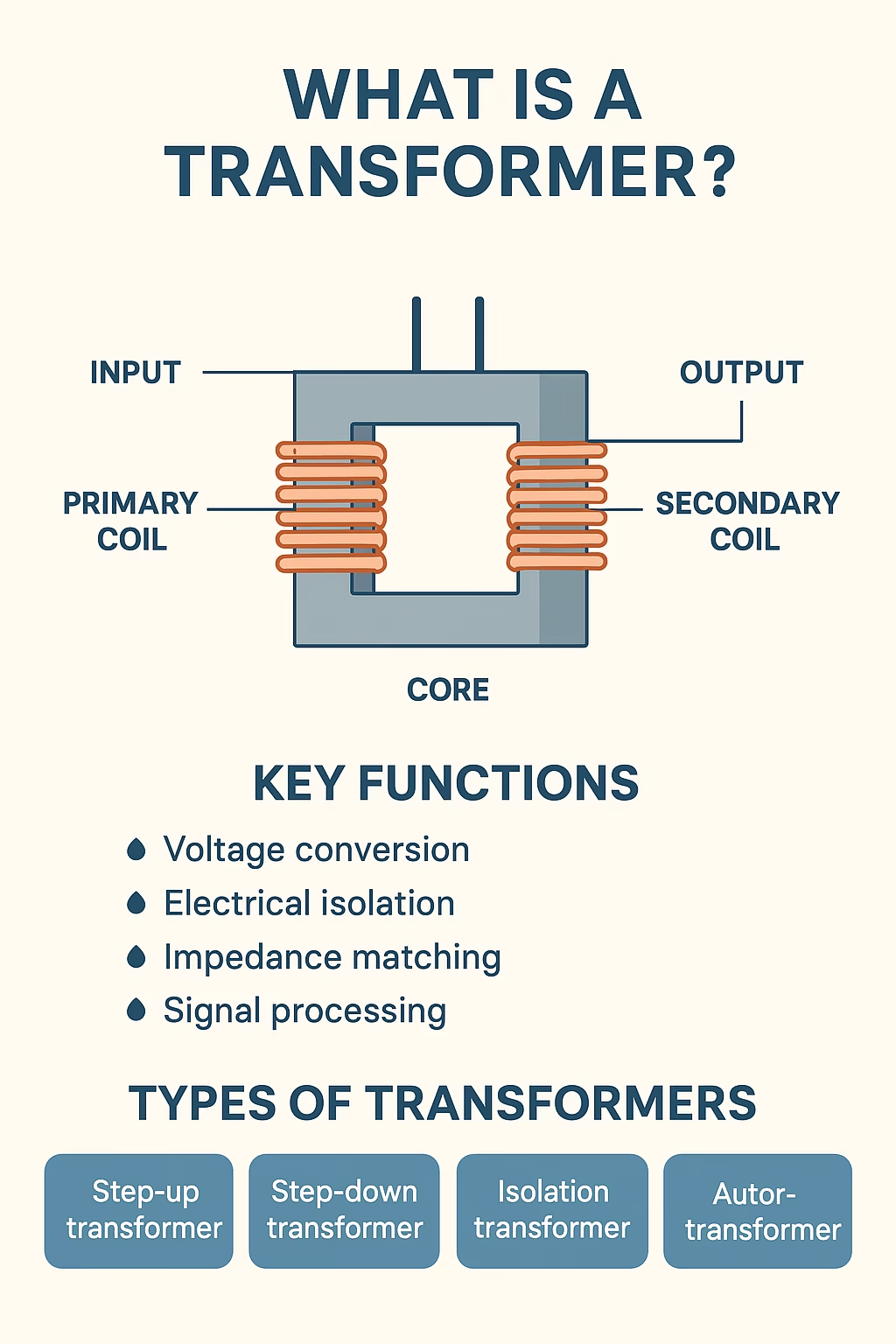
A transformer consists of:
- Primary Coil – Connected to the power source.
- Secondary Coil – Connected to the load (device or distribution line).
- Core – Made of laminated steel to provide a path for magnetic flux.
When alternating current flows through the primary coil, it generates a magnetic field in the core. This changing magnetic field induces a voltage in the secondary coil.
The voltage transformation depends on the ratio of turns in the primary and secondary coils: VpVs=NpNs\frac{V_p}{V_s} = \frac{N_p}{N_s}VsVp=NsNp
Where:
- VpV_pVp = Primary voltage
- VsV_sVs = Secondary voltage
- NpN_pNp = Number of turns in primary coil
- NsN_sNs = Number of turns in secondary coil
This formula shows that if the secondary coil has more turns than the primary, the voltage increases (step-up). Conversely, if it has fewer turns, the voltage decreases (step-down).
Key Functions of a Transformer
Transformers serve several important roles in power systems and electronics:
- Voltage Conversion
- Step-up transformers increase voltage for efficient long-distance transmission.
- Step-down transformers decrease voltage for safe household and industrial use.
- Electrical Isolation
- Prevents direct electrical contact between circuits, enhancing safety.
- Impedance Matching
- Ensures maximum power transfer between different electrical systems.
- Signal Processing
- Used in audio, radio, and communication systems for modulation and filtering.
Types of Transformers
Transformers come in various designs depending on application and structure. The main types include:
1. Based on Voltage Levels
- Step-Up Transformer – Increases voltage for transmission lines.
- Step-Down Transformer – Reduces voltage for distribution and usage.
2. Based on Core Construction
- Core-Type Transformer – Windings surround a laminated steel core.
- Shell-Type Transformer – Core surrounds the windings, offering better efficiency.
3. Based on Phases
- Single-Phase Transformer – Common in households and small industries.
- Three-Phase Transformer – Used in large-scale power distribution.
4. Special Types
- Isolation Transformer – Provides safety by electrically isolating circuits.
- Instrument Transformer – Includes current transformers (CT) and potential transformers (PT) for measurement and protection.
- Autotransformer – Uses a single winding for both primary and secondary, saving space and cost.
Applications of Transformers
Transformers are found in almost every sector of modern technology. Some common applications include:
- Power Transmission and Distribution
- Large power transformers at generating stations step up voltage for long-distance transfer.
- Distribution transformers step down voltage for homes, offices, and industries.
- Industrial Applications
- Welding machines, furnaces, and motors use specialized transformers for stable operation.
- Electronics
- Adapters, chargers, and power supplies use miniature transformers to provide required voltage.
- Communication Systems
- Transformers are used in radios, telephones, and broadcasting equipment to manage signals.
- Renewable Energy
- Solar and wind power plants use transformers to integrate generated electricity into the grid.
Advantages of Transformers
- High efficiency (95%–99%).
- Reliable and long service life.
- No moving parts, reducing maintenance needs.
- Enable safe power transmission over thousands of kilometers.

Challenges and Limitations
Despite their advantages, transformers also have limitations:
- Heavy and bulky, especially large power transformers.
- Energy losses due to hysteresis and eddy currents in the core.
- Require cooling systems for high-capacity units.
- Sensitive to overloading and short circuits.
Future of Transformers
As the world shifts toward smart grids and renewable energy integration, transformer technology is evolving. Modern developments include:
- Smart Transformers – Equipped with sensors for real-time monitoring.
- Eco-Friendly Transformers – Using biodegradable insulating fluids.
- Compact Designs – Lightweight and efficient models for urban areas.
Transformers will remain indispensable in the future of electricity distribution, supporting digital industries and sustainable power systems.
Conclusion of What is a Transformer?
A transformer is more than just an electrical device—it is the heart of modern power systems. From stepping up voltage for transmission to stepping it down for everyday use, transformers make electricity safe, efficient, and accessible. Their applications span across households, industries, electronics, and renewable energy.
As technology advances, transformers will continue to adapt, ensuring reliable energy supply for generations to come.