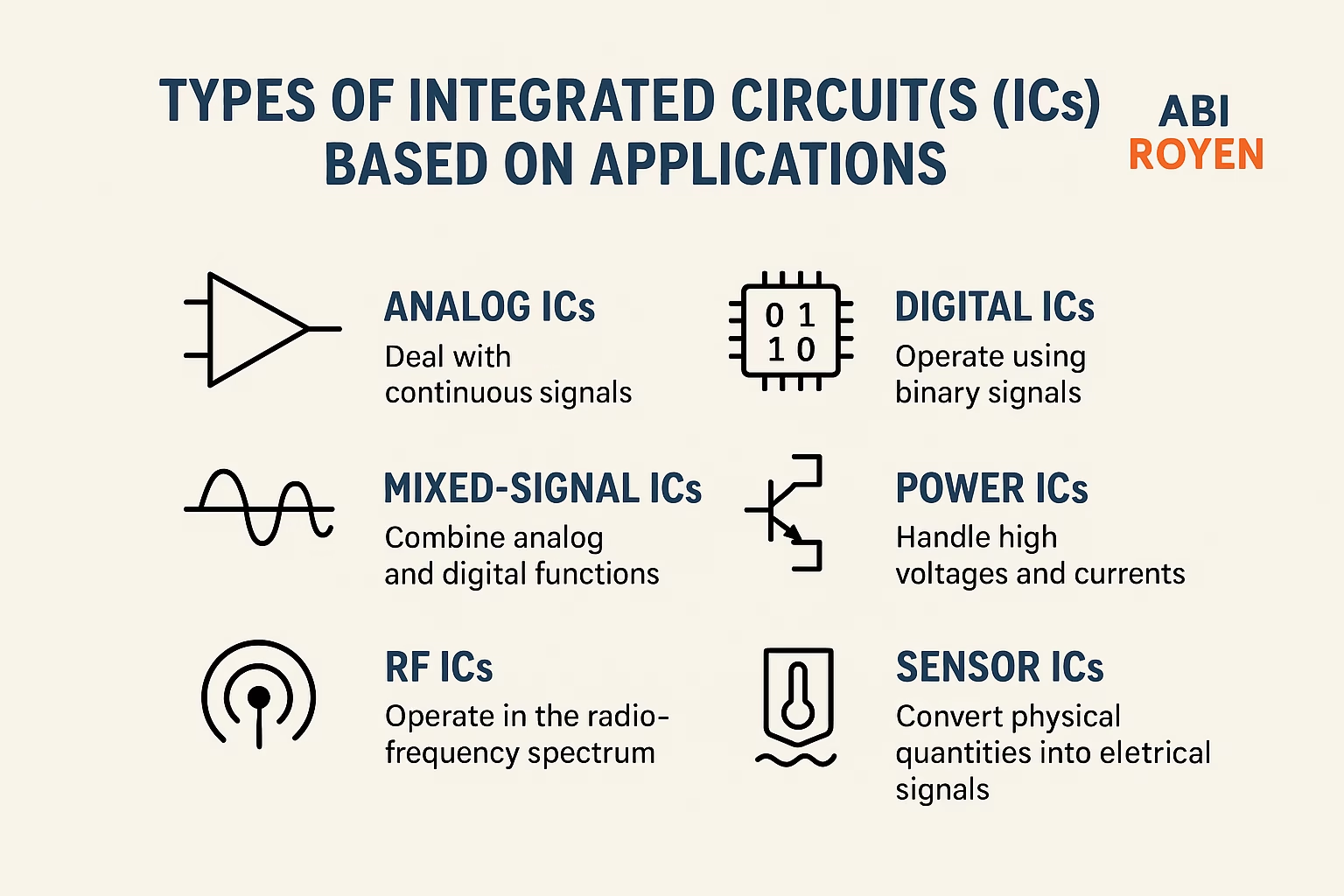
What Analog ICs ~ Analog Integrated Circuits (ICs) are the backbone of many modern electronic systems, especially where continuous signal processing is needed. Unlike digital ICs, which deal with binary data (0s and 1s), analog ICs process real-world continuous signals such as sound, light, temperature, and radio waves.
These circuits are found in applications ranging from audio amplifiers and radio receivers to sensor systems and power management devices.
In this article, we will cover the definition, working principle, types, advantages, and applications of Analog ICs to give you a complete understanding of their importance in electronics.
Definition of Analog ICs
An Analog IC (Integrated Circuit) is an electronic chip that processes continuous signals. The output signal from an analog IC varies smoothly over a range of values, rather than switching between discrete levels like a digital IC.
Examples include operational amplifiers (op-amps), voltage regulators, and analog-to-digital converters (ADCs).
The key feature of an analog IC is that it works with signals that can take on any value within a given range, which makes it perfect for real-world data processing.
How Analog ICs Work
Analog ICs function by amplifying, filtering, or modifying continuous signals.
When a real-world input (like a microphone signal) is fed into the IC, it processes the voltage or current in a way that retains its proportional variations.
Basic working principle:
- Input Signal – Continuous real-world signal enters the IC.
- Processing Stage – The IC manipulates the signal using transistors, resistors, capacitors, and other elements on a semiconductor chip.
- Output Signal – Modified or amplified continuous signal is sent to the next stage in the circuit.
Key Components Inside Analog ICs
Analog ICs are built from microscopic components integrated into a single chip. These include:
- Transistors – Control current flow.
- Resistors – Regulate voltage and current.
- Capacitors – Store and filter energy.
- Diodes – Control signal direction and voltage drops.
Types of Analog ICs
Analog ICs can be categorized into several types based on their functions:
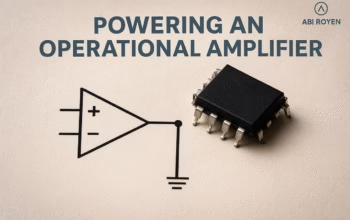
1. Operational Amplifiers (Op-Amps)
- Used for amplification, filtering, and mathematical operations.
- Examples: LM741, TL081.
2. Voltage Regulators
- Maintain a constant output voltage despite changes in input voltage or load.
- Examples: LM7805, LM317.
3. Analog Multipliers
- Multiply two analog signals.
- Used in modulation and signal processing.
4. Comparators
- Compare two voltages and output a digital signal indicating which is higher.
- Example: LM339.
5. Analog-to-Digital Converters (ADCs)
- Convert analog signals into digital format for processing by microcontrollers.
6. Digital-to-Analog Converters (DACs)
- Convert digital signals back into analog form for speakers, displays, and actuators.


Analog vs Digital ICs
| Feature | Analog ICs | Digital ICs |
|---|---|---|
| Signal Type | Continuous | Discrete (binary) |
| Precision | High for continuous data | High for logical operations |
| Speed | Often slower due to continuous processing | Generally faster |
| Examples | Op-Amps, Voltage Regulators | Microprocessors, Logic Gates |
Applications of Analog ICs
Analog ICs are widely used in:
- Audio Systems – Amplifiers, equalizers, and mixers.
- Communication Devices – Radio receivers, transmitters, and modulators.
- Sensors and Measurement Systems – Temperature sensors, strain gauges, and pressure sensors.
- Power Management – Voltage regulation and battery charging.
- Medical Equipment – ECG machines, hearing aids, and diagnostic tools.
- Industrial Automation – Process control, motor speed regulation.
Advantages of Analog ICs
- Compact Size – Multiple components in one chip reduce circuit size.
- High Reliability – Fewer interconnections mean less chance of failure.
- Lower Power Consumption – Especially in low-frequency applications.
- Cost-Effective – Mass production makes them affordable.
Limitations of Analog ICs
- Signal Noise – Susceptible to interference from external sources.
- Accuracy Limits – Precision can be affected by temperature changes.
- Design Complexity – Analog design often requires more expertise.
Future of Analog ICs
Even in a world dominated by digital technology, analog ICs remain essential. With the rise of IoT devices, medical sensors, and renewable energy systems, the demand for accurate and efficient analog signal processing is growing.
Hybrid ICs that combine analog and digital functions on a single chip (mixed-signal ICs) are becoming increasingly popular.
Conclusion of What Analog ICs
Analog ICs are vital for bridging the gap between the real world and digital systems. They process signals in their natural form, enabling electronics to interact with sound, light, temperature, and motion.
From your smartphone’s audio system to advanced medical devices, analog ICs ensure smooth, precise, and reliable operation.