How Analog ICs Work ~ Analog Integrated Circuits (ICs) are the unsung heroes of electronics, responsible for processing continuous signals in countless devices around us. From audio amplifiers to sensor interfaces, they form the backbone of many systems that require smooth and accurate signal handling. While digital ICs dominate the computing world, analog ICs remain indispensable because the real world operates in continuous, analog signals.
In this comprehensive guide, we will explore how analog ICs work, their internal structure, operating principles, and key applications, making it easier for engineers, students, and tech enthusiasts to understand their importance.
1. Understanding Analog ICs
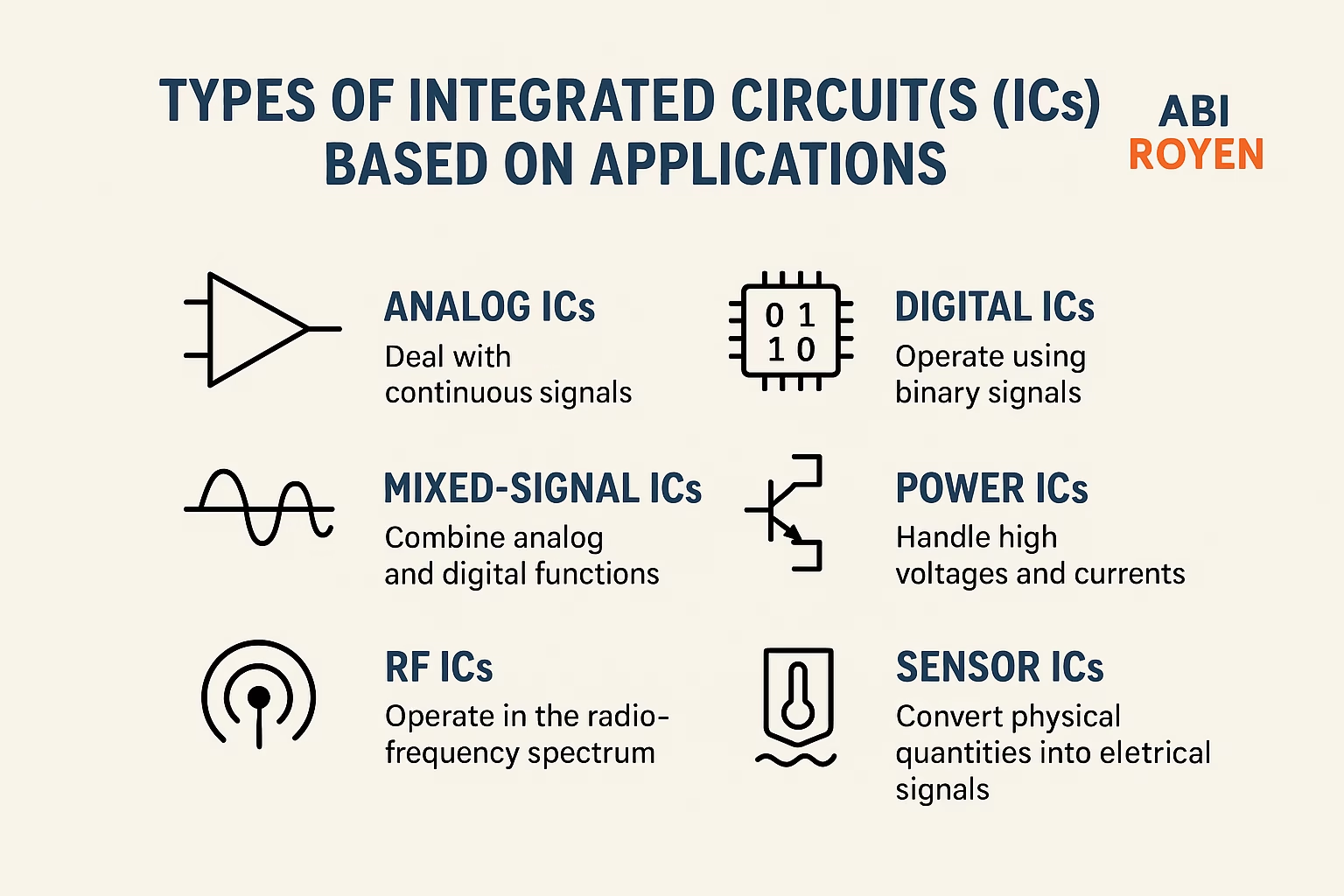
Analog ICs are semiconductor devices that manipulate continuous electrical signals. Unlike digital ICs, which work with binary logic (0s and 1s), analog ICs handle signals that can take any value within a range. This makes them ideal for applications like audio, video, and sensor data processing.
Key Features of Analog ICs:
- Process continuous waveforms
- Operate with voltage or current proportional to the input signal
- Capable of signal amplification, filtering, mixing, and modulation
- Sensitive to noise and require precise design
2. Internal Structure of Analog ICs
While each analog IC has its unique architecture, most contain common building blocks:
- Transistors (BJT or MOSFET) – Act as amplifiers or switches in the signal path.
- Resistors & Capacitors – Control signal timing, gain, and filtering.
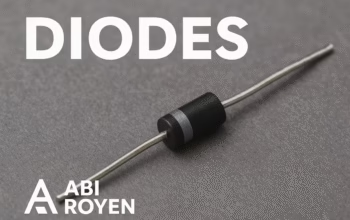
- Diodes – Used for rectification and signal shaping.
- Current Sources – Maintain consistent performance under varying loads.
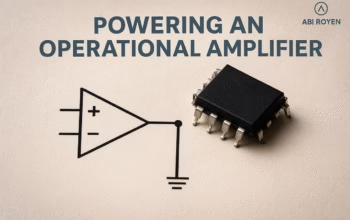
- Operational Amplifier (Op-Amp) Cores – Provide high gain and flexibility for various analog operations.
Example: In an operational amplifier IC (like the LM741), input differential transistors amplify the voltage difference, internal resistors set the gain, and output stages provide the necessary driving power.
3. How Analog ICs Process Signals
The operation of analog ICs can be explained in three main stages: input, processing, and output.
Stage 1: Input Stage
The IC receives a continuous signal from a source (e.g., a microphone or sensor).
- The signal is often weak and needs conditioning.
- Differential input transistors compare the signal against a reference.
Stage 2: Signal Processing
Inside the IC, the signal undergoes amplification, filtering, or modulation:
- Amplification: Increases the signal amplitude without changing its shape.
- Filtering: Removes unwanted noise or frequencies.
- Mixing/Modulation: Combines signals or changes their carrier frequency.
Stage 3: Output Stage
The processed signal is delivered to the output:
- Can drive speakers, displays, or other circuitry.
- Maintains signal integrity even under load.
4. Types of Analog ICs
Analog ICs come in various types based on their function:
- Operational Amplifiers (Op-Amps) – Amplify voltage differences with high gain.
- Voltage Regulators – Provide stable output voltage.
- Analog Multipliers – Multiply two analog signals.
- Comparators – Compare two voltages and output a digital-like signal.
- Data Converters (ADC/DAC) – Bridge between analog and digital worlds.
5. Real-World Applications
Analog ICs are found in nearly every electronic device:
- Audio Systems: Amplifiers for speakers and headphones.
- Radio & Communication Devices: Modulators and demodulators for signal transmission.
- Instrumentation: Signal conditioning in measurement devices.
- Power Supplies: Voltage regulation for stable operation.
- Industrial Automation: Sensor interface circuits.


6. Why Analog ICs Remain Important
Even in the age of digital electronics, analog ICs are essential because:
- Sensors output analog signals that need conditioning before digitization.
- Human senses (hearing, vision) operate in analog form.
- Analog processing can be faster and more efficient for certain tasks.
7. Design Considerations for Analog ICs
When designing or selecting an analog IC, engineers consider:
- Noise Performance: Lower noise for high-quality signals.
- Power Consumption: Especially important in portable devices.
- Bandwidth: Determines how fast the IC can process signals.
- Temperature Stability: Ensures consistent operation in various conditions.
8. Conclusion of How Analog ICs Work
Understanding how analog ICs work is crucial for anyone involved in electronics. These components bridge the gap between the physical world and digital systems, making them vital for everything from audio amplifiers to complex industrial machinery.
As technology advances, analog ICs continue to evolve, offering higher precision, lower noise, and better efficiency. Whether you are a student learning electronics or an engineer designing cutting-edge systems, mastering analog IC principles will remain a valuable skill.