Types of integrated circuits, also known as microchips or chips, are the building blocks of modern electronics. They pack thousands, millions, or even billions of electronic components—such as transistors, resistors, and capacitors—into a tiny piece of semiconductor material, usually silicon. Since their invention in the late 1950s, ICs have revolutionized technology, enabling the development of compact, efficient, and high-performance devices.
In this article, we will explore the main types of integrated circuits, their features, and their applications in everyday technology.
1. What is an Integrated Circuit?
An Integrated Circuit (IC) is a compact assembly of interconnected electronic components fabricated on a single semiconductor wafer. Unlike discrete circuits, which require separate components wired together, ICs integrate everything into a single chip, resulting in:
- Miniaturization – reduced size and weight
- Increased reliability – fewer connection points mean fewer failures
- Lower cost – mass production reduces manufacturing expenses
- Improved performance – shorter distances between components allow higher speed and efficiency
Read this article for a more detailed explanation: Understanding Integrated Circuits (ICs): Types, Functions, and Applications in Modern Electronics
2. Main Types of Integrated Circuits
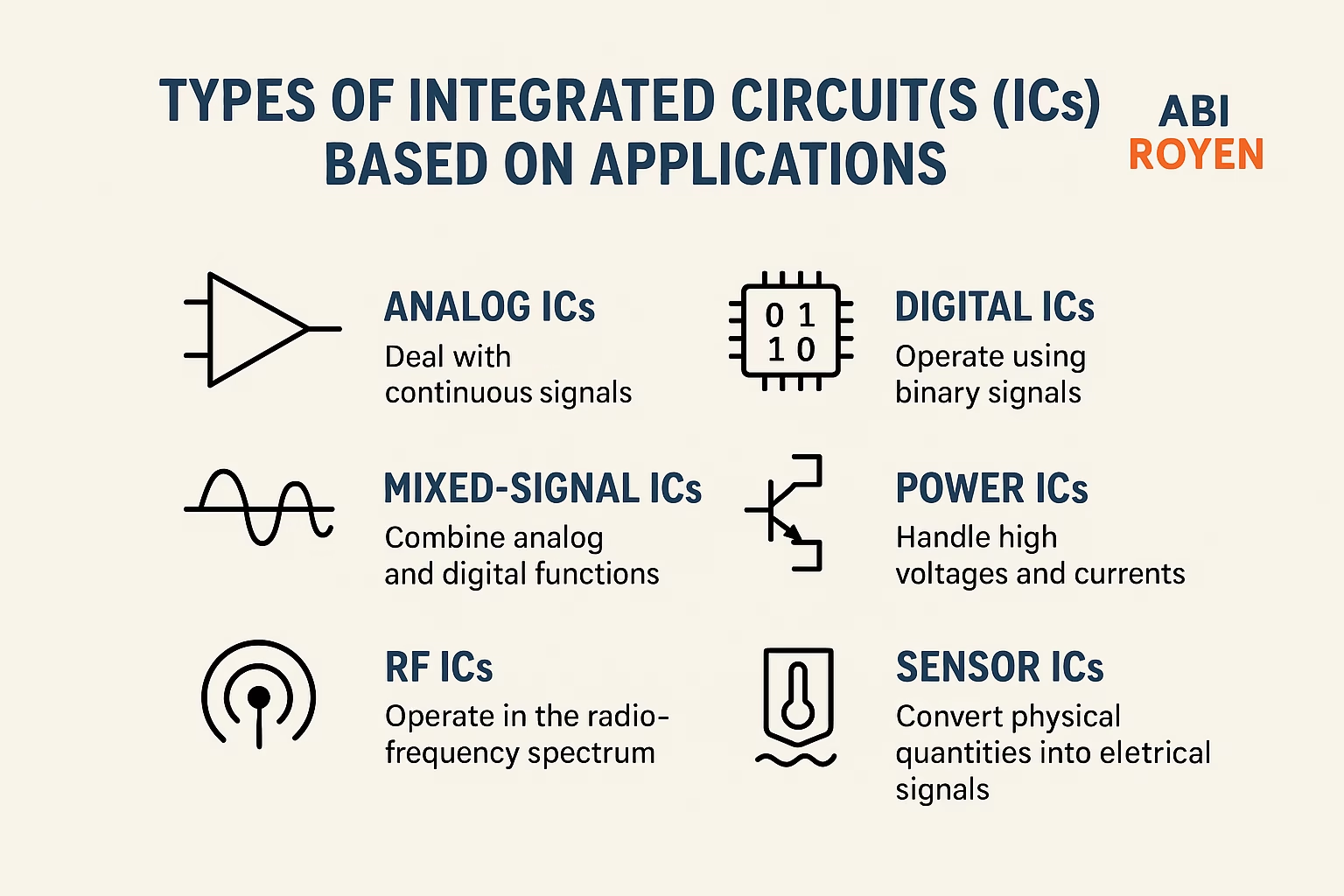
Integrated circuits can be categorized based on their function, scale of integration, or fabrication technology. Below, we focus on the functional classification, which includes:
- Analog Integrated Circuits
- Digital Integrated Circuits
- Mixed-Signal Integrated Circuits
2.1 Types of Integrated Circuits: Analog Integrated Circuits
Analog ICs process continuous signals. They are designed to handle real-world signals like sound, light, temperature, or voltage levels. Common examples include:
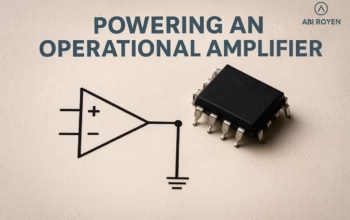
- Operational Amplifiers (Op-Amps) – Used in signal amplification, filtering, and mathematical operations.
- Voltage Regulators – Maintain a constant voltage level in a circuit.
- Analog Multipliers – Perform signal mixing and modulation.
Applications:
- Audio equipment (amplifiers, equalizers)
- Power supply regulation
- Sensor signal conditioning
- Communication systems
Advantages:
- Accurate representation of real-world signals
- High sensitivity to small signal variations
Read this article for a more detailed explanation: Analog ICs: Building Blocks of Modern Electronics
2.2 Types of Integrated Circuits: Digital Integrated Circuits
Digital ICs process discrete (binary) signals—only two states: 0 (low) and 1 (high). They are the core of computing and digital electronics.
Types of digital ICs include:
- Logic Gates (AND, OR, NOT, NAND, NOR, XOR, XNOR) – The basic building blocks of digital circuits.
- Microprocessors – Perform computation and control tasks.
- Microcontrollers – Integrate CPU, memory, and I/O ports in one chip for control applications.
- Memory Chips – Store data (RAM, ROM, Flash).
- Programmable Logic Devices (PLDs) – Configurable hardware for custom logic functions.
Applications:
- Computers and smartphones
- Digital cameras and TVs
- Robotics and automation systems
- Networking devices
Advantages:
- High processing speed
- Easy duplication of digital signals without degradation
- Compatibility with modern computing systems
Read this article for a more detailed explanation: Digital Integrated Circuits: Definition, Types, and Applications
2.3 Mixed-Signal Types of Integrated Circuits
Mixed-signal ICs combine both analog and digital circuitry on a single chip. This allows them to process real-world signals and perform digital computations in the same device.
Examples include:
- Analog-to-Digital Converters (ADC) – Convert analog signals to digital data.
- Digital-to-Analog Converters (DAC) – Convert digital data back to analog signals.
- System-on-Chip (SoC) – Integrates processors, memory, communication modules, and analog interfaces.
Applications:
- Smartphones (handling both audio signals and digital data)
- Wireless communication devices
- Automotive electronics (sensors + control systems)
- Industrial automation systems
Advantages:
- Compact integration of multiple functions
- Reduced component count and cost
- Improved signal processing efficiency
Read this article for a more detailed explanation: Mixed-Signal ICs: Bridging the Gap Between Analog and Digital Electronics
3. Classification by Scale of Integration
ICs can also be classified by the number of electronic components integrated into the chip:
- SSI (Small-Scale Integration) – Up to 100 components
- MSI (Medium-Scale Integration) – 100 to 1,000 components
- LSI (Large-Scale Integration) – 1,000 to 10,000 components
- VLSI (Very Large-Scale Integration) – 10,000 to millions of components
- ULSI (Ultra Large-Scale Integration) – Tens of millions to billions of components
Modern processors and memory chips often fall under VLSI or ULSI categories.
4. Fabrication Technologies Types of Integrated Circuits
The way ICs are manufactured also affects their characteristics. The most common fabrication technologies are:
- Bipolar Junction Transistor (BJT) Technology – High speed, good for analog applications.
- CMOS (Complementary Metal-Oxide-Semiconductor) Technology – Low power consumption, widely used in digital circuits.
- BiCMOS Technology – Combines BJT speed with CMOS low power.


5. Applications of Integrated Circuits in Everyday Life
ICs are found in almost every electronic device we use:
- Consumer Electronics – Smartphones, TVs, gaming consoles, audio systems.
- Automotive Industry – Engine control units, safety systems, infotainment.
- Industrial Automation – Process control, robotics, instrumentation.
- Medical Devices – ECG machines, diagnostic equipment, portable health monitors.
- Telecommunication – Networking hardware, wireless communication devices.
- Aerospace and Defense – Radar systems, guidance control, satellite electronics.
Read this article for a more detailed explanation: Exploring the Applications of Integrated Circuits: Revolutionizing Modern Electronics
6. Future Trends in Integrated Circuit Technology
With the demand for smaller, faster, and more energy-efficient devices, IC technology is evolving rapidly:
- Nanotechnology – Developing chips at the atomic scale for ultra-high performance.
- 3D ICs – Stacking multiple layers of circuits for higher density and performance.
- AI-Optimized Chips – Specialized ICs for artificial intelligence and machine learning workloads.
- Flexible Electronics – Bendable and wearable ICs for next-generation devices.
Conclusion
Understanding the different types of integrated circuits is crucial for engineers, students, and electronics enthusiasts. Whether analog, digital, or mixed-signal, each IC type plays a unique role in shaping modern technology.
From powering our smartphones to controlling industrial robots, integrated circuits have transformed how we live, work, and communicate. As technology advances, ICs will continue to become more powerful, efficient, and integrated—driving innovation in countless industries.