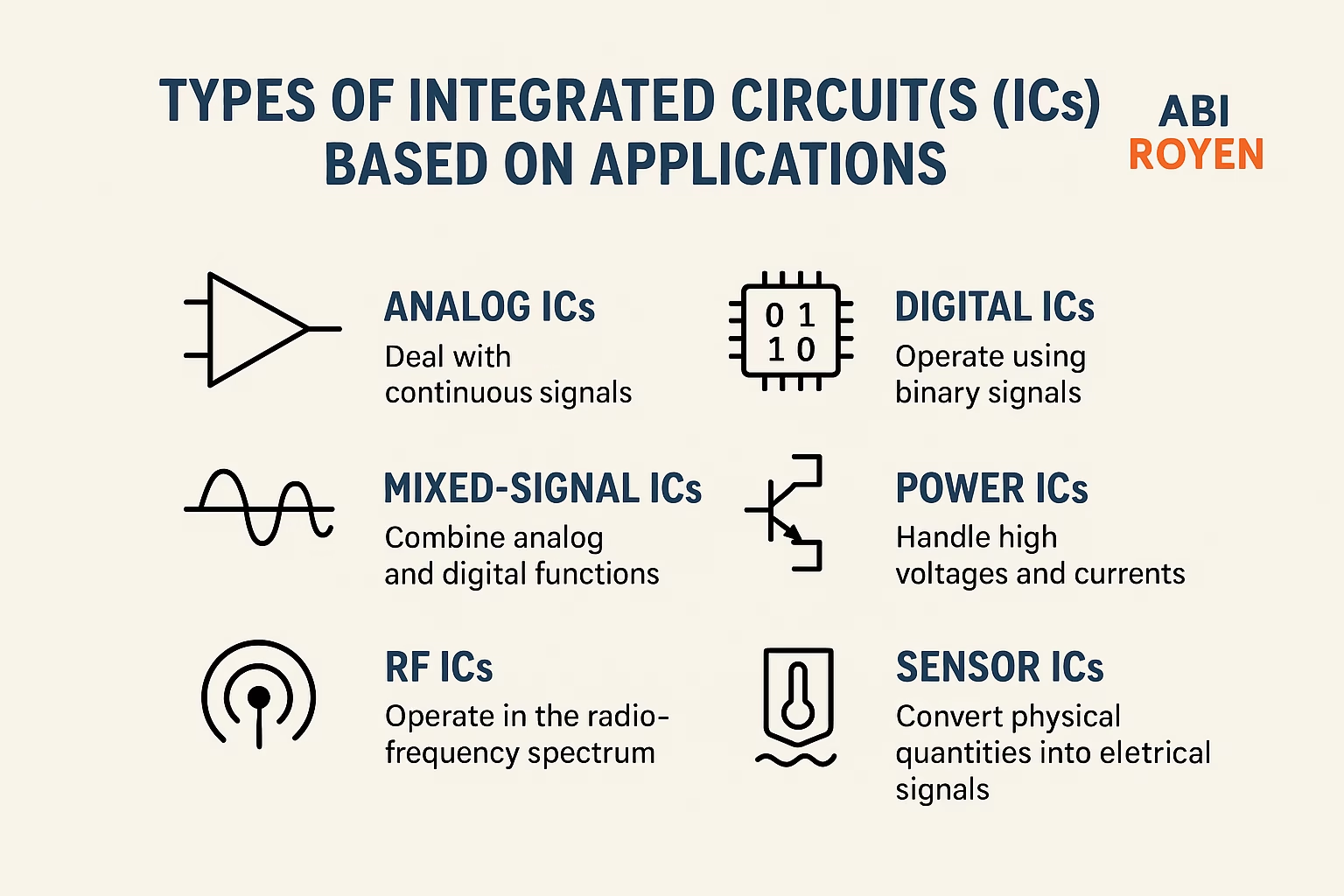
Types Digital Integrated Circuits ~ Digital Integrated Circuits (ICs) are at the heart of modern electronic devices, from smartphones and computers to industrial automation systems. These ICs process digital signals, which are represented by binary logic—0 (low) and 1 (high). Over the decades, digital ICs have evolved dramatically, enabling faster processing, higher storage capacity, and smaller device sizes.
In this article, we will explore the types of digital integrated circuits, their classifications, and their applications in real-world electronics.
1. What Are Digital Integrated Circuits?
A digital integrated circuit is an electronic component that uses digital signals for processing, calculation, and control. Unlike analog ICs that deal with continuous signals, digital ICs operate on discrete binary signals.
These circuits are fabricated on a semiconductor wafer (usually silicon) and contain thousands to billions of microscopic transistors, resistors, and capacitors interconnected to perform specific functions.
Key advantages of digital ICs include:
- High noise immunity
- Low power consumption (especially with CMOS technology)
- Compact size and portability
- High processing speed
2. Main Types Digital Integrated Circuits
Digital integrated circuits are generally classified based on their functionality and scale of integration.
2.1 Types Digital Integrated Circuits: Based on Functionality
There are two main categories:
a. Combinational Logic Circuits
These circuits produce outputs based only on the current input values, without considering previous states. They are often used in:
- Logic gates (AND, OR, NOT, NAND, NOR, XOR, XNOR)
- Adders and subtractors
- Multiplexers (MUX) and demultiplexers (DEMUX)
- Encoders and decoders
Example: A half-adder IC (like 7486) performs binary addition using XOR and AND gates.
b. Sequential Logic Circuits
Sequential circuits depend on both the current input and the previous state (memory). They require storage elements like flip-flops to hold data.
Examples include:
- Flip-flops (D, T, JK, SR)
- Counters (synchronous and asynchronous)
- Shift registers
- Memory devices
These circuits are essential in devices that require timing, sequencing, and data storage.
2.2 Types Digital Integrated Circuits: Based on Scale of Integration
The classification by scale refers to the number of logic gates or transistors in a single IC.
| Category | Logic Gates per IC | Example |
|---|---|---|
| SSI (Small-Scale Integration) | Less than 10 gates | 7400 (NAND gates) |
| MSI (Medium-Scale Integration) | 10 to 100 gates | 7483 (4-bit adder) |
| LSI (Large-Scale Integration) | 100 to 10,000 gates | Simple microprocessors |
| VLSI (Very Large-Scale Integration) | 10,000+ gates | Modern CPUs, GPUs |
| ULSI (Ultra Large-Scale Integration) | Millions of gates | Advanced processors and memory chips |
3. Popular Types Digital Integrated Circuits
Let’s look at the most common types of digital ICs used in electronics:
3.1 Types Digital Integrated Circuits: Logic Gate ICs
The most basic building blocks of digital systems.
- Examples: 7400 (Quad 2-input NAND), 7408 (Quad 2-input AND), 7432 (Quad 2-input OR)
- Applications: Decision-making circuits, arithmetic operations, control systems
3.2 Types Digital Integrated Circuits: Programmable Logic Devices (PLDs)
These are ICs that can be programmed by the user to perform specific logic functions.
- Types:
- PROM (Programmable Read-Only Memory)
- PAL (Programmable Array Logic)
- PLA (Programmable Logic Array)
- FPGA (Field-Programmable Gate Array)
- Applications: Custom digital designs, rapid prototyping, industrial automation
3.3 Types Digital Integrated Circuits: Microprocessors
Microprocessors are powerful ICs that act as the brain of computing devices. They execute instructions, perform calculations, and control hardware.
- Examples: Intel 8085, Intel Core i7, AMD Ryzen
- Applications: Computers, industrial controllers, embedded systems
3.4 Microcontrollers
A microcontroller integrates a CPU, memory, and I/O peripherals on a single chip.
- Examples: PIC microcontrollers, Arduino ATmega328P, ARM Cortex-M series
- Applications: IoT devices, appliances, robotics, automotive systems
3.5 Memory ICs
These ICs store data for processing or long-term retention.
- Types:
- RAM (Random Access Memory)
- ROM (Read-Only Memory)
- EEPROM (Electrically Erasable Programmable ROM)
- Flash Memory
- Applications: Computers, smartphones, embedded systems
3.6 Interface ICs
These ICs help digital systems communicate with other devices or systems.
- Examples: UART, USB controllers, Ethernet controllers
- Applications: Data transfer, networking, device interfacing


4. Digital IC Technologies
Digital ICs can be built using different semiconductor technologies:
- TTL (Transistor-Transistor Logic) – Fast switching, moderate power consumption
- CMOS (Complementary Metal-Oxide-Semiconductor) – Very low power, high noise immunity
- ECL (Emitter-Coupled Logic) – Extremely fast but high power consumption
Today, CMOS technology dominates due to its energy efficiency and scalability.
5. Applications of Digital ICs
Digital integrated circuits are used in nearly every modern electronic device:
- Consumer Electronics: Smartphones, tablets, TVs, gaming consoles
- Computing: Laptops, desktops, servers
- Automotive: Engine control units (ECUs), infotainment systems
- Industrial: PLCs, automation controllers, robotics
- Communication: Routers, switches, satellite systems
- Medical Devices: Patient monitors, imaging equipment
6. Future Trends in Digital ICs
With the rise of AI, IoT, and 5G, digital ICs are becoming even more powerful and energy-efficient. Key trends include:
- Nanometer-scale fabrication (3nm, 2nm technology)
- Integration of AI accelerators
- Quantum computing research
- Energy-harvesting ICs for self-powered devices
Conclusion of Types Digital Integrated Circuits
Understanding the types of digital integrated circuits is essential for anyone working in electronics, whether you’re an engineer, student, or hobbyist. From simple logic gates to complex microprocessors, digital ICs form the backbone of our digital world.
As technology advances, the capabilities of these ICs will continue to expand, enabling new innovations in every aspect of life—from smarter devices to faster computing systems.