

Boilers are essential components in both industrial and residential heating systems. Their main function is to generate steam or hot water by applying heat energy to water. Boilers are used in power generation, process industries, central heating, and even cooking applications. With evolving technologies and increasing energy efficiency demands, different types of boilers have emerged, each serving specific operational and environmental requirements.
In this article, we will explore the main types of boilers, their designs, advantages, and typical applications.
Types of Boilers
1. Types of boilers: Fire-Tube Boilers
Overview:
In a fire-tube boiler, hot gases from combustion pass through tubes that are surrounded by water. The heat from the gases transfers to the water, producing steam.
Key Characteristics:
- Simple construction
- Ideal for low-pressure applications
- Lower cost compared to water-tube boilers
Applications:
- Small-scale power generation
- Heating systems in schools, hospitals, and small industrial plants
Examples:
- Lancashire Boiler
- Cochran Boiler
- Scotch Marine Boiler
2. Water-Tube Boilers
Overview:
Contrary to fire-tube boilers, water-tube boilers have water running through tubes while combustion gases circulate around the tubes.
Key Characteristics:
- High thermal efficiency
- Suitable for high-pressure applications
- Faster steam generation
Applications:
- Large-scale power generation
- Oil refineries
- Chemical and paper industries
Examples:
- Babcock and Wilcox Boiler
- Stirling Boiler
- Yarrow Boiler
3. Types of boilers: Electric Boilers
Overview:
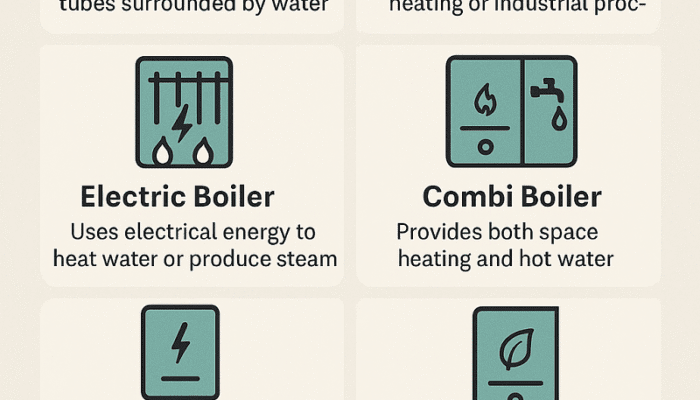
Electric boilers use electrical energy to heat water or produce steam without combustion. They are compact, clean, and easy to maintain.
Key Characteristics:
- Zero emissions
- High efficiency
- Quiet operation
Applications:
- Residential heating
- Commercial buildings
- Process heating in sensitive environments (e.g., pharmaceuticals)
Limitations:
- Higher operational costs due to electricity rates
- Not ideal for high-capacity needs
4. Condensing Boilers
Overview:
Condensing boilers are designed to improve energy efficiency by recovering heat from flue gases and using it to preheat incoming water.
Key Characteristics:
- Up to 98% efficiency
- Reduced fuel consumption
- Lower greenhouse gas emissions
Applications:
- Modern residential heating systems
- Green buildings and eco-friendly construction
Advantages:
- Energy-efficient and cost-saving in the long term
- Compact design
5. Steam Boilers
Overview:
Steam boilers generate steam for various industrial or heating purposes. These can be further categorized into fire-tube or water-tube types.
Key Characteristics:
- Versatile in application
- Available in low, medium, or high-pressure configurations
Applications:
- Power plants
- Textile industries
- Breweries and distilleries
6. Combi Boilers
Overview:
Combination (Combi) boilers provide both central heating and hot water from one compact unit.
Key Characteristics:
- No need for separate water tanks
- Instant hot water
- Space-saving
Applications:
- Small to medium-sized homes
- Apartments and flats
Limitations:
- Less effective for large homes with high simultaneous hot water demand

7. Types of boilers: Biomass Boilers
Overview:
Biomass boilers use organic materials like wood pellets, chips, or logs as fuel, offering a sustainable heating option.
Key Characteristics:
- Renewable energy source
- Carbon-neutral if managed sustainably
- Can qualify for green energy subsidies
Applications:
- Rural heating
- Eco-conscious buildings
- Agricultural facilities
8. Oil Boilers
Overview:
Oil-fired boilers use petroleum-based fuels to produce heat. They are typically used in areas without access to natural gas.
Key Characteristics:
- Powerful heating capacity
- Requires fuel storage tank
Applications:
- Off-grid homes
- Remote industrial plants
Considerations:
- Higher emissions than gas or electric boilers
- Fuel price volatility
9. Types of boilers: Gas Boilers
Overview:
Gas boilers use natural gas or propane to heat water. They are among the most common boiler types due to their efficiency and ease of use.
Key Characteristics:
- Cleaner than oil boilers
- Cost-effective in areas with gas infrastructure
Applications:
- Residential and commercial heating
- Water heating systems
Choosing the Right Types of boilers: Key Factors to Consider
When selecting a boiler, the following considerations should guide your decision:
- Application Type: Industrial, commercial, or residential
- Fuel Availability: Electricity, gas, oil, or biomass
- Efficiency Requirements: Condensing vs. non-condensing
- Installation Space: Floor area and vertical clearance
- Budget and Maintenance Needs
Future Trends in Boiler Technology
Boiler systems are evolving in response to energy efficiency regulations and climate goals. Modern boilers now incorporate:
- Smart controls and IoT integration
- Hybrid systems combining solar and gas/oil
- Advanced heat exchangers for better heat transfer
- Emission-reduction technologies to meet environmental standards
Conclusion of Types of boilers
Boilers remain critical to modern infrastructure, from residential heating to industrial operations. Understanding the different types of boilers—such as fire-tube, water-tube, electric, condensing, and biomass models—allows engineers, homeowners, and facility managers to make informed choices based on performance, cost, fuel type, and environmental impact.
Whether you’re designing a heating system for a home or selecting an efficient steam generator for an industrial plant, choosing the right boiler ensures long-term reliability, energy savings, and regulatory compliance.