Ship’s deck equipment categories ~ Modern ships are equipped with a wide array of deck equipment that supports safe and efficient maritime operations. These tools are critical for maneuvering, anchoring, mooring, cargo handling, and ensuring the safety of both crew and cargo. Understanding the different categories of ship’s deck equipment is essential for marine engineers, deck officers, and ship operators.
This article explores the major categories of ship’s deck equipment, their key components, functions, and how they contribute to overall vessel operations.
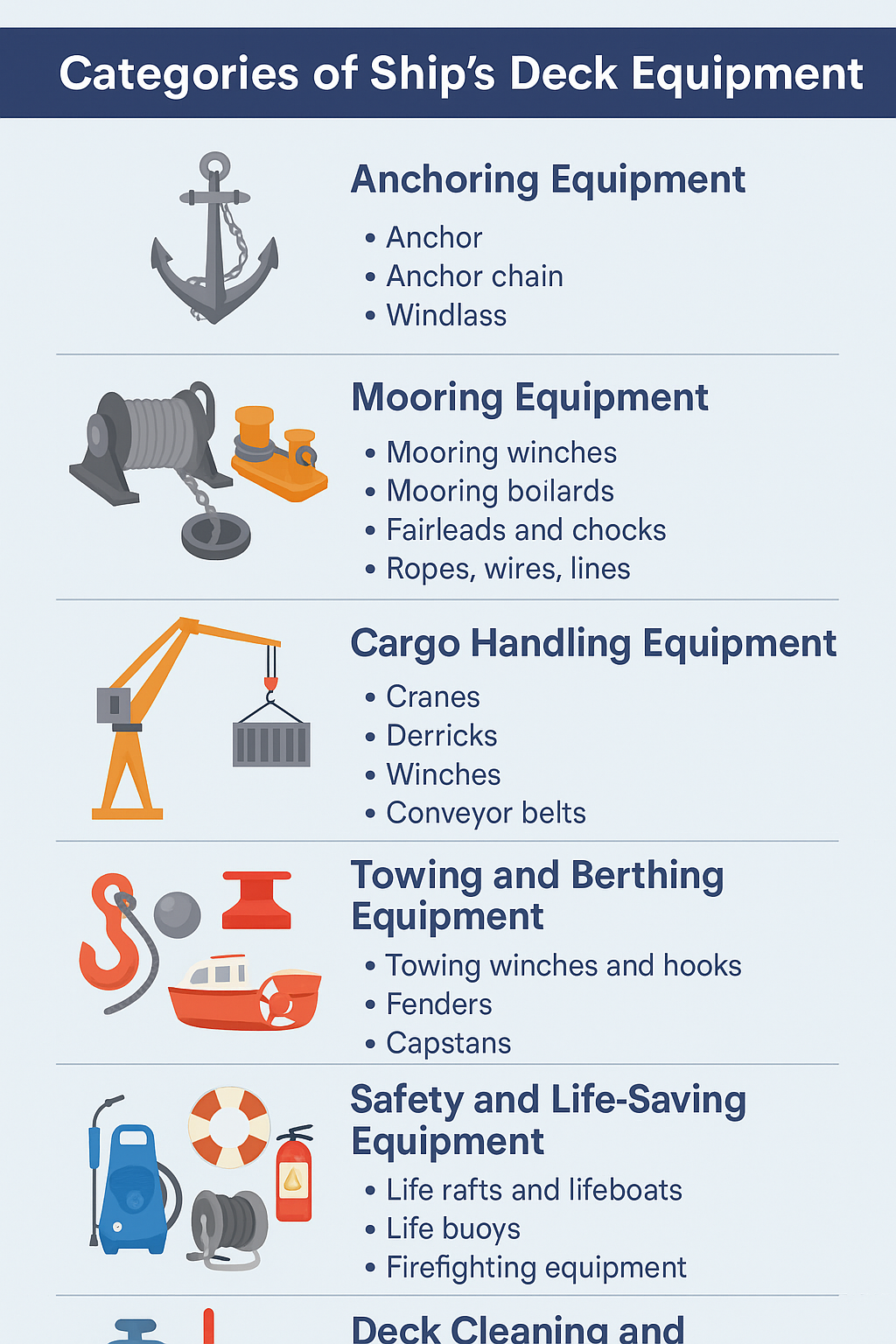
1. ⚓ Ship’s Deck Equipment Categories: Anchoring Equipment
Anchoring systems are crucial for holding the ship in position when it is not underway.
Main Components:
- Anchor: A heavy metal device designed to grip the seabed.
- Anchor Chain (or Cable): A chain that connects the anchor to the windlass or capstan.
- Windlass: A mechanical device used for handling the anchor and chain.
Functions:
- Securing the vessel in shallow or deep waters.
- Emergency halting of the vessel.
- Used during offshore operations or port stays.
2. 🪢 Ship’s Deck Equipment Categories: Mooring Equipment
Mooring equipment allows a ship to be safely secured alongside a dock, berth, or another vessel.
Key Equipment:
- Mooring Winches: For tensioning and releasing mooring lines.
- Mooring Bollards: Posts for fastening mooring lines on the deck.
- Fairleads and Chocks: Guide the ropes and reduce friction.
- Ropes/Wires/Lines: Made of synthetic fiber or steel wire for tying the vessel.
Types of Mooring Methods:
- Single Point Mooring (SPM)
- Conventional Buoy Mooring (CBM)
- Alongside Mooring
Importance:
- Ensures the vessel remains in position.
- Prevents drift due to wind, currents, or tides.
- Essential for loading and unloading at ports.
3. 🏗️ Ship’s Deck Equipment Categories: Cargo Handling Equipment
Cargo handling equipment is vital for efficient loading and unloading of goods from the ship.
Types:
- Cranes: For lifting heavy containers or cargo.
- Derricks: Traditional equipment used for general cargo.
- Winches: For pulling or hoisting cargo.
- Conveyor Belts: Used in bulk carriers for material transport.
Applications:
- Container ships, bulk carriers, Ro-Ro ships, and tankers.
- Minimizes port stay time.
- Enhances cargo safety and efficiency.
4. 🚢 Ship’s Deck Equipment Categories: Towing and Berthing Equipment
Used when the vessel needs to be towed or assisted by tugboats for docking or maneuvering in restricted waters.
Components:
- Towing Winches and Hooks: For controlled pulling.
- Fenders: Cushions to prevent damage during berthing.
- Capstans: Used for handling heavy hawsers and ropes.
Role:
- Crucial for large vessels during harbor entry or exit.
- Reduces risk of collision or hull damage.
5. 🧯 Safety and Life-Saving Equipment
Essential deck equipment also includes tools for ensuring crew safety and complying with international maritime regulations.
Common Equipment:
- Life Rafts and Lifeboats: For emergency evacuation.
- Life Buoys: For man-overboard scenarios.
- Firefighting Equipment: Fire hoses, extinguishers, and water mist systems.
- Emergency Escape Routes and Alarms
Standards and Compliance:
- Must adhere to SOLAS (Safety of Life at Sea) regulations.
- Regular inspections and drills are mandatory.
6. 🌊 Deck Cleaning and Maintenance Equipment
Maintaining the cleanliness and structural integrity of the deck is important for safety and longevity.
Includes:
- High-pressure Washers
- Deck Scrubbers and Brushes
- Paint Sprayers
- Rope and Hose Reels
Purpose:
- Removes oil, salt deposits, and dirt.
- Prevents corrosion and slippage.
- Enhances deck aesthetics and safety.

7. 🧵 Miscellaneous Deck Tools and Accessories
In addition to major equipment, several small but vital tools assist daily operations.
Examples:
- Boathooks: For docking assistance.
- Deck Lights: For night-time operations.
- Hand Tools: Hammers, spanners, knives, etc.
- Signaling Devices: Whistles, horns, and signal flags.
⚙️ Material Considerations in Ship’s Deck Equipment Categories
Deck equipment must be:
- Corrosion-resistant (marine-grade steel, stainless steel, or aluminum).
- Durable and weatherproof
- Easy to operate under extreme conditions
🧭 Role of Deck Equipment in Ship Operations
Operational Efficiency:
Reduces time spent on mooring, anchoring, or cargo handling—improving turnaround times.
Crew Safety:
Reliable equipment minimizes human error and reduces accidents onboard.
Regulatory Compliance:
Many components are mandated by international maritime organizations.
🔄 Innovations in Modern Ship’s Deck Equipment Categories
The maritime industry continues to evolve with automation and smart systems.
Examples:
- Remote-controlled winches
- Hydraulic or electric mooring systems
- Integrated cargo management systems
- Digital monitoring of towing loads and anchor chains
✅ Maintenance and Inspection Tips
To ensure reliable operations, all deck equipment must undergo:
- Routine inspection schedules
- Lubrication and tightening of moving parts
- Corrosion checks
- Crew training on emergency operations
🧩 Conclusion of Ship’s Deck Equipment Categories
Ship’s deck equipment forms the backbone of vessel operations—from anchoring and mooring to cargo handling and crew safety. Understanding the different categories and their specific roles helps maritime professionals operate vessels more efficiently and safely. As technology evolves, the role of deck equipment becomes increasingly critical in enabling sustainable and smart shipping practices.
Published by: Abi Royen
Website: https://abiroyen.com/
For more articles on maritime engineering and ship operations, visit our blog.