

Selection Guide for Thermocouples ~ Thermocouples are one of the most widely used temperature measurement devices across industries. From industrial furnaces to laboratory experiments and food processing, thermocouples provide a cost-effective, reliable, and robust way to measure temperature.
However, selecting the right thermocouple is not as simple as picking the first type you see in a catalog. Each thermocouple type is designed for specific conditions, temperature ranges, and levels of accuracy. Choosing the wrong one could lead to inaccurate measurements, equipment damage, or even safety hazards.
This Selection Guide for Thermocouples will walk you through the most important factors to consider when choosing the right thermocouple for your application.
1. Understanding the Basics of Thermocouples
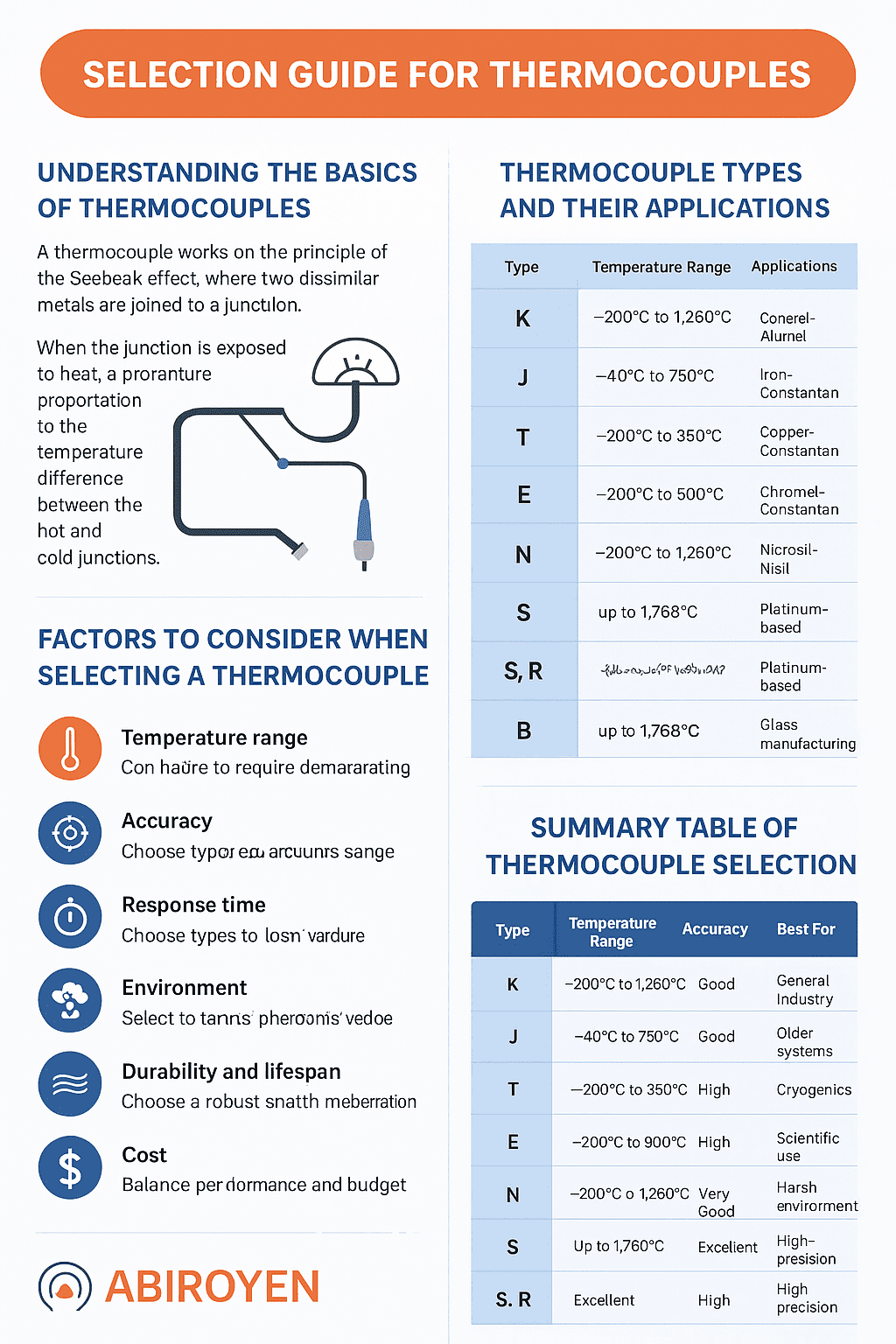
A thermocouple works on the principle of the Seebeck effect, where two dissimilar metals are joined to form a junction. When this junction is exposed to heat, it produces a small voltage proportional to the temperature difference between the hot and cold junctions.
The output voltage is then interpreted by a measuring instrument to determine temperature. Thermocouples are widely used because they:
- Can measure very high and low temperatures.
- Are robust and durable.
- Respond quickly to temperature changes.
- Are cost-effective compared to other temperature sensors.
2. Thermocouple Types and Their Applications
There are several standardized thermocouple types, each identified by a letter code. The most common are Type K, J, T, E, N, S, R, and B.
Type K (Chromel–Alumel)
- Temperature Range: −200°C to +1,260°C (−328°F to +2,300°F)
- Advantages: Widely available, good accuracy, corrosion-resistant in oxidizing atmospheres.
- Applications: General-purpose use in industries like food, plastics, and manufacturing.
Type J (Iron–Constantan)
- Temperature Range: −40°C to +750°C (−40°F to +1,382°F)
- Advantages: Low cost, suitable for reducing atmospheres.
- Applications: Older equipment, oil and gas, and industrial ovens.
Type T (Copper–Constantan)
- Temperature Range: −200°C to +350°C (−328°F to +662°F)
- Advantages: Excellent for low-temperature measurement, high accuracy.
- Applications: Cryogenics, pharmaceuticals, food storage.
Type E (Chromel–Constantan)
- Temperature Range: −200°C to +900°C (−328°F to +1,652°F)
- Advantages: High output voltage, suitable for cryogenic use.
- Applications: Aerospace, scientific experiments.
Type N (Nicrosil–Nisil)
- Temperature Range: −200°C to +1,260°C (−328°F to +2,300°F)
- Advantages: More stable than Type K at high temperatures.
- Applications: Chemical processing, high-temperature furnaces.
Types S, R, and B (Platinum-based)
- Temperature Range: Up to 1,768°C (3,214°F) depending on type.
- Advantages: Extremely accurate and stable, but expensive.
- Applications: Glass manufacturing, metal melting, high-precision laboratory work.
3. Factors to Consider When Selection Guide for Thermocouples
Choosing the right thermocouple involves evaluating several factors:
1. Selection Guide for Thermocouples: Temperature Range
Ensure the thermocouple can handle your required temperature range without degrading. For example, Type K is suitable for most general industrial applications, while Type B is used for extremely high temperatures.
2. Selection Guide for Thermocouples: Accuracy
If precision is critical, choose types known for stability and accuracy, such as Type T for low temperatures or platinum-based types for high temperatures.
3. Selection Guide for Thermocouples: Response Time
A smaller-diameter probe will respond faster but may be less durable. For processes where temperature changes quickly, response time is crucial.
4. Environment
Consider the atmosphere where the thermocouple will be used:
- Oxidizing: Type K is a good choice.
- Reducing or vacuum: Type N or Type R/S may be better.
- Corrosive: Special sheaths like Inconel or stainless steel may be required.
5. Durability and Lifespan
If the thermocouple will be exposed to vibration, pressure, or abrasive materials, choose a robust sheath material and construction.
6. Cost
Higher-accuracy and specialized thermocouples cost more. Select a balance between performance and budget.
4. Sheath Materials and Protection
The sheath protects the thermocouple wire from damage and contamination. Common materials include:
- Stainless Steel: Good corrosion resistance, general-purpose.
- Inconel: Excellent at high temperatures and in corrosive environments.
- Ceramic: Ideal for extreme heat but fragile.
5. Thermocouple Junction Types
Thermocouple junctions determine how the sensor interacts with the measured material:
- Grounded Junction: Fast response time, but susceptible to electrical noise.
- Ungrounded Junction: Slower response but electrically isolated.
- Exposed Junction: Fastest response, best for gas measurements, but less durable.
6. Installation Tips for Accurate Readings
- Place the thermocouple at the point of interest in the process.
- Avoid sharp bends in the probe.
- Use proper mounting hardware to prevent movement.
- Keep lead wires away from electrical noise sources.

7. Summary Table of Selection Guide for Thermocouples
| Type | Temperature Range | Accuracy | Best For | Cost |
|---|---|---|---|---|
| K | −200°C to 1,260°C | Good | General industry | Low |
| J | −40°C to 750°C | Good | Older systems | Low |
| T | −200°C to 350°C | High | Cryogenics | Low |
| E | −200°C to 900°C | High | Scientific use | Medium |
| N | −200°C to 1,260°C | Very Good | Harsh environments | Medium |
| S/R/B | Up to 1,768°C | Excellent | High-precision work | High |
8. Conclusion of Selection Guide for Thermocouples
Choosing the right thermocouple is essential for accurate and reliable temperature measurement. By considering factors such as temperature range, accuracy, environmental conditions, and response time, you can ensure optimal performance and longevity of your sensor.
Whether you need a general-purpose thermocouple like Type K or a high-precision platinum-based sensor, selecting the right type will improve efficiency, reduce errors, and protect your equipment.