1. Introduction
Resistance Carbon Composition Resistors ~ Resistors are among the most fundamental components in electronic circuits, controlling the flow of current and protecting sensitive parts from damage. Among the earliest types of resistors used in the electronics industry are carbon composition resistors. These components have been around since the early 20th century and, despite the emergence of more modern resistor technologies, they are still used in certain applications today.
One of the key aspects of these resistors is their resistance value, which determines how they interact with current and voltage in a circuit. In this article, we will explore the concept of resistance in carbon composition resistors, their construction, properties, advantages, and disadvantages.
2. What Is a Carbon Composition Resistor?
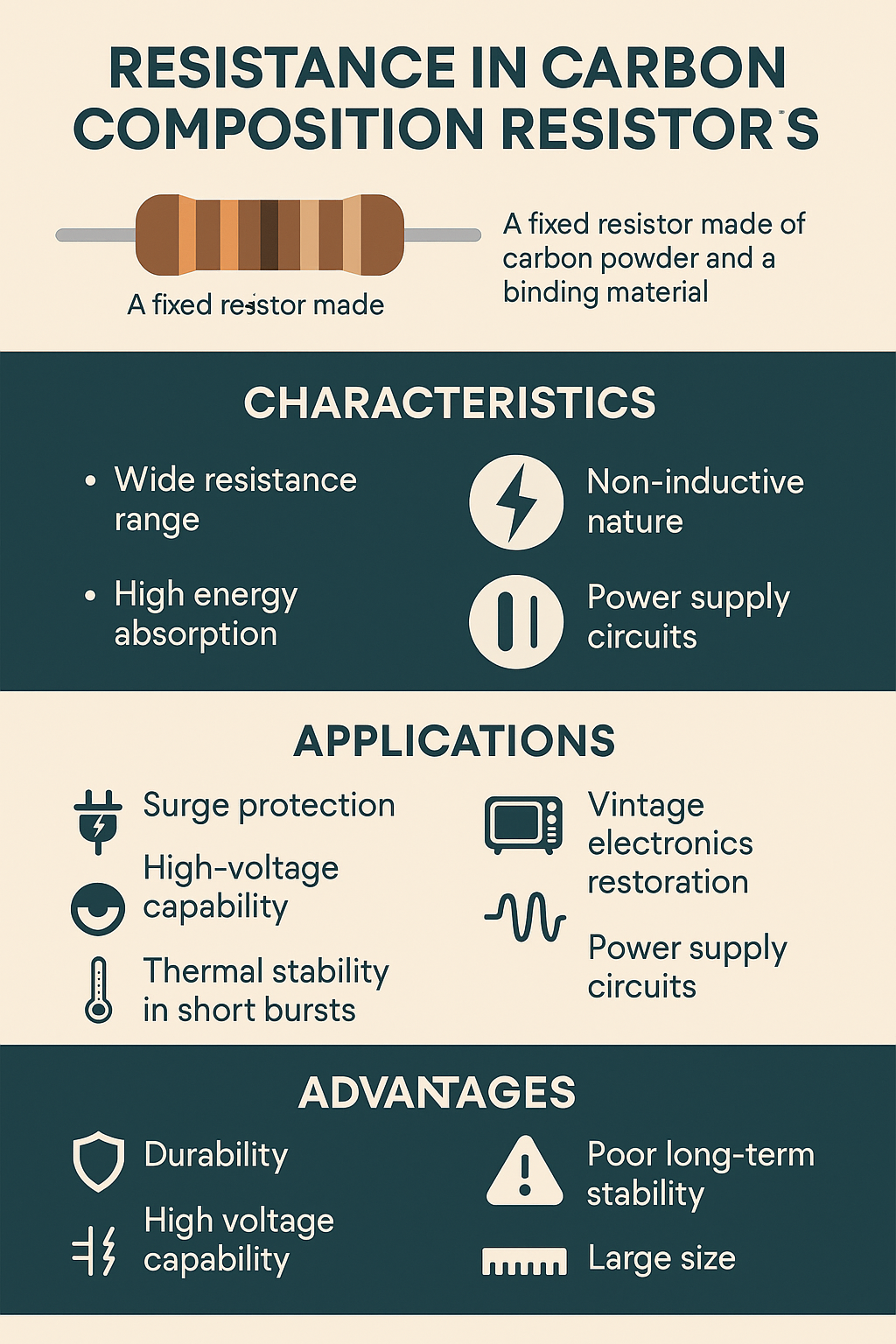
A carbon composition resistor is a type of fixed resistor made from a mixture of carbon powder and a binding material, usually a thermosetting resin. This mixture is molded into a cylindrical shape, with metal caps or leads attached at both ends. The carbon mixture is then coated with a protective layer to prevent environmental damage.
The proportion of carbon to binder determines the resistance value of the resistor — more carbon results in lower resistance, while less carbon increases resistance.
3. The Concept of Resistance Carbon Composition Resistors
Resistance is the property of a material that opposes the flow of electric current, measured in ohms (Ω). In carbon composition resistors, resistance is determined by:
- The ratio of carbon to insulating material.
- The physical dimensions of the resistor body.
- The manufacturing process and level of compaction.
The resistance value is fixed at the time of manufacturing and cannot be adjusted later. These resistors typically range from 1 Ω to 22 MΩ.
4. Characteristics of Carbon Composition Resistors
Carbon composition resistors have distinct characteristics that set them apart from other resistor types such as film or wire-wound resistors.
4.1 Wide Resistance Range
- Available in values from a few ohms to several megaohms.
4.2 High Energy Absorption
- Can handle short bursts of high energy, making them suitable for surge protection.
4.3 Non-Inductive Nature
- The internal structure does not create inductance, making them effective at high frequencies.
4.4 High Tolerance
- Often have a tolerance rating of ±5%, ±10%, or ±20%, meaning their actual resistance may vary significantly from the nominal value.
5. Applications of Carbon Composition Resistors
Although modern resistors like carbon film, metal film, and wire-wound resistors have largely replaced them, carbon composition resistors are still used in specific situations.
5.1 Surge Protection
Their ability to handle high-energy pulses without damage makes them ideal for protecting circuits from voltage spikes.
5.2 Vintage Electronics Restoration
Enthusiasts restoring old radios, amplifiers, and vintage equipment often use original carbon composition resistors for authenticity.
5.3 High-Frequency Applications
Their non-inductive construction helps prevent signal distortion at high frequencies.
5.4 Power Supply Circuits
They can be used in power supply designs to limit inrush current and dissipate excess energy.
6. Advantages of Carbon Composition Resistors
- Durability: Can withstand overload conditions for short durations.
- High Voltage Capability: Effective in circuits where high voltage transients are common.
- Non-Inductive Design: Suitable for RF and high-frequency applications.
- Thermal Stability in Short Bursts: Can handle temperature spikes better than some modern resistors.
7. Limitations of Carbon Composition Resistors
Despite their advantages, carbon composition resistors have several limitations that have led to their decline in popularity.
7.1 High Noise
They produce more electrical noise compared to film resistors due to irregularities in the carbon mixture.
7.2 Poor Long-Term Stability
Resistance values can change significantly over time, especially in humid environments.
7.3 Large Size
For the same resistance and power rating, they are physically larger than modern alternatives.
7.4 Wide Tolerance
The high tolerance can make them unsuitable for precision applications.

8. Factors Affecting Resistance Carbon Composition Resistors
Several environmental and operational factors can affect the resistance value of these resistors over time:
- Temperature: High operating temperatures can cause resistance drift.
- Humidity: Moisture absorption changes conductivity.
- Age: Resistance tends to increase with age due to degradation of the carbon mixture.
- Electrical Stress: Frequent surges or overloads can alter resistance permanently.
9. How to Identify Carbon Composition Resistors
They are easy to identify by their cylindrical brown or tan body with color-coded bands indicating the resistance value. The color code follows the Electronic Industries Alliance (EIA) standard.
Example:
A resistor with bands Red – Violet – Yellow – Gold means:
- Red (2)
- Violet (7)
- Yellow (× 10,000) = 270,000 Ω or 270 kΩ
- Gold (±5% tolerance)
10. Conclusion of Resistance Carbon Composition Resistors
Carbon composition resistors were once the backbone of electronics design, offering durability and versatility in many applications. While newer resistor technologies have taken over due to better precision and stability, carbon composition resistors still hold value in specialized roles such as surge protection, vintage equipment restoration, and high-frequency circuits.
Understanding the resistance characteristics of these resistors allows engineers and hobbyists to use them effectively where their unique strengths outweigh their limitations. For those working with older circuits or in need of a component that can withstand high-energy pulses, the carbon composition resistor remains a reliable choice.