Tolerance carbon composition resistors ~ Carbon composition resistors are among the oldest and most widely used resistor types in electronics. While their design and construction are straightforward, one of the most important specifications that determines their performance is tolerance.
Tolerance plays a crucial role in deciding how closely a resistor’s actual resistance value matches its nominal (labeled) value. In applications where precision is vital, understanding resistor tolerance is essential for ensuring circuit reliability and performance.
In this article, we will explore the concept of tolerance in carbon composition resistors, why it matters, how it is specified, and its implications for electronic circuit design.
1. What is Tolerance in Resistors?
Tolerance is the allowable deviation from the nominal resistance value stated by the manufacturer. It is expressed as a percentage (%).
For example:
- A 100 Ω resistor with ±10% tolerance can have an actual resistance anywhere between 90 Ω and 110 Ω.
- A 1 kΩ resistor with ±5% tolerance can range from 950 Ω to 1050 Ω.
This percentage indicates the range within which the resistor’s actual value can vary due to manufacturing differences and environmental factors.
2. Tolerance Carbon Composition Resistors
Carbon composition resistors are made by mixing carbon powder with a binding resin and forming it into a cylindrical shape. This simple manufacturing method makes them affordable but also leads to higher tolerances compared to modern resistor types such as metal film or wirewound.
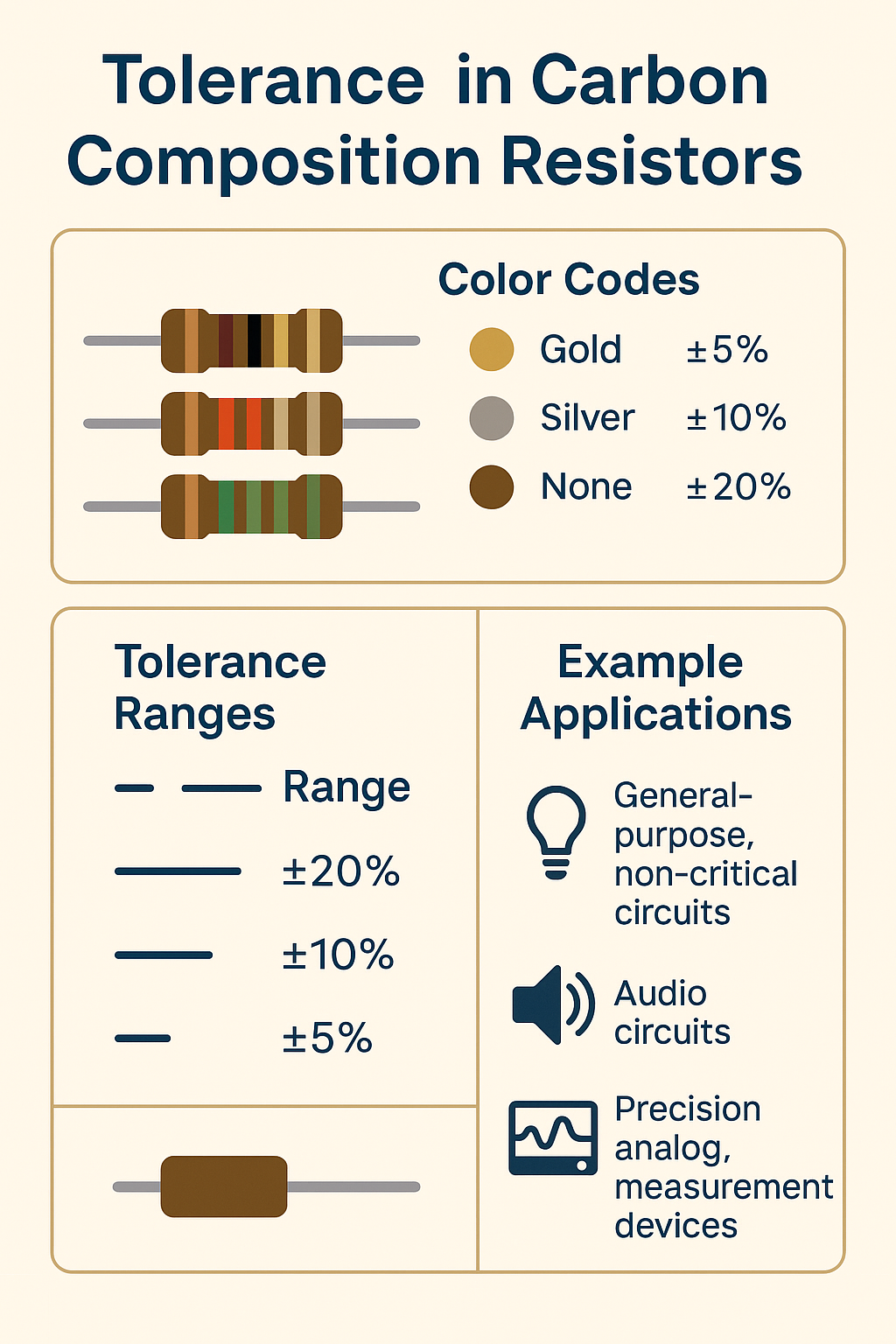
Typical tolerance values for carbon composition resistors are:
- ±5% (more precise, higher quality)
- ±10% (common standard)
- ±20% (economical, less precise applications)
Historically, ±20% tolerance was the most common in general-purpose electronics.
3. Why Tolerance Matters in Electronics
Tolerance affects how accurately a resistor performs its intended role in a circuit. While small variations may be acceptable in some designs, others require precise control over resistance values.
Key reasons tolerance is important:
- Circuit Performance – In precision circuits like audio equipment or measurement devices, even a small deviation can alter performance.
- Temperature Stability – Carbon composition resistors tend to drift in value over time and under high temperatures, making tolerance a key reliability factor.
- Interchangeability – When replacing components, the tolerance ensures the new resistor will function similarly to the original.
- Cost vs. Precision – Lower tolerance (higher precision) resistors cost more, so designers must balance accuracy needs with budget.
4. How to Identify Tolerance Carbon Composition Resistors
Carbon composition resistors use color codes to indicate their resistance value and tolerance. The tolerance is represented by the fourth color band in a four-band resistor code (or fifth band in a five-band resistor).
Common tolerance color codes:
- Brown = ±1%
- Red = ±2%
- Green = ±0.5%
- Blue = ±0.25%
- Violet = ±0.1%
- Gold = ±5%
- Silver = ±10%
- No band = ±20%
For example:
- A resistor with color bands Brown-Black-Brown-Gold means 100 Ω ±5% tolerance.
5. Factors Affecting Tolerance Carbon Composition Resistors
Several factors influence the actual resistance and tolerance:
- Manufacturing Process – Variations in carbon-resin mixture lead to deviations.
- Temperature – High temperatures cause value drift due to changes in carbon structure.
- Humidity – Carbon composition is hygroscopic, absorbing moisture which alters resistance.
- Aging – Over time, carbon composition resistors naturally drift, sometimes beyond their stated tolerance.
- Load Stress – Repeated exposure to high electrical loads can permanently change the resistance.
6. Applications of Carbon Composition Resistors with Different Tolerances
Different tolerance grades are used in different situations:
- ±20% Tolerance
- Used in non-critical circuits like household appliances, toys, and general lighting.
- ±10% Tolerance
- Suitable for basic audio circuits, power supplies, and industrial equipment.
- ±5% Tolerance
- Applied in precision analog devices, test equipment, and sensitive measurement circuits.
7. Advantages and Disadvantages of Wider Tolerances
Advantages:
- Lower manufacturing costs.
- Adequate for circuits that are not sensitive to resistance variation.
- More widely available and easier to source.
Disadvantages:
- Less predictable circuit performance.
- Not suitable for precision applications.
- Greater drift over time and under stress.
8. Modern Trends and Replacements
While carbon composition resistors are still used in certain high-pulse applications (like surge protection in power systems), they have been largely replaced by metal film, carbon film, and wirewound resistors which offer:
- Lower tolerances (as low as ±0.1%).
- Better temperature stability.
- Longer lifespan.
However, in vintage electronics restoration and audio equipment manufacturing, carbon composition resistors are still valued for their unique electrical characteristics and “warm” distortion profile.

9. Summary Table: Tolerance Carbon Composition Resistors
| Tolerance (%) | Color Code | Precision Level | Typical Application |
|---|---|---|---|
| ±20% | None | Low | General-purpose, non-critical circuits |
| ±10% | Silver | Medium | Audio circuits, industrial equipment |
| ±5% | Gold | High | Precision analog, measurement devices |
10. Conclusion of Tolerance Carbon Composition Resistors
Understanding tolerance in carbon composition resistors is key to designing reliable and efficient circuits. Whether you’re building a high-precision measuring device or repairing a vintage amplifier, knowing how much variation you can expect from a resistor helps in choosing the right component.
While modern resistor technologies offer tighter tolerances, carbon composition resistors remain a viable choice in certain applications, especially where their electrical behavior under high surge currents is beneficial.
Choosing the right tolerance is ultimately a balance between performance requirements, cost, and availability—a decision every electronics engineer must make with care.