1. Introduction of Radio Electromagnetic Spectrum
The Radio Electromagnetic Spectrum is a cornerstone of modern communication and technology. From your car’s FM radio to satellite navigation systems, mobile networks, and even Wi-Fi connections, all rely on carefully allocated radio frequencies. This invisible yet highly valuable natural resource powers our ability to send and receive information across the globe, enabling everything from everyday conversations to critical scientific missions.
Understanding how the radio electromagnetic spectrum works is essential for engineers, communication specialists, policymakers, and anyone interested in the science behind wireless technologies. This article explains the concept, the science, the frequency divisions, and the many ways the radio spectrum shapes our world.
2. What is the Radio Electromagnetic Spectrum?
The electromagnetic spectrum is the entire range of electromagnetic radiation — from gamma rays with extremely short wavelengths to long radio waves. The radio spectrum is the portion of the electromagnetic spectrum with frequencies ranging from 3 Hz to 300 GHz.
Radio waves travel at the speed of light and can be used for communication because they can be modulated to carry information. Unlike higher-frequency waves, radio waves can travel long distances, penetrate buildings, and reflect off the atmosphere under certain conditions.
3. Scientific Principles Behind the Radio Electromagnetic Spectrum
The behavior of radio waves is determined by wavelength and frequency:
- Wavelength (λ): The physical length of one cycle of the wave.
- Frequency (f): The number of cycles per second, measured in hertz (Hz).
- The relationship between them is given by:
c = λ × f
where c is the speed of light (≈ 3 × 10⁸ m/s).
Lower-frequency waves have longer wavelengths and can travel farther with less energy loss, while higher frequencies have shorter ranges but can carry more data.
4. Frequency Bands in the Radio Electromagnetic Spectrum
The radio spectrum is divided into several standardized frequency bands, each with specific applications:
| Band Name | Frequency Range | Common Uses |
|---|---|---|
| Extremely Low Frequency (ELF) | 3–30 Hz | Submarine communication |
| Super Low Frequency (SLF) | 30–300 Hz | Underground communication |
| Ultra Low Frequency (ULF) | 300–3000 Hz | Military comms |
| Very Low Frequency (VLF) | 3–30 kHz | Navigation, time signals |
| Low Frequency (LF) | 30–300 kHz | Maritime, aeronautical nav |
| Medium Frequency (MF) | 300–3000 kHz | AM radio |
| High Frequency (HF) | 3–30 MHz | Shortwave broadcasting |
| Very High Frequency (VHF) | 30–300 MHz | FM radio, TV, aviation |
| Ultra High Frequency (UHF) | 300–3000 MHz | TV, mobile phones |
| Super High Frequency (SHF) | 3–30 GHz | Radar, satellites |
| Extremely High Frequency (EHF) | 30–300 GHz | Advanced radar, high-speed data |
5. Allocation and Regulation of Radio Electromagnetic Spectrum
Because the radio spectrum is a limited resource, governments and international organizations regulate its use. The International Telecommunication Union (ITU) plays a central role in assigning frequency ranges for different services to avoid interference.
Each country has its own regulatory body — for example:
- FCC (Federal Communications Commission) in the USA
- Ofcom in the UK
- Kominfo in Indonesia
Licenses are often required for specific frequency bands, especially those used for broadcasting, aviation, or defense.
6. Applications of the Radio Electromagnetic Spectrum
The versatility of the radio spectrum makes it essential in various industries:
a) Broadcasting
- AM/FM Radio: Entertainment and news broadcasting.
- Television: Analog and digital transmission.
b) Telecommunication
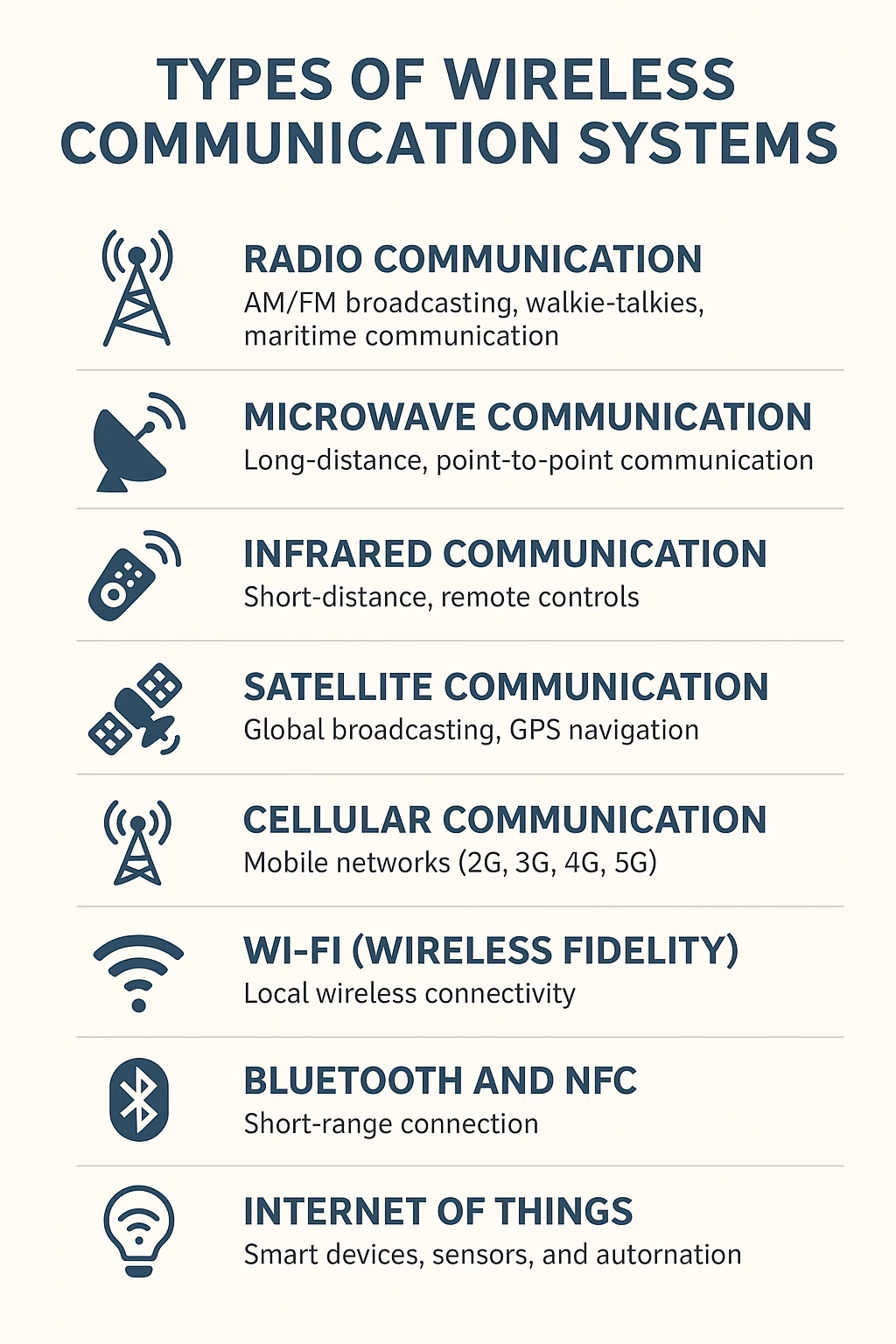
- Mobile networks (2G to 5G and beyond) operate across UHF and SHF bands.
- VoIP and wireless internet services.
c) Navigation
- GPS: Operates in the UHF and L-band.
- Maritime and aviation navigation beacons.
d) Military and Defense
- Secure communication channels.
- Radar for surveillance and targeting.
e) Science and Space
- Radio telescopes for astronomy.
- Deep-space communication.
f) Industrial & IoT
- Wireless sensors and control systems.
- RFID for supply chain tracking.


7. Challenges and Spectrum Management
As demand for wireless communication grows, spectrum congestion becomes a major issue. With the explosion of IoT devices, smart cities, and high-speed mobile networks, careful spectrum management is essential.
Challenges include:
- Interference between services.
- Spectrum scarcity for emerging technologies.
- The need for spectrum re-farming (reassigning underused frequencies).
Solutions include:
- Dynamic Spectrum Access (DSA) — allows frequencies to be shared intelligently.
- Millimeter-wave technology for expanding bandwidth.
- Satellite-based systems to extend reach.
8. The Future of the Radio Electromagnetic Spectrum
With the rollout of 6G networks, satellite internet services like Starlink, and advancements in autonomous systems, spectrum management will become even more critical.
Trends include:
- Cognitive Radio: Devices that automatically detect and switch to unused frequencies.
- Higher frequency utilization: Moving into the EHF and THz bands.
- AI-powered spectrum allocation to improve efficiency.
9. Conclusion
The Radio Electromagnetic Spectrum is more than just a set of invisible frequencies — it’s the backbone of modern life. From enabling global communication to powering future technologies, it is a shared natural resource that requires careful management. By understanding its structure, applications, and challenges, we can better appreciate and optimize the way we use it.