

Introduction
Radar, an acronym for Radio Detection and Ranging, is a pivotal technology used across various sectors including maritime navigation, aviation, meteorology, and defense. Since its development during World War II, radars has evolved dramatically, becoming a highly sophisticated tool that helps in detecting objects, measuring their distance, direction, speed, and even shape—regardless of visibility conditions.
This article explores the principles behind radars, different types of radar systems, their components, and the vast array of applications in modern technology, especially in the maritime domain.
1. What is Radar and How Does It Work?
At its core, this a system that uses radio waves to detect and locate objects. The basic working principle involves transmitting a pulse of radio waves from an antenna. These waves travel through the air and bounce off objects in their path. The reflected signal, or “echo,” returns to the receiver, which then calculates information such as:
- Distance: by measuring the time delay between transmission and echo
- Direction: using the orientation of the antenna
- Speed: via the Doppler effect
- Size and shape: based on the strength and pattern of the returned signal
2. Main Components of a Radar System
A typical radar system includes the following components:
- Transmitter: Generates high-frequency radio pulses.
- Antenna: Sends and receives radio waves.
- Duplexer: Switches the antenna between transmitting and receiving modes.
- Receiver: Amplifies and processes the returned signal.
- Processor: Analyzes data and provides a visual output on the display.
3. Types of Radar Systems
This device systems are designed based on their specific use-cases. The most common types include:
a. Pulse
- Transmits short bursts (pulses) of energy and listens for echoes.
- Ideal for long-range detection.
- Common in maritime and aviation use.
b. Continuous Wave (CW)
- Transmits continuously rather than in pulses.
- Often used in speed detection (e.g., police radars guns).
- Not ideal for range measurement.
c. Doppler
- Measures object velocity using the Doppler shift.
- Used in weather forecasting and traffic monitoring.
d. Phased Array
- Uses multiple antennas to steer the radars beam electronically.
- Common in military applications.
e. Synthetic Aperture Radar (SAR)
- Used for high-resolution imaging, especially from aircraft or satellites.
4. Applications Across Industries
a. Maritime Navigation
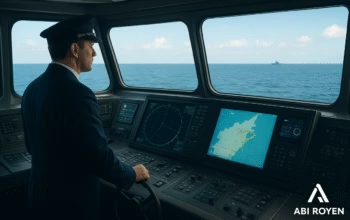
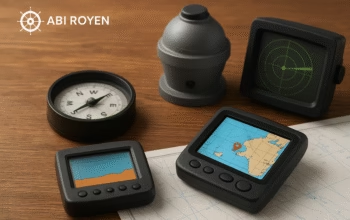
In marine settings, is critical for:
- Detecting other vessels
- Avoiding collisions
- Navigating through fog or darkness
- Monitoring shorelines, buoys, and landmasses
Maritime radars can differentiate between moving and stationary targets and is often integrated with Automatic Radar Plotting Aids (ARPA) for advanced target tracking.
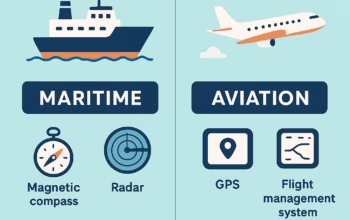
b. Aviation
Aircraft use radars for:
- Terrain following and avoidance
- Weather detection
- Air traffic control and collision avoidance (TCAS)
c. Meteorology
Weather radars help meteorologists:
- Track rain, snow, and storms
- Predict weather patterns
- Monitor severe weather like hurricanes or tornadoes
d. Military and Defense
Defense systems rely on radars for:
- Surveillance
- Target tracking
- Missile guidance
- Air defense and early warning systems
e. Automotive and Robotics
Modern vehicles are equipped with radars-based sensors for:
- Adaptive cruise control
- Collision avoidance
- Autonomous driving

5. Advantages of Radar Technology
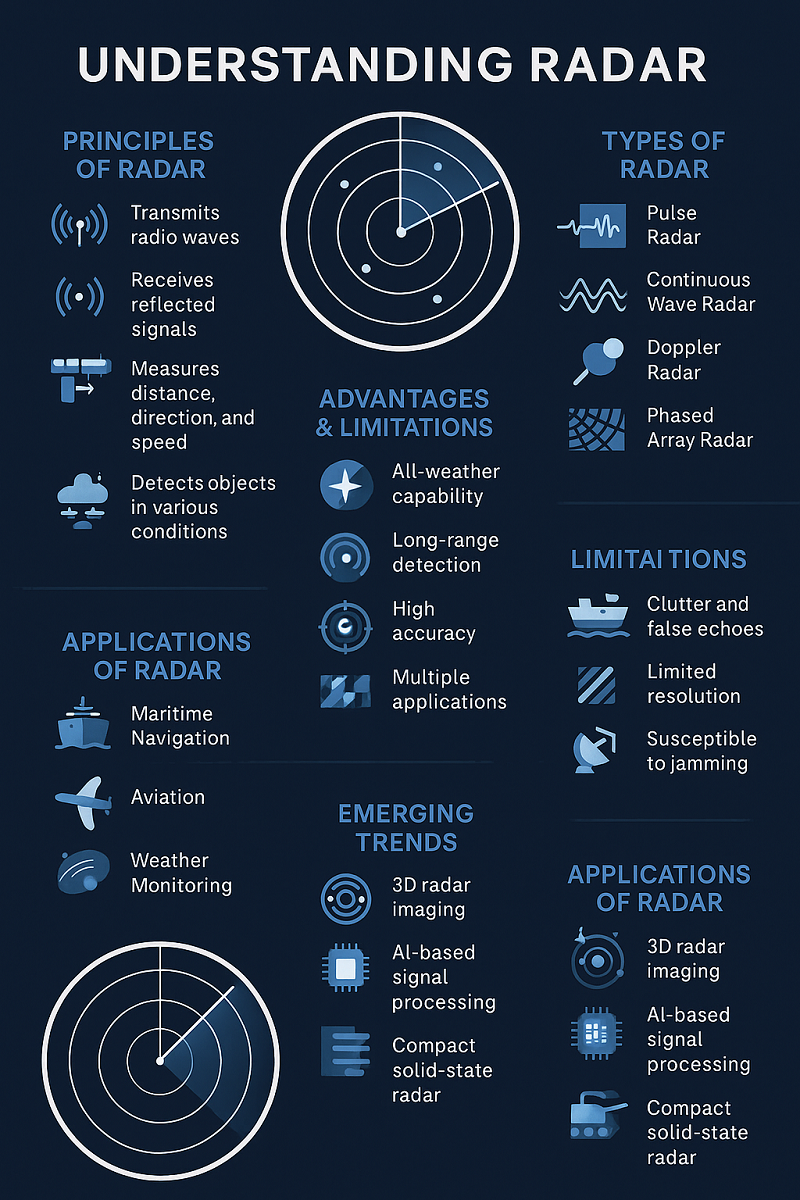
- All-weather capability: Operates effectively in fog, rain, or darkness.
- Long-range detection: Can detect targets hundreds of kilometers away.
- High accuracy: Measures speed and position with precision.
- Multiple applications: Adaptable to various industries.
6. Limitations of Radar
Despite its advantages, also has some limitations:
- Clutter and false echoes: Especially near coastlines or in rain.
- Limited resolution: Compared to optical systems.
- Susceptible to jamming: In military settings, can be disrupted by electronic countermeasures.
7. Emerging Trends in Radar Technology
With the growth of artificial intelligence (AI), machine learning, and sensor fusion, radar systems are becoming smarter and more reliable. Some emerging trends include:
- 3D radar imaging
- Integration with satellite navigation (GNSS)
- AI-based signal processing
- Compact solid-state radar for drones and IoT devices
These innovations will push radars technology further into everyday applications, from smart cities to autonomous delivery systems.
8. Radar in Maritime Compliance and Safety
For ship operators and crew, is not just a tool—it’s a regulatory necessity. According to the International Maritime Organization (IMO), all vessels above a certain size must be equipped with radar systems. Training and certification are also required to ensure radar is used effectively and safely.
Conclusion
Radar technology is an essential part of modern navigation and surveillance systems. From the open seas to high altitudes and beyond the Earth’s atmosphere, radar continues to play a crucial role in enhancing safety, efficiency, and situational awareness.
Whether you’re navigating a vessel, forecasting the weather, or securing national defense, understanding how works—and how to interpret its data—is vital. As technology evolves, radar systems are expected to become even more accurate, compact, and intelligent, reinforcing their status as indispensable tools in the modern world.